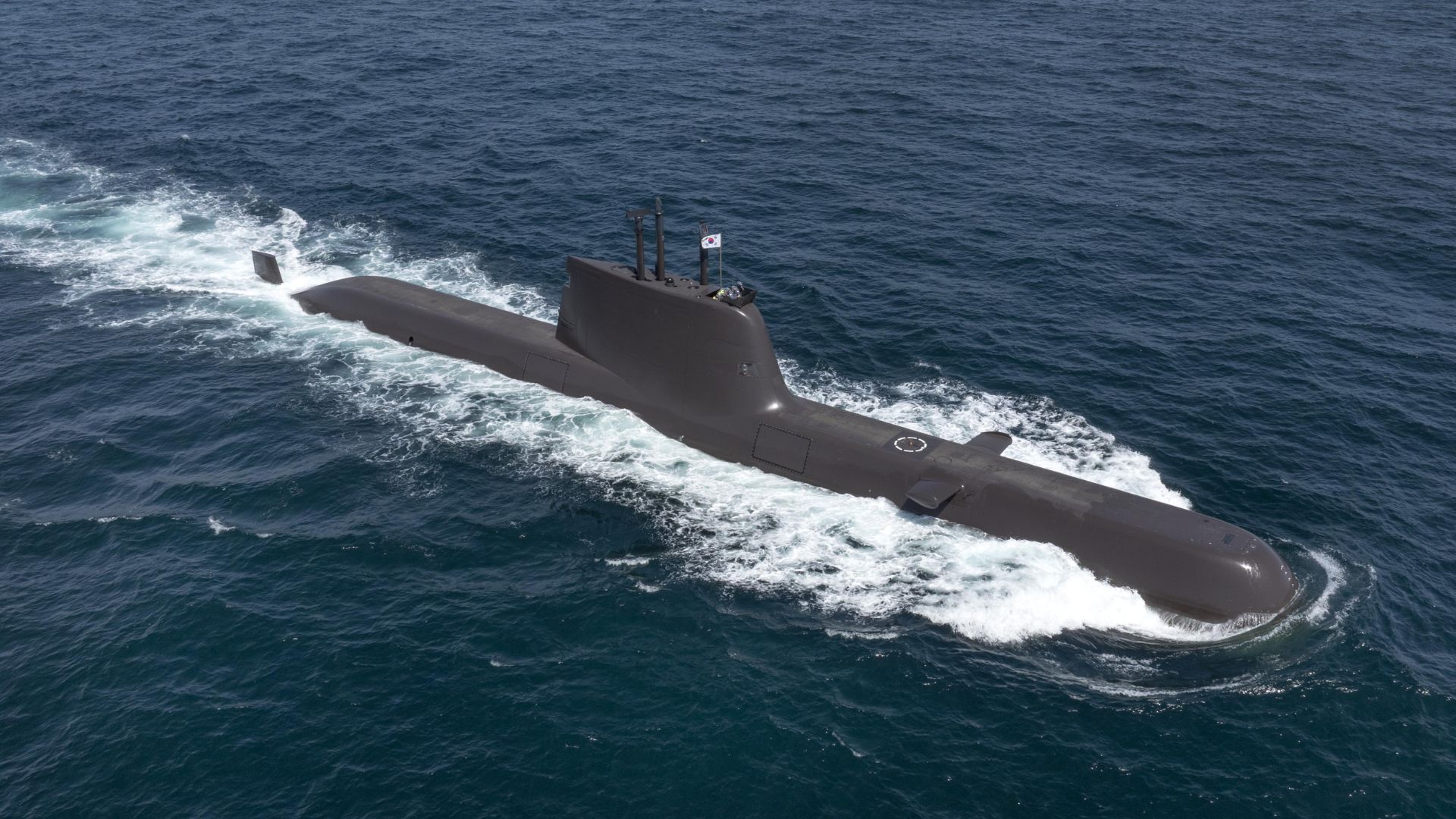
Image: Sea trials of an 1,800-ton submarine built by HD Hyundai Heavy Industries and delivered to the Republic of Korea Navy in 2016.HD Hyundai South Korea’s HD Hyundai Heavy Industries (HHI) and Peru’s state-owned shipbuilder SIMA have unveiled the HDS-MGP, a next-generation submarine concept jointly developed for the Peruvian Navy that could eventually serve as the foundation for a regional submarine construction and maintenance hub in Latin America. The announcement marks the completion of the submarine’s basic design phase, a significant milestone that moves the program closer to detailed engineering, industrial qualification, and ultimately local construction. Beyond replacing aging submarines, the project shows Peru’s ambition to develop sovereign submarine-building capabilities while strengthening its domestic defense industry. A submarine tailored for Peru’s operational needs According to Naval News, the HDS-MGP (Hyundai Design Submarine – Marina de Guerra del Perú) is a 65-meter, 1,500-tonne conventional submarine derived from HD Hyundai’s HDS-1500 export design. Rather than offering an off-the-shelf platform, the design has been customized around the Peruvian Navy’s operational experience and the unique maritime conditions of the Pacific coast of Latin America. The publication reported that HD Hyundai’s long-term objective extends beyond supplying submarines. The company aims to help SIMA independently construct, maintain, and eventually support the HDS-MGP while establishing a self-sustaining submarine industrial ecosystem capable of serving future regional customers. The submarine program builds on a rapidly expanding partnership between the two organizations. Following a landmark agreement in 2024 to jointly construct four naval vessels for Peru, HD Hyundai and SIMA signed a memorandum of understanding for submarine development before formalizing their cooperation through a joint development agreement in late 2025. Building submarines is far harder than designing them While completing the basic design is an important milestone, Indefence Magazine notes that the real challenge lies in transforming the design into an operational submarine built largely in Peru. Submarines are among the most demanding defense platforms to manufacture. Unlike conventional surface ships, every pressure-hull section must be formed, welded, aligned, and inspected to extremely tight tolerances. Material traceability, precision manufacturing, and non-destructive testing are required throughout construction because even minor defects can compromise a vessel designed to repeatedly operate under immense external pressure. The publication also points out that although SIMA possesses extensive naval shipbuilding experience, submarine production introduces entirely new requirements, including specialized facilities, controlled manufacturing environments, acoustic engineering, advanced systems integration, and highly disciplined quality assurance procedures. Technology transfer will define the program’s success According to Indefence Magazine’s analysis, meaningful technology transfer involves much more than sharing engineering drawings. To achieve genuine industrial independence, SIMA must gradually develop expertise in supplier qualification, design management, configuration control, engineering documentation, and lifecycle support. Equally important is developing a skilled workforce. Beyond welders and shipbuilders, submarine construction requires naval architects, hydrodynamic specialists, acoustic engineers, combat systems integrators, quality assurance personnel, and project managers whose expertise often takes years to develop. Many sophisticated components, including sonar, combat management systems, propulsion equipment, and acoustic treatments, are also expected to remain internationally sourced during the early phases before local industry expands its capabilities. Looking toward a regional role As reported by Naval News, HD Hyundai also sees Peru as a potential gateway for future submarine programs across Latin America. If the HDS-MGP program successfully transitions from design to construction, SIMA could evolve beyond a national shipyard into a regional center for submarine maintenance, overhaul, logistics support, and possibly future exports. With the basic design now complete, the next phase will focus on detailed engineering, infrastructure upgrades, workforce development, and industrial qualification. Successfully navigating those challenges will determine whether the HDS-MGP becomes not only Peru’s next submarine but also the catalyst for a long-term submarine-building capability in Latin America. Recommended ArticlesGet the latest in engineering, tech, space & science - delivered daily to your inbox.Kaif Shaikh is a journalist and writer passionate about turning complex information into clear, impactful stories. His writing covers technology, sustainability, geopolitics, and occasionally fiction. A graduate in Journalism and Mass Communication, his work has appeared in the Times of India and beyond. After a near-fatal experience, Kaif began seeing both stories and silences differently. Outside work, he juggles far too many projects and passions, but always makes time to read, reflect, and hold onto the thread of wonder.
Customized 1,500-ton submarine tailored for Pacific operations moves closer to construction
Full Article
Original Source
Read the full article at Interestingengineering →KhanList aggregates and links to publicly available news content. We do not host full articles from third-party sources. Always verify important information with original sources.