
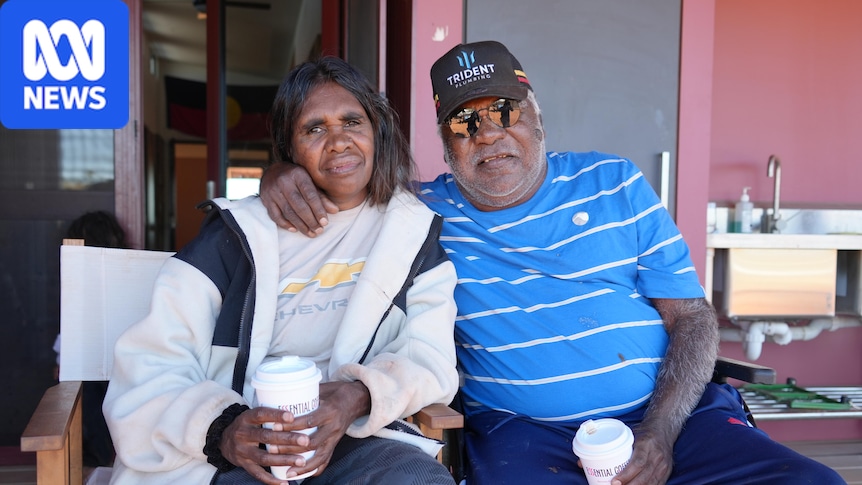
Sitting proudly on the verandah of his new home, Warumungu man Norman Frank Jupurrurla surveys the white-dotted buildings of Tennant Creek hidden among green Barkly scrubland before him."It's just a billion-dollar view," he says.Norman Frank says his family is making the most of the property's stunning landscape views. (ABC Alice Springs: Victoria Ellis)Mr Frank grew up in an overcrowded tin shed, which was stiflingly hot in Central Australia's harsh desert summers and leaked when it rained.After living in multiple government houses, Mr Frank, his wife Serina Morton and their three young daughters, moved into their new home in January.The prefabricated house, which cost about $1 million to construct, was built specifically for them, set atop a hill on Mr Frank's grandmother's country a few kilometres north of Tennant Creek.Norman Frank enjoys feeling the breeze and admiring the view from his verandah. (ABC Alice Springs: Victoria Ellis)Mr Frank said it was too good to be true."I felt back home again," he said."I felt, you know, where I'm supposed to be and where I really wanted to be, where my spirit is."The house cost about $1 million to build. (ABC Alice Springs: Victoria Ellis)The federal and Northern Territory governments unveiled a $4 billion remote housing package for the Northern Territory in 2024 which aimed to build 2,700 homes over 10 years.But Mr Frank's house was not built by the government.It was the first house built by Wilya Janta, an organisation working with communities and experts to build climate and culturally appropriate housing for First Nations people.Wilya Janta chief operating officer Simon Quilty said houses being built by the Northern Territory government were not suitable for the needs of remote Indigenous residents.Simon Quilty says diseases like diphtheria and rheumatic heart disease could spread in overcrowded houses. (ABC Alice Springs: Victoria Ellis)Dr Quilty said government houses were too hot for extreme Northern Territory temperatures and could not accommodate large Indigenous families, sometimes up to 20 people in one house, which led to disease."What Wilya Janta has done is demonstrated that we can build a home designed by Aboriginal people, around culture and climate, for the same price in a scalable way," he said."That's the way government should be delivering homes."Until we get housing right, Aboriginal families cannot thrive."Simon Quilty says adequate housing is the foundation of wellbeing. (ABC Alice Springs: Victoria Ellis)Designed for culture and climateWilya Janta worked closely with Mr Frank and Ms Morton to ensure their home was built appropriately.Ms Morton, an Alyawarre Wakaya woman, played a key role in the design, considering the cultural needs of her family.Serina Morton says her favourite part of the house is the kitchen. (ABC Alice Springs: Victoria Ellis)"My favourite was the kitchen," she said."I had two kitchens, outside and inside, and two toilets."The extra facilities were intended to accommodate surges of visiting family during busy periods and to help the family abide cultural avoidance lore, which prevented some family members from sharing the same spaces.Crushed termite mounds from Phillip Creek station were made into thermally efficient mud bricks for the walls of the house, decorated with imprints of the two snakes from the Junkaragu Dreamtime story.The Junkaragu Dreamtime story is told on the walls of the house. (ABC Alice Springs: Victoria Ellis)The house has a sacred objects room to keep valuable cultural items safe until they are brought out for ceremonies.Campfires at either end of the house allow smoke to be blown through on the wind, spiritually cleansing the home.Mr Frank said he loved the verandah, which encompassed the north, east and southern sides of the house.Campfires at either end of the house allow smoke to blow through and spiritually cleanse the home. (ABC Alice Springs: Victoria Ellis)"That fresh air, it helps me connect to country," he said."You smell that yakkula, that spinifex, that wax, you know, that's Mother Nature, and that's like a bush medicine … what we breathe in and what we carry with us every day."The breezy location is strategic, along with high ceilings and wide windows, to keep the house cool in summer, while electricity is powered by an off-grid solar system.Mr Frank uses a wheelchair, so the house has an accessible bathroom, wide doorways and ramps.Serina Morton says she is emotional to see her design come to life. (ABC Alice Springs: Victoria Ellis)Ms Morton said she was emotional to see her design become reality."I was thinking my life, I've done it, I've done it for myself and it came really true," she said.'Look after your house, he'll look after you'While their red-walled fortress on a hill is a dream come true for Mr Frank and Ms Morton, many Indigenous families across the Northern Territory live in housing with overdue maintenance, overcrowding and unsafe temperatures.As at the start of this year, 300 new homes had been built in the NT under the $4 billion remote housing scheme.However, the NT government has since asked to renegotiate the deal to reduce the number of new homes built.Simon Quilty says some public housing in the NT is in terrible condition. (ABC Alice Springs: Will Green)Dr Quilty encouraged federal and Territory governments to provide operational funding for Wilya Janta or copy the organisation's culturally and climate appropriate design for the remaining builds."This is up to Prime Minister [Anthony] Albanese and Lia Finocchiaro to acknowledge that there is a very serious problem of housing that has a ripple-on effect … whether it be policing, youth justice, health, education and work," he said."We can't allow our First Nations people to live in such atrocious conditions of brand new houses that are not even yet built."Some of the NT's housing has been described as having "atrocious conditions". (ABC News: Jayden O'Neill)Member for Lingiari and Special Envoy for Remote Communities Marion Scrymgour said funding houses like the Wilya Janta home would improve outcomes for Aboriginal communities."I've got to get Canberra to come out here and to come and have a look at houses like this," she said."When you look at infrastructure in communities, when it's been driven by the communities, when the communities have an input into that, the level of destruction or, you know, whether it's graffitied and destroyed, it is low."But when you look at infrastructure that people haven't had input into, we see high levels of repairs and maintenance and damage."Marion Scrymgour says culturally appropriate housing could improve outcomes for Aboriginal communities. (ABC Alice Springs: Victoria Ellis)Mr Frank said "if you look after your house, he'll look after you"."The government needs to listen to us about housing … I hope we can have a few more of these houses around the country," he said.Hope for the futureDownhill from the verandah where Mr Frank sat, a group of barefoot children played "tip tip", "cubby house" and "hide and seek" under the endless blue Barkly sky.One of Mr Frank and Ms Morton's daughters, Nina Simone, has just turned seven.Nina Simone's seventh birthday celebration at the new home was extra special. (ABC Alice Springs: Victoria Ellis)She had an extra special birthday celebration timed to coincide with the house warming party for the new Wilya Janta home.Mr Frank said Nina had received a child's motorbike as a present, but the house itself was also a gift."She'll never forget the day," Mr Frank said."It'll stick to her for the rest of her life, and even her kids and her kids after that."Nina Simone says she wants to look after her own house when she grows up. (ABC Alice Springs: Victoria Ellis)
Custom home gives outback family 'billion-dollar view'
Full Article
Original Source
Read the full article at Abc →KhanList aggregates and links to publicly available news content. We do not host full articles from third-party sources. Always verify important information with original sources.