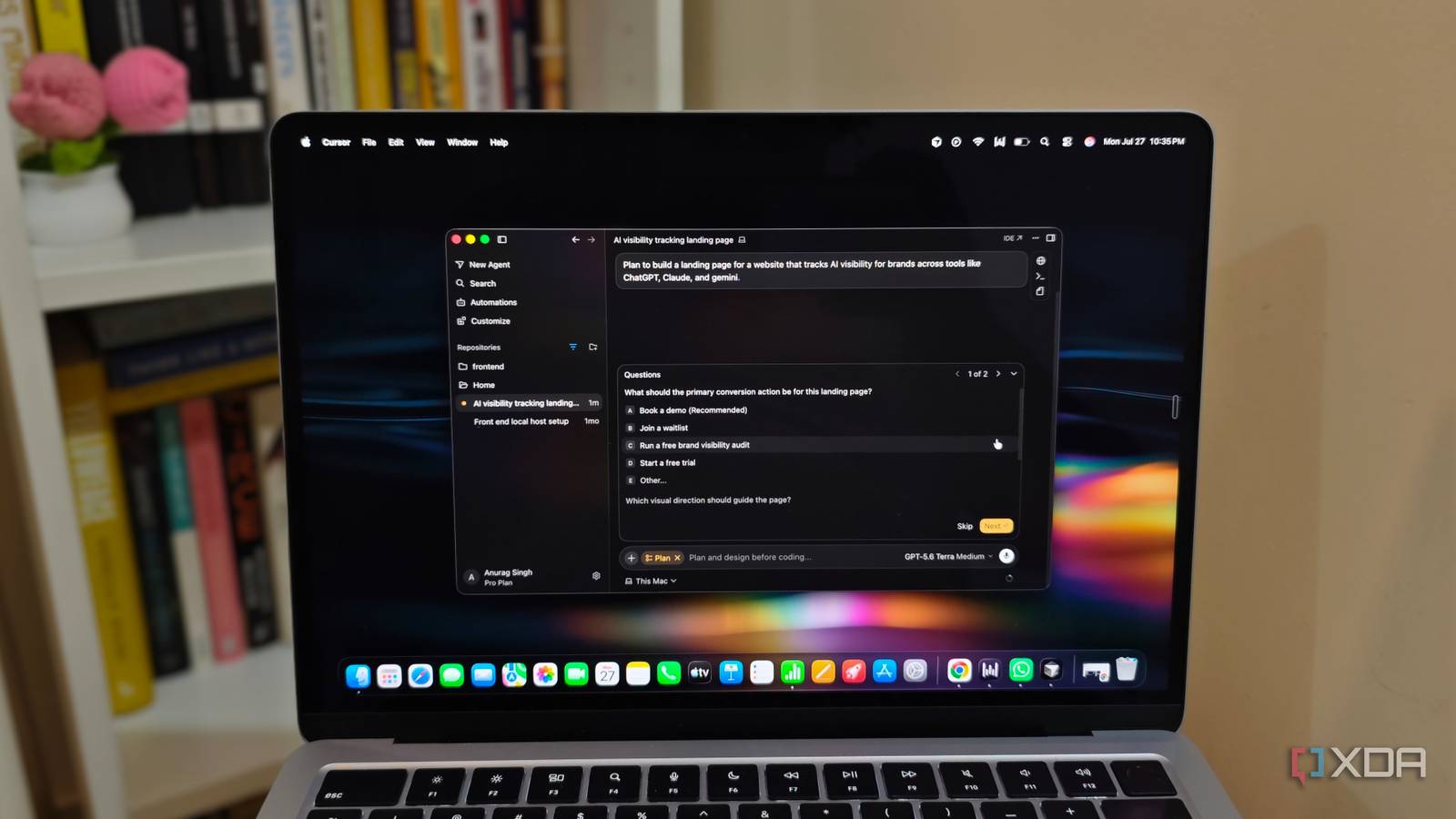
Published Jul 29, 2026, 3:30 PM EDT Anurag is an experienced journalist and author who’s been covering tech for the past 5 years, with a focus on Windows, Android, and Apple. He’s written for sites like Android Police, Neowin, Dexerto, and MakeTechEasier. Anurag’s always pumped about tech and loves getting his hands on the latest gadgets. When he's not procrastinating, you’ll probably find him catching the newest movies in theaters or scrolling through Twitter from his bed. I am a long-term Cursor user and really like the agentic features it brings. Its $20 plan offers a lot more value than what you get with Claude Code for the same amount. I also love the auto mode, which uses models according to the task instead of using the top-tier model to even change file names, which is sometimes the case with both Claude Code and Codex. However, Cursor’s real edge over the competition is how well it understands your entire project. The same Claude or GPT model can perform differently inside Cursor. The model is only one part of the product. Cursor also controls the instructions, search tools, file-reading process, and the amount of context returned to the model. Cursor doesn’t read every file at once It doesn’t read everything blindly When I say Cursor understands the entire project, I don’t mean it takes every file in the repository and pushes all of it into the model’s context window. That would be incredibly inefficient, and filling the context window with generated files, old code, and unrelated components would probably make the model perform worse. Cursor instead makes the entire project searchable and gives the model access to the parts it needs as it works through a task. Say I ask Cursor to change how authentication works without mentioning any file names. The agent can search for the relevant terms, inspect the project structure, and follow references until it finds where the authentication flow is actually implemented. It can then read the connected files and check how similar functionality has been handled elsewhere before making the change. Cursor previously relied heavily on semantic indexing for this. It divided the codebase into smaller chunks and used embeddings to find code based on meaning, even when my prompt didn’t contain the exact terminology used inside the project. However, recent versions have started replacing that system with Instant Grep and regular file reads. The agent now tries several possible search terms, explores directories, and progressively opens the files that appear relevant. Instant Grep keeps these searches fast even in large repositories because it maintains a local text index instead of scanning every file from scratch each time. Cursor gets more out of the same model Same model, much better supporting cast It is easy to compare coding agents by looking at the models they offer. If Cursor, Claude Code, and Codex all give you access to the same Claude or GPT model, you would expect them to perform similarly. But I have seen the same model handle a task better inside Cursor because it's working with a different set of instructions and tools. Every coding agent has a harness around the model that decides what it can do and how information is presented to it. Cursor tunes this harness separately for the different models it supports. It gives the model tools for searching the project, reading files, and applying changes, while its own instructions influence when those tools should be used. A model that is good at working through a terminal might be encouraged to rely more on search commands, while another might perform better with Cursor’s dedicated file tools. The quality of the context also makes a big difference. If Cursor retrieves the correct files and gives the model only the relevant sections, the model can spend more of its context window understanding the problem. If an agent pulls in several unrelated files or misses a shared component, the same model has to reason from incomplete or noisy information. A more capable model can sometimes recover from that, but it is still starting with a disadvantage. This becomes noticeable when a change extends beyond a single file. Cursor often searches for existing patterns before writing anything and checks where the same function or type is used elsewhere. The model therefore receives a clearer picture of how the change fits into the project instead of treating the prompt as an isolated coding task. Once it starts editing, Cursor also allows it to search again, inspect the result, and correct anything that no longer matches the rest of the codebase. Cursor gets better as the project gets bigger Messier projects make Cursor work better A blank project is probably the worst place to compare coding agents. There is no existing architecture to understand, and very little code that a new feature can break. Most capable models can create a basic application from scratch because they are free to choose the structure and write everything the way they want. The difference becomes clearer when I use Cursor on an existing project. A new component might need to follow the same structure as the rest of the interface, use an existing API client, and work with the state management already in place. Cursor can search for similar implementations and build around those patterns instead of creating another way to solve the same problem. This also prevents one of the most annoying problems with AI-generated code — duplication. Coding agents often create a new helper or component simply because they don’t realize that the project already contains one. Cursor’s ability to search the repository makes it more likely to find and reuse the existing implementation. Agent matters more than the model Frontier models are now available through nearly every serious coding tool, so access to Claude or GPT alone does not give any one of them much of an advantage. What matters is how effectively the tool helps the model work with a real codebase. Cursor Cursor is an IDE and an agentic coding platform.
Cursor's real edge isn't speed – it's how deeply it reads your entire project
Full Article
Original Source
Read the full article at Xda-developers →KhanList aggregates and links to publicly available news content. We do not host full articles from third-party sources. Always verify important information with original sources.