
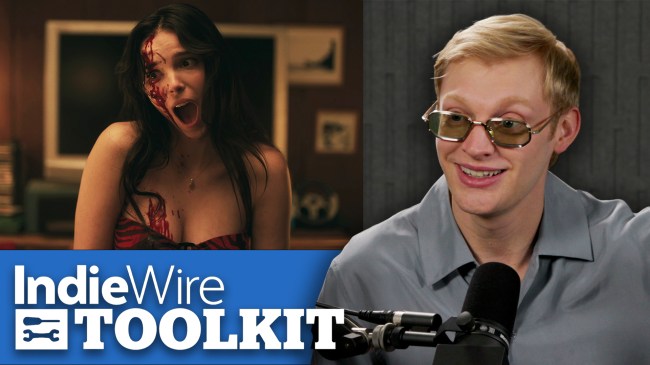
It’s been quite a year for Curry Barker. In September 2025, he brought his $700,000 horror film to the Toronto International Film Festival, where it sparked a bidding war that Focus Features won for $17 million. That hefty price tag turned into the deal of the century, as “Obsession” went on to become a half-billion-dollar box-office sensation, with audiences growing week to week. It was clear the then 26-year-old “YouTuber” (a moniker Barker rightfully dismisses) was something special. This was not just a flash in the pan, but a real talent with a seemingly boundless number of ideas and movies he wanted to make. His next film, “Anything but Ghosts,” was already in the can by the “Obsession” premiere, a yet-to-be-announced third film is in the works, while potential franchises (“Texas Chainsaw Massacre” and “Obsession,” Barker sees the One Wish Willow story device having “Knives Out” anthology-like potential) linger in the background. Which is why it’s interesting that Hollywood’s hottest new director took time out from editing (he’s cutting “Ghosts” himself) and writing (“I have my next thing that I’m working on — I’m really excited about it, and nobody knows anything about it, which is super exciting”), and an unexpected Oscar campaign (“Obsession” is a legit contender for Best Picture, Actress, and Original Screenplay nominations), to make a 5-minute short film, “Mama Bear.” On this week’s episode of the Filmmaker Toolkit Podcast, Barker talked about how the success of “Obsession” interrupted his established flow of churning out short-form content for his popular YouTube channel. “I have two or three short films where I’m like, ‘Oh man, this all took off really quickly, and I have this short film idea I’ve been dying to do,” said Barker on Toolkit. “I actually have no time to do those short films, and then justifying if it be would be worth my time to do them when I need to be writing this, I need to be editing this, and I need to be doing press for this.” It’s less about Barker’s desire to scratch the itch of the shorts he never got to make, but more about a hesitancy to step away completely from the iterative process by which he learned his craft — justifying the brief time he took off to make “Mama Bear” because he felt the need to sketch. “It’s fun to have that playground because the features are bigger stakes,” said Barker. “We were like, ‘Okay, this is a short film: We can do weird stuff. Let’s come up with crazy rules that don’t make sense, and experiment.’” Barker and his “Mama Bear” cinematographer — his young brother Riley, who worked on the “Obsession” camera department — created different rules for the camera, as Curry is still trying to hone his discipline for storytelling within longer takes. Not only would they shoot a narrow 4:3 aspect ratio, but the Barker brothers denied themselves the ability to move the camera left, right, up, down, or dolly in. “I do have a lot to learn,” said Barker of making “Mama Bear.” “It’s so funny because I was having dinner and I told someone, ‘Oh, I’d love to shadow on Ari Aster’s set.’ And someone was like, ‘Well, you’re Curry Barker, what are you going to shadow for?’” His 2026 meteoric rise has allowed Barker to collect a group of more experienced peers he views as mentors — including Aster, Bill Hader, Zach Cregger, and Rian Johnson — and successful producers, like Jason Blum, investing in his career, but he believes there’s a misconception of what comes along with “making it.” “People think that once you’re in this club, you’re in the club, and everyone talks to everyone. But no — you’re in a bubble, and I want to know how Zach Cregger writes his outline. I want to watch him do it,” said Barker. “You’re all alone. Your process is your own, and you figure this stuff out on your own. Once you get into this league, there’s no one telling you, ‘Well, actually you do it like this, this, and this.’ It’s whatever you learned all along your journey; that’s your process.” One of the most impressive things about the self-taught Barker’s journey is how quickly he turned himself into a successful actor/writer/director/editor. In 2018, when Barker left Alabama to come to Los Angeles to pursue a career in movies, he saw himself as an actor. Despite all the story scenarios dancing around his head, the idea that he would become a screenwriter was laughable. “I never would’ve thought I was a screenwriter. I didn’t make great grades. I made Cs and Ds, and I wasn’t the best in English class,” said Barker, who naively assumed professional writers were the kids who won spelling bees: “I just thought to be respected as a writer you have to be that.” Barker credits taking screenwriter Aaron Sorkin’s MasterClass as what opened his eyes. “It was the first time I thought, ‘I can do this, too.’ It’s really just about being creative and cracking a story, and there are rules, there’s structure.” Directing organically grew out of Barker pulling together collaborators to shoot sketches and shorts for him to act in. Barker, half-joking, likes to say he realized one day that what he was doing was directing, and that he both enjoyed “telling people what to do” and had a knack for it. What Barker accomplishes in a single shot — establishing a tonal balance that teeters between horror and comedy, combining blocking and camera movement to edit within the frame — is remarkably sophisticated. But Barker, who studies and strives for what masters like Kiyoshi Kurosawa can accomplish, quickly says he fell short in “Obsession.” ‘Obsession’©Focus Features/Courtesy Everett Collection “Things that you might think we pulled off [with longer takes in ‘Obsession’], we reshot,” said Barker, who on the podcast described in detail a key early scene between Bear (Michael Johnston) and Nikki (Inde Navarrette) in the bedroom that had to be reshot because the action took too long to unfold. “I think Ari [Aster] said once that if you realize you needed to give this information in four seconds, but then it took 25 seconds, you’re stuck with 25 seconds.” Curry Barker, the editor, is Curry Barker, the director’s harshest critic, giving him a bird’s-eye view of what he believes is the director’s inability to envision the required pacing of how a scene will play on screen, even if it might feel unnaturally fast on set. “Every single oner that I’ve shot in my career has been a problem in the edit,” said Barker. “I think there’s two ways to fail at something. You can either fail, realize that it didn’t work, get scared of it, and then be like, ‘Well, in my last film I did a bunch of oners and then it killed me in the edit, so I’m not going to do that anymore.’ Or you can fail, realize how you did it wrong, and try to get better at that for the next time.” As Barker discussed at the Future of Filmmaking Summit last month, that iterative process is key to how he got where he is, and it’s a mindset he clearly hasn’t given up. When asked how “Obsession” would have been different if he had more money, Barker doesn’t talk about locations, sets, special or visual effects, or scenes he envisioned that he couldn’t pull off — in terms of scale, he likes both writing and directing within set limitations. “I would’ve reshot everything,” Barker answered without hesitation. “If I was finishing the edit before we got into TIFF, and you were like, ‘Dude, this is really good, we really love this movie, we think it has potential, but we want to give you $10 million to reshoot the whole thing, I would be like, ‘Deal.’ I would take it.” “I think it’s so funny to look back and think about that now,” Barker catches himself, knowing he’s talking about a film that broke the box office and catapulted his career. “Now I wouldn’t change anything because I would be too scared to touch it.” To hear Curry Barker’s full interview, subscribe to the Filmmaker Toolkit podcast on Apple, Spotify, or your favorite podcast platform. You can also watch the full interview on YouTube.
Curry Barker Would Have Completely Reshot ‘Obsession’ If He Could
Full Article
Original Source
Read the full article at Indiewire →KhanList aggregates and links to publicly available news content. We do not host full articles from third-party sources. Always verify important information with original sources.