
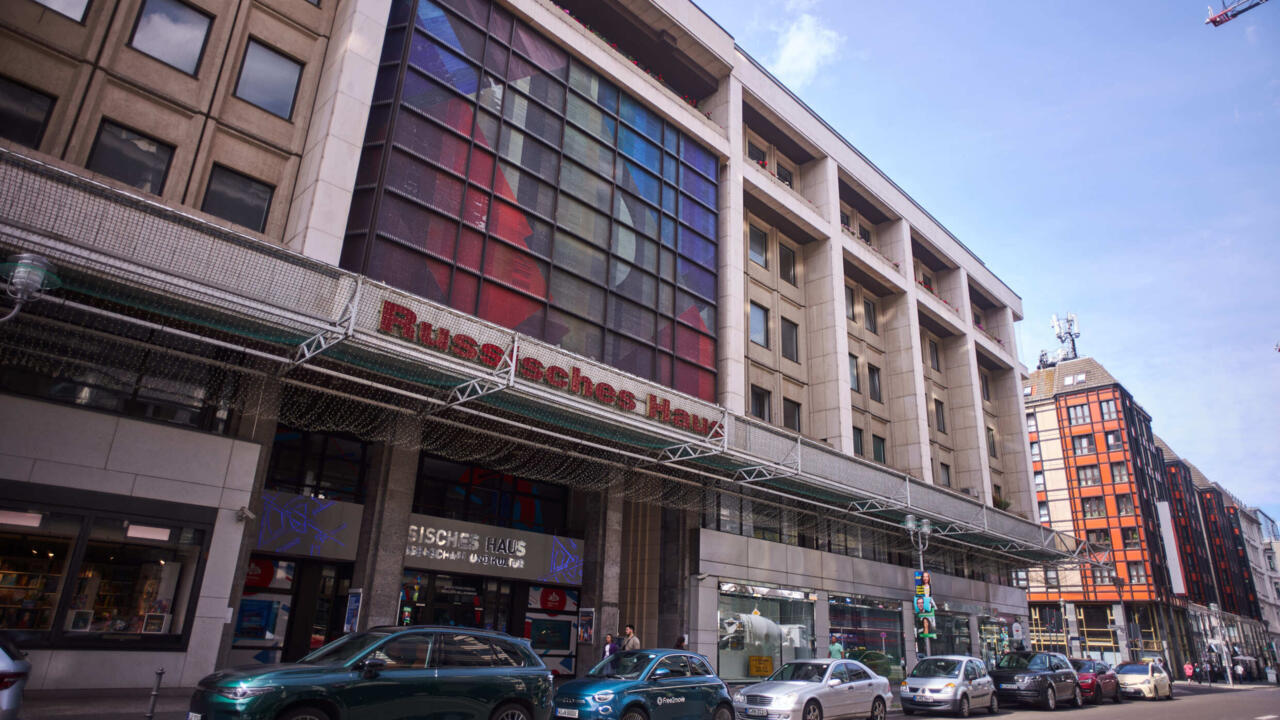
A dispute between Germany and Russia over their cultural centres is drawing fresh attention to a network of Russian Houses that has faced years of accusations of propaganda and espionage, but continues to operate in several European countries. Moscow said on Thursday it would close branches of Germany's Goethe Institute after Berlin moved to shut its Russian House, one of a string of centres that officially promote Russian culture and language and operate in dozens of countries. Meanwhile, a similar centre remains open in Paris despite EU sanctions against the Russian state agency that runs it. Since Russia's full-scale invasion of Ukraine in February 2022, Russian Houses have faced growing scrutiny over accusations that they promote Kremlin ideology and, in some cases, provide cover for intelligence activities. Germany announced on Tuesday that it would terminate the agreement governing the Russian House of Science and Culture in Berlin. The decision was part of retaliatory measures against Moscow after Germany held Russia responsible for what it called a “hybrid attack” involving an explosive drone at Leipzig airport on 4 August. Calls to close the Berlin centre have been made repeatedly over the past four years. Security concerns grew after Germany's digital ministry moved into a neighbouring building in late July, European news outlet Euractiv reported, with some sensitive services remaining in Bonn. EU summons Russian envoy, eyes sanctions after Germany drone 'attack' Espionage suspicions More misgivings emerged in early August, when German outlets WDR and Süddeutsche Zeitung reported on a French Interior Ministry document stating that the Berlin Russian House was “used as a cover by Russian intelligence services”. The claim appeared in an expulsion order against Xenia Fedorova, the former head of Russian state-funded broadcaster RT France, who was reported to have sought to head the Berlin centre. Around 100 people were based there and their exact roles were unknown, German MP Roderich Kiesewetter told Euractiv. He has previously described the centre as an extension of Russian President Vladimir Putin's power. “We also know that its energy consumption is significantly higher than what you would expect from a cultural institution,” said Kiesewetter, a member of the centre-right Christian Democratic Union who specialises in security and intelligence matters. Despite those suspicions, the centre continued operating, advertising children's classes and cultural events into October. Berlin is not alone. Rossotrudnichestvo, a Russian government agency under the authority of Russia's Foreign Ministry, runs the network of Russian Houses abroad. Its own map lists 15 in the European Union, including centres in Paris, Rome, Brussels and Budapest. Rossotrudnichestvo “explicitly supports the diplomatic orientations, geopolitical principles and values promoted by government bodies” in Moscow, Russia specialist Maxime Audinet wrote in a 2017 article in French geopolitics journal Hérodote. The EU sanctioned Rossotrudnichestvo and froze its assets in July 2022, describing it as “the main state agency projecting the Kremlin's soft power and hybrid influence”. The sanctions do not automatically force its offices to close, however, and several Russian Houses remain active four years later. A war on words: why Russian strikes are targeting Ukrainian publishers Quieter influence in Paris The Paris Russian House, in the city's 16th arrondissement, advertises paid Russian-language courses, children's activities, concerts and trips to Russia for 2026-2027. These include New Generation, a programme for young professionals organised and funded by Rossotrudnichestvo. In research into Russian cultural diplomacy between 2021 and 2024, Paris-Nanterre University master's graduate Marika Ruggiero described the Paris centre as an “agent of Russian propaganda” in France. “They are not trying to make all of France agree with Russia. They are instead trying to consolidate an audience that already had a certain attraction to Russia,” Ruggiero told RFI. Messaging was particularly direct at the start of the invasion. On 15 March 2022, the Paris centre published testimony from a woman from Donbas accusing Ukrainian soldiers of targeting schools and orphanages, before thanking Putin and Russia for intervening. By 26 March, after saying on Facebook that its “alternative messages” had found an audience in France despite an “avalanche of one-sided information”, the centre announced that it would focus mainly on cultural events. The Russian House of Science and Culture in Paris, one of 15 Russian Houses still operating in the European Union despite sanctions against the Russian state agency that runs them. © Jean-Baptiste Breen “The disinformation was no longer as clear as in 2022 or as in other Russian Houses closer to the post-Soviet space,” Ruggiero said. War subsequently featured less directly, while topics like history, the “Great Patriotic War”, Crimea, “Russophobia” and “traditional values” provided ways to invoke favoured narratives more obliquely. In 2024, the centre's Telegram channel shared comments from Russian foreign intelligence chief Sergey Naryshkin linking French pilots who fought Nazi Germany alongside the Soviet Union with French people who went to Donbas to fight what he called “Nazism in the 21st century”. Culture and diplomacy continue to overlap in the centre's programming. In June, the Paris Russian House hosted a book launch attended by diplomats from several Arab countries, Russia's chargé d'affaires in France and Moscow's permanent representative to Unesco. Russia “traditionally considers diplomacy the main mechanism and instrument for resolving conflicts”, Russian diplomat and author Oleg Ozerov said at the event. Four charged in Paris over suspected Russia-linked spy network Sanctions and closures Questions remain over how the centres keep functioning while Rossotrudnichestvo is subject to an EU asset freeze. Germany's Finance Ministry confirmed in 2024 that the Berlin centre was a “non-autonomous part” of Rossotrudnichestvo and that its assets were frozen. Funds can still be released in some circumstances with authorisation from the Bundesbank, Germany's central bank. French authorities have provided less information. Asked by RFI how the asset freeze was being applied to the Paris centre and whether any exemptions or authorisations had been granted, the French Treasury declined to comment. The Paris Russian House did not respond to questions about how sanctions affected its activities. No visible interruption to the French centre's activities followed the adoption of sanctions during the period she studied, Ruggiero said. Events and trips to Russia continued to be offered. More Russians seeking to leave as fears of another mobilisation grow Other European governments have taken a different approach. Denmark reduced the number of Russian diplomats after the 2022 invasion, after which the Copenhagen Russian House shut down. Romania ordered the closure of the Bucharest centre in February 2023, saying it had repeatedly engaged in activities that distorted “reality and historical truth” and that the problem had worsened after Russia invaded Ukraine. The decision was a “new step aimed at depriving Romanian citizens of access to an alternative point of view that exposes the aggressive absurdity of NATO and EU propaganda”, Russian Foreign Ministry spokeswoman Maria Zakharova said at the time. Moldova decided in July to shut the Russian centre in Chisinau. In total, Russian Houses have closed in nine European countries since February 2022. Hungary, by contrast, has taken no action against the Budapest centre, despite promises from Prime Minister Peter Magyar to combat Kremlin influence. Beyond Europe Outside Europe, some Russian Houses in Africa have been handed to private organisations, including the Wagner paramilitary group, Lou Osborn from the investigative collective All Eyes on Wagner told RFI in December 2025. Beyond cultural exhibitions, Russian Houses in several African countries “serve as recruitment centres” for industrial and military workers, Osborn said. Attracted by false promises of access to education, people have allegedly been put to work instead supporting Moscow's war effort. Nothing similar has been observed in European centres. France has not announced measures comparable to those taken by some other European countries. The French Foreign Ministry did not respond before publication when RFI asked about the government's apparent tolerance of the Paris centre. One reason could be a desire to “maintain relations and not completely close the door to communication with Russia”, Ruggiero said. “Closing cultural centres could be seen as another attack.” The culture promoted in the centres is also “fairly sanitised” and tends towards subjects that do not cause controversy, she said: “the great Russian composers, literature, language”. Germany has now chosen a different course. German weekly Der Spiegel reported on 21 August that ending the 2011 agreement governing the Berlin Russian House was no longer considered taboo. Eleven days later, after blaming Moscow for the explosive drone attack at Leipzig airport, Berlin announced it would terminate the agreement allowing the Russian House to occupy its premises. The Kremlin responded by announcing the forthcoming closure of branches of the Goethe Institute, Germany's equivalent cultural institution, in Russia. This article was adapted from the original version in French by Aurore Lartigue and Jean-Baptiste Breen.
Culture or Kremlin influence? Europe divided over its Russian Houses
Full Article
Original Source
Read the full article at Rfi →KhanList aggregates and links to publicly available news content. We do not host full articles from third-party sources. Always verify important information with original sources.