
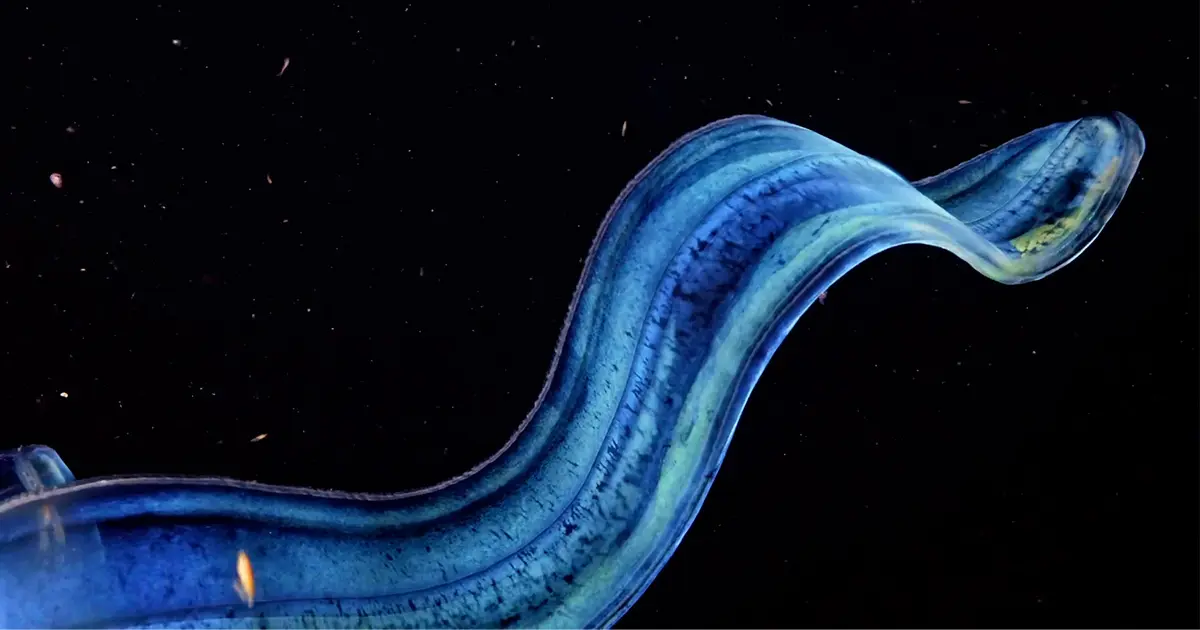
Comb jellies are helping answer fundamental questions in biology, from how the earliest nervous systems evolved to how bioluminescence works. Around 700 million years ago, a group of organisms resembling little more than glowing, gelatinous blobs split off from the rest of the animals, forming possibly the earliest branching animal lineage. Nearly 200 species of ctenophores, commonly known as comb jellies (but unrelated to jellyfish), live today in environments ranging from the cold depths of the sea to warm coastal surface waters. Their magic isn’t just in their persistence or iridescence; it’s in their DNA. Over the past decade, ctenophores have helped answer long-standing questions about fundamental biology, from how early nervous systems evolved to the origins of the mesmerizing phenomenon of bioluminescence. Having access to closely related species across such variable environments “lets you ask questions about how certain things evolved,” such as adaptation to high pressure or light-sensing genes, said Steven Haddock, a marine biologist who studies ctenophores at the Monterey Bay Aquarium Research Institute. “That’s one of the reasons why we work with ctenophores,” said Pawel Burkhardt, an evolutionary biologist at the University of Bergen who studies the origins and evolution of neurons and nervous systems. “They’re very exciting to work with, and they’re also extremely beautiful organisms.” For more than a century, scientists thought that sponges, or porifera, were the first to branch off — the sister group to all other animals. But over the past two decades, evidence has emerged that ctenophores were earlier. In 2023 — after years of a “ping-pong game” between labs debating which group came first, Burkhardt said — a landmark paper analyzing chromosome organization found that ctenophores, not sponges, are the sister group, though this is yet to be fully settled. How the phylogenetic tree looks under the Ctenophora-sister hypothesis. Kristina Armitage/Quanta Magazine What makes this all the more surprising is that sponges lack muscles and neurons, while ctenophores have muscles and exhibit evidence of a simple nervous system. “If you think about the earliest branching animal lineage, you would expect less complexity,” Burkhardt said. “That changes a lot of the assumptions [about] how the very first animal may have looked.” The more researchers investigate comb jellies, the more complex they appear and the more we learn about the origins of animal life. Some species have recently been observed reversing their development from adult to larval stages. Others have special types of lipids that help them withstand extreme pressure in the deep sea. They hold clues to the evolution of more and more complex body shapes. It’s really important to study organisms that might seem strange or weird because they can tell us a lot about the physical, chemical, and biological principles of life, which can then be applied to ourselves, said Itay Budin, a biophysicist who studies cell membranes at the University of California, San Diego. “We are as distantly related to a ctenophore as a ctenophore is to a jellyfish.” Using volume electron microscopy, Burkhardt’s lab identified 17 unique cell types in Mnemiopsis leidyi — 11 of which were previously unknown — in an all-important structure called the aboral organ (center). Together, these cells help ctenophores sense light, pressure, and gravity, and the aboral organ is tightly integrated with a continuous network of fused neurons that forms the nervous system. “Having more neurons condensed at a certain place, that’s one theory [for] how the very first brains evolved,” Burkhardt said. The research was published in March 2026 in Science Advances. Alexandre Jan, Michael Sars Centre/University of Bergen Nervous systems are typically defined as networks of neurons that communicate across synapses. But Burkhardt’s lab found something unique in ctenophores: Beneath the animal’s outer surface is a nerve net (pink mesh in this 3D reconstruction) whose neurons are connected by continuous cytoplasm — but with no synapses between them. “I don’t think any other animal has a nervous system like that,” Burkhardt said. Because ctenophores are one of the earliest branches of the animal family tree, the finding indicates that evolution may have crafted nervous systems twice: in ctenophores, and separately in jellyfish and all other animals. Pawel Burkhardt Genome regulation is fundamental to determining when and where genes are turned on and off. But over long stretches of the genome, this process becomes more complicated, requiring DNA and proteins to physically fold into loops. Researchers think this was critical to enabling multicellular organisms to develop specialized cells without needing to evolve new genes. “These are key for cell-type specialization and building complex tissues,” said Arnau Sebé-Pedrós, an evolutionary biologist who studies genome regulation at the Center for Genomic Regulation in Barcelona. The ctenophore M. leidyi (pictured) has more than 4,000 loops in its genome of just 100 million base pairs (compared to 3 billion in the human genome), which suggests that looped DNA may have evolved 150 million years earlier than scientists thought. Joan J. Soto-Angel Many species of marine life can produce their own light through bioluminescence. As one of the most distant relatives of other glowing multicellular organisms, ctenophores harbor clues in their genomes that point to how and why this evolved. Haddock’s team found that a few non-glowing ctenophore species lack genes that they suspect help synthesize a light-emitting chemical called coelenterazine. Subsequent research identified the full-length gene in bioluminescent ctenophores. “It’s the most abundant, widespread light-emitting molecule in the ocean,” Haddock said; it appears in copepods, shrimp, squid, mollusks, and more. “It is hard to explain how these things crop up independently across the tree of life,” Haddock said. “They’re maybe co-opting some kind of precursor gene that they [all] have, and then they’re modifying it to use it for a different purpose.” S. Haddock/MBARI/The Bioluminescence Web Page Lipids are cone-shaped molecules that make up all cell membranes. Unlike most lipids, a special type called the plasmalogen only has one oxygen molecule instead of the usual two. Human brains have them, and so do deep-sea comb jellies. They flex in a way that makes it possible for the ctenophores to withstand extreme hydrostatic pressure. When the ctenophore Bathocyroe aff. fosteri was brought to the surface and released from that pressure (left), the plasmalogens expanded (center), cell membranes split apart (right), and the comb jelly disintegrated. “We went into this asking a very fundamental question about life in the deep sea,” Budin said, “but it involved a biomolecule that’s also very important in our bodies [and] in human health.” Fewer plasmalogens in human brains can be associated with neurogenerative diseases such as dementia, Budin said. These lipids may help cell membranes fuse and break fast enough for neurons to fire. Jacob Winnikoff Two of the comb jelly species studied under pressure by Budin and colleagues show the animals’ remarkable variety and complexity. On the left is the deep-sea lobate comb jelly Bathocyroe aff. fosteri. “Bathocyroe” means “master of the deep,” and the species is found at depths ranging from 200 to more than 3,000 meters. The red pigmentation in the animal’s stomach is thought to block light emitted when it engulfs bioluminescent organisms, so its prey doesn’t give away its location to other predators. The shallow-water comb jelly Leucothea pulchra (right) is named after the Greek goddess of sea-foam. This species is rarely found deeper than 20 meters. The orange knobs are prehensile, sticky, and used for prey capture. Jacob Winnikoff During embryonic development, cells arrange themselves into distinct morphologies due to a blastopore: an indentation that ultimately becomes the anus or mouth (central area pointing upward in this image of M. leidyi). The same developmental process for embryos in ctenophores is also found in bilaterians, the large group of animals that share our bilateral symmetry. This indicates that the blastopore organizer — which turns a mere ball of cells into a complex, multicellular embryo — is conserved across species. “Understanding where the organizer came from tells us which parts of our development are ancient and robust, and which are recent inventions,” said Andreas Hejnol, an evolutionary biologist at Friedrich Schiller University Jena in Germany. Human embryos use the same signaling pathways that Hejnol and his colleagues found in ctenophores. Lisa-Marie Barf Next article Black Holes or Black Hole Stars? Astronomers Spar Over Webb Telescope’s ‘Little Red Dots.’
Ctenophores Aren’t Just Beautiful. They’re Biological Wonders.
Full Article
Original Source
Read the full article at Quantamagazine →KhanList aggregates and links to publicly available news content. We do not host full articles from third-party sources. Always verify important information with original sources.