
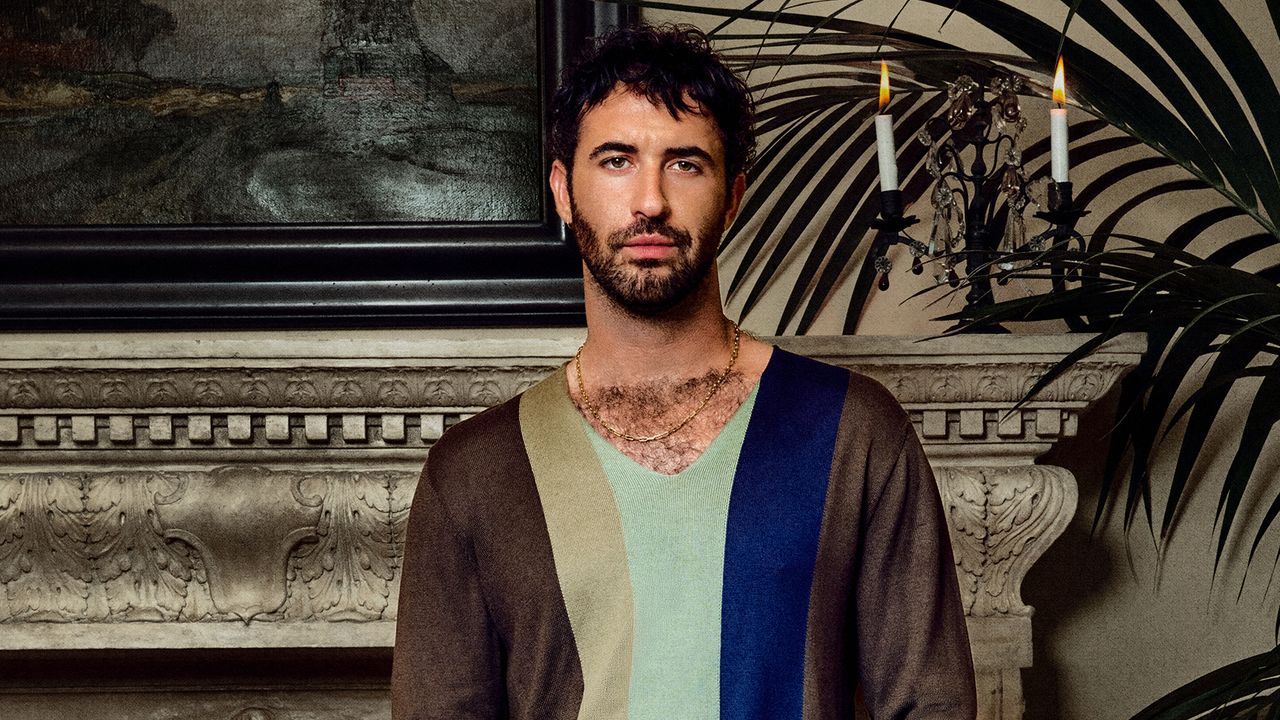
After breaking out with ironic Instagram videos and self-caricaturing roles, the 35-year-old is ready to show us a ‘more true side’ of himself with his atypically earnest directorial debut, Club Kid.Sweater by Giorgio Armani. Pants by Zegna. Belt by Artemas Quibble. Boots by Alessandro Vasini. Watch by Rolex from Foundwell. Necklace by Cartier.“This is what you’re keeping me from right now,” Jordan Firstman says, and pivots his laptop screen to face a high hotel window overlooking a long, tempting stretch of Brazilian beach.Firstman is in Rio de Janeiro for work, presenting three film-festival screenings of Club Kid, his directorial debut, which he also wrote and stars in as Peter, a dissolute downtown New York club promoter whose own extended adolescence ends abruptly when he’s called upon to parent Arlo, the 10-year-old son he’s never met.The Brazilian audiences “really got it,” Firstman reports. It seems like everybody who watches Club Kid really gets it. The film received a seven-minute ovation at the Cannes Film Festival back in May, and sold to A24 for a reported $17 million after a brief, buzz-stoking bidding war. Preview screenings in LA, where Firstman lives, have been packed to the rafters.Shirt and pants by Brioni. Bow tie and cummerbund, stylist’s own. Vintage watch by Rolex from Foundwell. Vintage cufflinks by Cartier from Foundwell. Earring, his own. But when it’s suggested that this all bodes well for Club Kid’s broader appeal when it finally hits theaters, Firstman says, “Only time will tell. I hope it translates to the gen-pop.”What we do know: Club Kid is hands down the most heartwarming film ever made about a man raising a child conceived during a blotto bisexual threesome—a supremely confident comedy-drama, raw and honest about gay sex, party drugs, and parenting in a way that’s excitingly and delightfully at odds with the sweetness of its tone. It’s an extremely likeable film, and its director-star is extremely likeable in it. And, I’ll say—at the risk of being rude—this means it’s kind of a departure for Firstman, who up until now has cultivated an almost proudly polarizing comedic persona online and onscreen. “I think, when you’re annoying and gay, people can’t get past that, in our culture,” he says, “and it’s interesting to me.”Firstman is 35, and has not been famous particularly long, but if his public life so far has taught him anything, it’s how quickly the wind can shift. He broke through doing silly front-facing video sketches during COVID—playing banana bread’s publicist, yass-ing up his new favorite client, that sort of thing—and before long found himself apologizing for unearthed edgelord tweets he’d written in his early 20s. (He said in a statement that he’d “grown a million lifetimes” since those posts.)His run on Fox’s English Teacher ended with the show’s cancellation in 2025; around the same time, he popped off to Vulture about the sex scenes in Heated Rivalry, suggesting the hockey bromance didn’t have a clue about “how gay people fuck.” (He is perhaps the only person ever to have pissed off that show’s fan base and lived to tell the tale, which may be evidence that nothing can stop his rise.)Now ensconced once again as a TV-series regular—on HBO’s I Love LA—and with a buzzy movie in the pipeline, he’s able to look at all this with sunrise/sunset serenity.“There’s ebbs and flows to whether people fuck with you or not,” he says. “Everyone loved me during the pandemic, and then everyone hated me for a little bit, and now it feels like people like me again.”Still, he remains, by his own admission, “too online,” unable to not read things written about him, and it’s hard not to internalize some of that stuff, a little bit. He was gay and annoying in 2023’s Rotting in the Sun, playing “Jordan Firstman,” a dick-swinging, clout-chasing imp who torments a depressive artist played by the film’s director, Sebastián Silva. No less an authority than Pedro Almodóvar saw the movie and told Firstman he was a “real actor,” but his was one of the kinder reactions.“I kind of assumed audiences would understand it was a performance,” Firstman says, “and I think many didn’t.” He thinks the movie is brilliant and calls Silva a genius. But he’s also convinced that playing a maximally annoying caricature of himself “really did affect the way people saw me, and then it affected how I saw myself. The year after Rotting was actually very tough for me, because I felt very hated.”The new film, he says, is partly a response to that experience, he says. “I think Club Kid came from a place of, ‘I know how I feel, and I know how I’m being perceived is so different than how I feel, and I want to show a more true side of myself through this work.’”Jacket, shirt, and pants by Tom Ford.That wasn’t how it started, of course. It started with Firstman at a dinner party, doing bits with his friends’ kid. That was the spark—Firstman realizing that putting a Jordan Firstman–type character, talking the way he does, in situations with an impressionable minor who maybe shouldn’t hear the kinds of things Firstman tends to say out loud, could be a great comedic setup.Club Kid is in conversation with a long line of films about characters thrust into a parental role they’re ill-equipped for; Firstman can rattle them off, from Chaplin’s The Kid to Auntie Mame to Kramer vs. Kramer to Big Daddy. But as he wrote, bigger ideas emerged—about the “arrested development” of a certain cohort of childless gay men, about what it actually means to be an adult. And in working out how Peter would show up to his newfound relationship with Arlo, he thought about his own parents—two Newsday reporters who raised him in the New York suburbs—and what he got from them, as well as what he wished he’d gotten.“I feel like no one taught me what life was going to be like. We just got by in a pleasant-ish way. But I don’t think I got major insights,” he says. A beat. “It is what it is. I am grateful that I went looking for those insights in my early 20s, through drug trips.”This is what it’s like to talk to Firstman these days; he’s reflective, but he’ll still spring a provocative overshare on you like a trap door. (Boing! Drug trips!) The first time we met, at a photo shoot a few weeks before the call from Brazil, he told me that although the standing ovation thing at Cannes is overblown (“It felt great, but it’s such a ruse. It’s like, you can keep it going if you want. You just don’t let it stop. [From the stage] You keep pointing at different people in the movie”), the experience of showing the movie to an appreciative audience at the most prestigious film festival in the world had been transformative, that it felt like “20 years of validation that I didn’t get,” and that he no longer feels the same need to “say the edgy thing” all the time.But at the very beginning of that conversation—as I remember it, we were still in the process of shaking hands—he started telling me an off-the-record story involving, let’s say, an adult situation. Today, over Zoom, I ask if that anecdote (explicit, slightly alarming) was the old Jordan briefly reasserting himself by saying the edgy thing.“It probably came from a place of, maybe, nervousness, if I’m being honest,” he says. “But I think, probably, there was some sort of provocation that was a bit of a shield in that story.”And it’s more complicated than that, he notes—because the guy who says the edgy thing is a part of him, too, and who’s to say it’s not his best self? He really does feel, after Cannes, like he doesn’t have to prove himself in quite the same way, he says.“But then I’m like, ‘Oh, am I changing into something that’s less honest, or more honest? Are the gritty parts of me honest, and I’m letting go of them to be more palatable?’” Or is it a defense mechanism, “and the real me is something softer and sweeter and more put-together?”The goal, of course, is to amalgamate all our disparate selves. Wouldn’t that be great? Firstman has tried his best.“I’ve done a lot,” he says. “Everything mystical, I’ve tried.”Earring, his own.He’s tried past-life regression, and he’s tried ayahuasca, and he’s the second person I’ve interviewed—the first being Mike Tyson—who has tried bufotenin, a hallucinogen found in the venom of the Sonoran desert toad. (He doesn’t recall much about the first time he tried it, except a feeling “like something really bad happened”; the second time was “a way more positive, beautiful experience.”)“I think I’ve always been a very curious person,” he says. “They say with ayahuasca, it finds you when you’re supposed to do it.”When he heard about ayahuasca—a traditional psychoactive tea brewed from two plants native to the Amazon—on comedian Duncan Trussell’s podcast, he says, “It felt like I got shot in the stomach. I was like, ‘I have to do this.’” The next day he was at a party and somebody told him they’d just done it, under the supervision of a shaman in Topanga. Firstman went on to do it nine times over the course of his 20s.“By the end, it kicked me out,” he says. “God, literally, was like, ‘You can’t come back here. This realm is not for you, ever again.’ I still did it one more time after that, and it was like, Bitch, are you serious? It almost really fucked me up.”So he was pushing it, he reasons, with the toad venom. “I maybe shouldn’t have even done that, but I think it’s a different thing.”He has this secret spiritual tool kit now, of stuff he’s learned from these experiences, about his own perceptions, and he thinks it’s protected him. He wasn’t looking for a way out of anything or relief from any particular suffering or struggle. He wanted to learn about life and what there was to experience—which, as it happens, is also how he’s approached his working life.“I do it through film, I do it through music. I do it through social interactions. I think life is about learning in any way you can and experiencing everything you can.”Instagram videos. Sitcoms. Directing a movie. Each another trip: What happens when I do this? He figures he could probably have built a more stable career, “if I had a more diligent respect for one medium, maybe.” But he can’t help where his creative impulses take him. Was anybody clamoring for Firstman to make 2025’s Secrets, a full-length comedy album of oddly well-executed genre-parody songs with titles like “I’m Hoarding Cum” and “Pennies in My Pussy”?The answer is no. (The actual answer is probably “not at all.”) But once he started making the record, Firstman says, “there was no stopping me. I was in the studio, like, ‘What am I doing in a music studio?’ But I couldn’t not. I was there every day. I was begging any producer I knew to help me, because I just needed to.”Chances are you could not make a movie like Club Kid, whose realness stems in part from a clearly lived-in understanding of partying, without having done some wild shit. But it would be difficult to make this movie if you were still living that way. Peter has Arlo to drop-kick him out of suspended adolescence and into adulthood; I ask Firstman what the catalyst was for his own growth.“I think it was a slow process,” he says, “that’s still happening, to some degree.”Some of what happened was professional: In 2025, he put out the album and shot the second season of English Teacher, the first season of I Love LA, and Club Kid. The practical demands of that schedule forced him to lock in: “I didn’t have Saturdays off to party, and I couldn’t afford, on a Monday, to not feel like my best.”He also went through a breakup “that was really, really, really sad and just really unexpected, and someone I never thought I would break up with.”He doesn’t want to be too specific about, y’know, the specifics. But it was a split he initiated.“It came to a point where I was like, ‘I know the life I want to live and I don’t think this love is aligning with that life.’ I had to choose my life over love—which is such a mind-fuck, because you’re like, ‘Love is everything. There’s nothing more important than love.’ But then, your life is also—on a day-to-day level, it’s pretty important. And so yeah, I think it was a really tough, bizarre out-of-body experience almost, because it was a love I had never known the likes of before, and then it was over.”By the time they broke up they had been together for four years. When it started, Firstman says, he couldn’t believe they’d found each other and the depth of what he was feeling for this person. “And I felt the exact same way with the breakup,” he says. “I was like, ‘I cannot believe this is happening.’ It feels so unreal. It just doesn’t make any sense. As much as the love didn’t make sense in the beginning, how powerful it felt, the breakup didn’t. It was the exact same feeling.After their last conversation they agreed to stay friends, and then they didn’t talk for a year. “I think he was protecting himself and maybe protecting me too,” Firstman says. When his ex finally responded to a message, Firstman was on set, about to shoot a climactic scene in Club Kid—he’d scripted, as it happens, a big emotional moment for Peter, a moment where two characters connect on the phone after a long time apart.“The first time, in a year, he had responded, was the moment before they called ‘Action,’” Firstman says. “That’s why I cried so hard in that scene, just like a huge release.”Sunglasses by Jacques Marie Mage.His ex hasn’t seen the movie yet, Firstman says, and maybe he never will. It’s dedicated to him, though—his name is in the end credits. “He doesn’t know that either,” he says. “I’m a little scared. I’m a little scared, because to me, the movie is a love letter to him.”He starts crying here, a little bit, apologizing even as it’s happening.“All of that extra love that I still have for him, I put it directly into the movie. If he does see it, which I don’t expect him to or need him to, I hope he sees that’s where all my love went, and that I still have it for him and I always will.”He has not started writing his next movie yet, but he’s started thinking about it. He knows that like this one, it’ll be a love story—and that after writing, in Club Kid, about familial love, community love, and loving yourself, he wants to write about friendship next.In the past year, he’s been blown away by two movies of vast scope, Paul Thomas Anderson’s One Battle After Another (“I was making my movie when that came out, and I think that is a movie, for him, about growing up, and not feeling like a grown-up as an adult”) and the equally sprawling queer epic La Bola Negra. I ask him if he’s looking to go similarly big with his next project. Maybe, he says.“But I think I’d like to take incremental steps and learn more as a filmmaker before.…”You make your war movie?“Yeah,” he says, laughing. “My war movie. The Firstman war movie. I have zero context for war, so I would be completely making everything up.” ✦PRODUCTION CREDITS:Photographs by Danielle LevittStyling by Brandon TanHair by Teddy Charles using Maison BeauxMakeup by Holly Silius using RetrouvéProp styling by Evan JourdenTailoring by Kanna Taniuchi and Oluwatobi KalejaiyeProduction by Hinoki GroupSign up for Manual to receive useful advice on style, health, and more, six days a week.Alex Pappademas is the Senior Culture Editor of GQ. He has been writing about music, film, television and other forms of popular culture for over 20 years. He is the author of Keanu Reeves: Most Triumphant— The Movies and Meaning of an Irrepressible Icon (2022, Abrams Image) and the coauthor, ... Read More
Crying in the Club (and Everywhere Else) With Jordan Firstman
Full Article
Original Source
Read the full article at Gq →KhanList aggregates and links to publicly available news content. We do not host full articles from third-party sources. Always verify important information with original sources.