
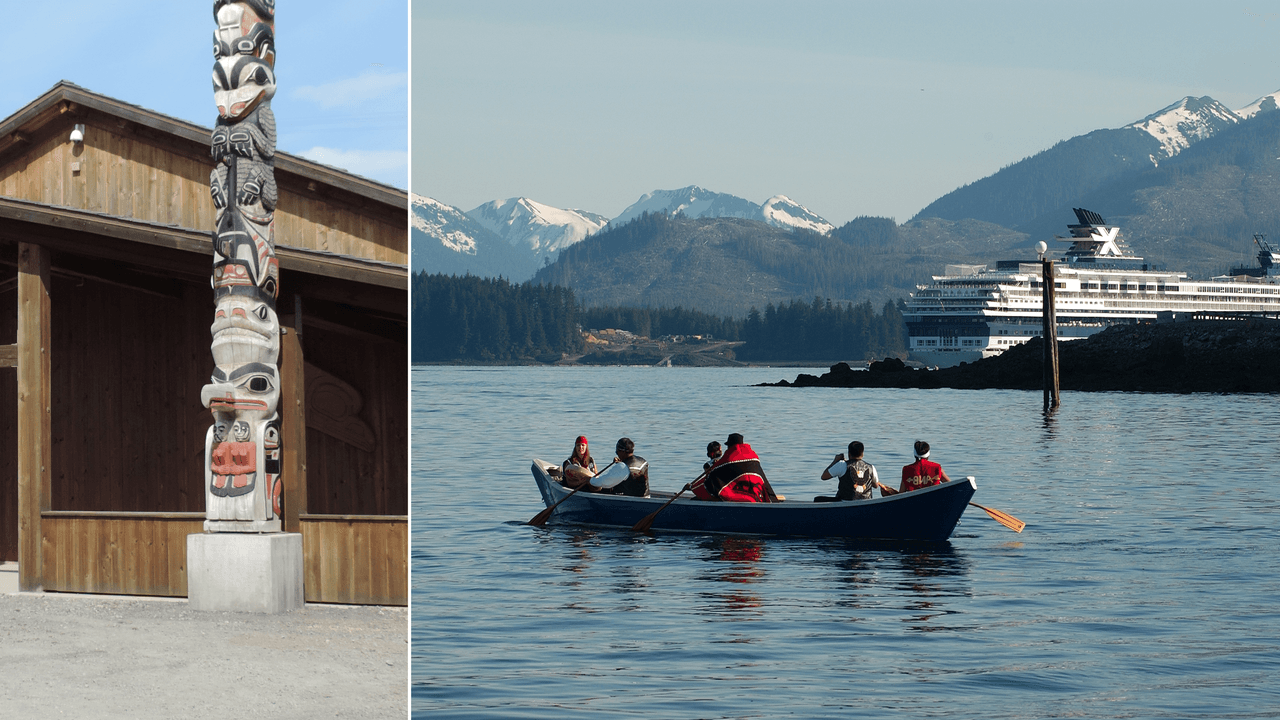
Alaska’s cruise industry has long relegated Indigenous peoples to the margins of the tourism economy. Now, a shift is occurring.Thompson & CoThe Huna Totem Corporation was featured on Condé Nast Traveler's Bright Ideas in Travel 2026. Read the full list of winners here.From April to October, cruise ships tower over downtown Juneau’s Marine Way, a coastal path that connects the port zone to downtown. Should a traveler pause for a moment between ship and souvenir store, they’ll notice Kaagwaantaan Kootéeyaa, a tall, intricately carved pole rising against a backdrop of forest and mountains. At its base, a panel explains that the cedar pole depicts five of the Kaagwaantaan Tlingit clan’s crests: a hat, person, orca, eagle and bear. It is an arresting introduction to the long-overlooked human history of this place.unknownSince 2023, totem poles have adorned this highly trafficked shoreline, part of Kootéeyaa Deiyí (“Totem Pole Trail”)—a city-wide project led by the Sealaska Heritage Institute (SHI) that represents the cultures of the Tlingit people who have inhabited Juneau for at least 10,000 years, as well as the Haida and Tsimshian who arrived a few hundred years ago. Visible evidence of the region’s Indigenous communities was previously limited, says SHI’s Ricardo Worl (Tlingit), who sees the trail as “an opportunity to reestablish our presence on our ancestral lands.” Noting that more than a million cruise ship passengers land in Juneau each year, Worl hopes the trail “is the beginning of their education about our culture.”Alaska’s cruise industry has long invited travelers to experience the “Last Frontier” while relegating Indigenous peoples to the margins of the tourism economy. Now, a shift is occurring—one that goes beyond simply incorporating Indigenous culture into the cruise experience. Across Alaska, Native corporations are increasingly owning and shaping the tourism infrastructure itself, from cruise docks and terminals to ground transportation, giving them a greater stake in how destinations develop, and how visitors experience them.I came to Alaska to see how Indigenous ownership is changing the experience on the ground, following a route that took me from whale watching at cruise ports on the coast to bear and moose spotting at a lodge deep in the Interior. At each stop, I saw how Alaska Native corporations are shaping the places that travelers pass through.Icy Strait Point-Nature Created following passage of the 1971 Alaska Native Claims Settlement Act, Alaska Native corporations are for-profit companies run by and for Alaska Native shareholders. For Huna Totem, a Tlingit village corporation representing shareholders with ties to Hoonah and Glacier Bay, tourism is an important part of its economic development strategy. Its best-known development, Icy Strait Point in Hoonah, is Alaska’s first private cruise destination and has become a model for Alaska Native-owned tourism—creating local jobs, keeping economic benefits within the community and making Tlingit culture part of the visitor experience.When Icy Strait Point opened in 2004, Huna Totem leadership was focused on “providing economic stability for generations, so the culture can be perpetuated,” says Ruth Banaszak, director of marketing and communications. Icy Strait Point has two cruise ship piers located about a half-mile apart and activity areas for 30 different excursions to distribute visitor flow around the site so that it never becomes overwhelming. To get around the vast site, I made use of the forested walking trails and two gondola systems, one of which took me to the summit of Hoonah Mountain, which I quickly and thrillingly descended via the ZipRider, a six-cable zipline. Walking around the museum exhibits housed inside a 1912 salmon cannery that closed when the fishing industry declined, I could connect tourism's present and future with its economic history. The cannery was once a symbol of loss; now it provides new economic opportunities. “We hire around 350 people for the season,” says Banaszak. “So, in a town of 950, anybody who wants to have a job in the community has one.” The model has also allowed local residents to build businesses of their own, including boat tours to Point Adolphus where, in just two hours, I spotted dozens of orcas, a few humpback whales and uncountable numbers of sea lions and sea otters. In each place, instead of being whisked onto an excursion operated by an outside company, I was experiencing a destination that had been shaped by the community whose ancestral home I was visiting.Klawock Island Richard Dalton“We’ve done this for our own community in Hoonah,” says Banaszak, “so now [we’re asking] how can we take what we’ve learned here and help other rural communities do the same thing?”That thinking has led Huna Totem around Southeast Alaska and beyond. In Whittier, the corporation opened Glacier Gateway cruise terminal in 2024. Huna Totem and Doyon, Limited, another Alaska Native corporation, have also acquired Portage Glacier Cruises and Alaska Coach Tours, creating Native-owned touchpoints that extend from ship to shore and beyond. In Klawock, on Prince of Wales Island, Huna Totem partnered with Doyon and the local Alaska Native village corporation Klawock Heenya to develop a new cruise port in 2024. The destination uses a single-ship model, with development focused on Tlingit culture, local involvement and community values.Back in downtown Juneau, Huna Totem is developing Áak’w Landing, a cruise dock and waterfront development targeting its first full season in 2028. The project is designed to improve how cruise visitors move through the city—including eliminating the need for tender boats at the site—rather than simply bringing in more ships. Reflecting its approach of being “culturally driven, community-centric, [and] business-focused,” says Banaszak, Huna Totem sees the project as both infrastructure enhancement and an opportunity to incorporate Alaska Native culture into the visitor experience—two poles from SHI’s Kootéeyaa Deiyí will be raised at the site.The broader ambition is to create a network of Native-owned tourism businesses across Alaska. “So that Alaska Native tourism grows: culturally-led tourism as it should be done, people telling their own story themselves,” Banaszak says.The cruise industry may seem an odd venture for Doyon, Limited, which is based in Fairbanks and represents the largely Dene people of the Interior, but, says Jordan Sanford, president of Doyon Tourism, “more than 60% of visitors come to Alaska by cruise, so [we realized] if we wanted to grow, we needed to be involved.”Klawock Island Richard DaltonDeep in Denali National Park, Doyon has operated Kantishna Roadhouse, the park’s only Indigenous-owned lodge, for 30 years. Arriving via a small plane from the park entrance—road access, closed for five years due to a landslide, will return in 2027—I spent blissful days backcountry hiking free from cell service. Evenings were spent listening to presentations by staff, such as an introduction to Dene beadwork and regalia; spotting wildlife including grizzly bears, moose, and caribou, then watching the setting sun light up the slopes of mighty Denali. Since 2004, in partnership with Aramark, Doyon has also operated bus tours, transit services, and campgrounds in the park. The partnership with Huna Totem gives Doyon an opportunity to diversify and grow, while responding to a recent shift in cruise passengers’ expectations: “They’re looking for more authentic experiences,” she explains. “We see that as our advantage. We put shareholders to work, and they share their culture,” she says. “There's a lot of businesses here that have been sharing the culture for so long, but from non-Alaska Natives,” she adds.Icy Strait Point-Culture Next up is the restoration of the 1925 Chatanika Gold Camp near Fairbanks, which is scheduled to open in 2027 as a northern lights experience center, filling a critical infrastructure gap. Aurora viewing in Alaska today typically means pulling off the side of the road and drinking a hot chocolate, says Sanford. With Chatanika, “we're creating a space [with] cultural programming to make it more of an experience.”It’s another link in an emerging network of Native-owned businesses across the state. The ultimate goal is “an Alaska Native-owned corridor, where [travelers] are visiting Alaska Native-owned businesses along the way,” says Sanford. For cruise passengers, that means more opportunities to encounter Indigenous culture, while knowing that Indigenous people are benefiting from the industry. And it means that your next Alaska cruise itinerary might begin at a Native-owned port, continue aboard a Native-owned bus, lead to a Native-owned excursion, and end at a Native-owned lodge.
Cruising to Alaska? Check if Your Next Port, Bus, or Lodge is Indigenous-Owned
Full Article
Original Source
Read the full article at Cntraveler →KhanList aggregates and links to publicly available news content. We do not host full articles from third-party sources. Always verify important information with original sources.