
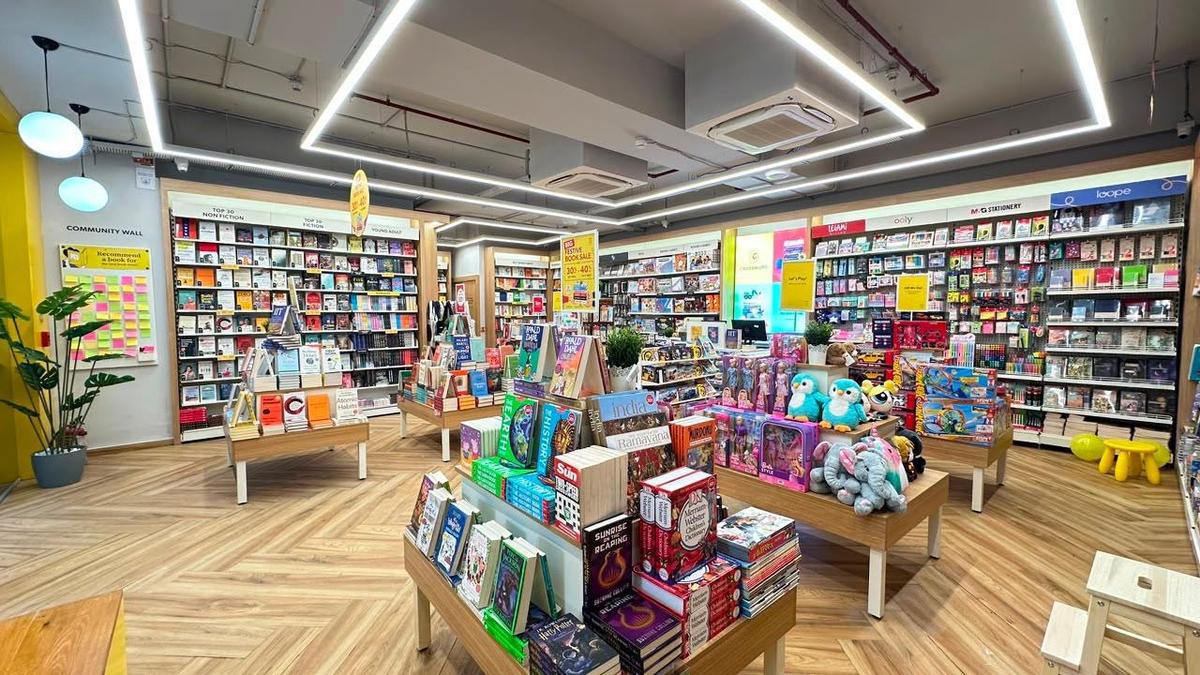
Nidhi Gupta, the executive director of Crossword, remains remarkably optimistic about the future of books and bookstores, despite the spectre of AI looming over the industry. “I believe people continue to crave a personal point of view, and a book meets that need in a way few other formats can.”This craving, Nidhi believes, comes from the intrinsic value we bestow on an original human voice. “When it comes to books, I think readers will continue to value the originality and perspective of a human voice,” believes Nidhi, an avid reader herself. “I don’t think books are going anywhere. There will always be readers.” It is why the bookstore chain, which has just opened its 133rd outlet in the country at Powai, Mumbai, continues to champion Indian literature with the annual Crossword Book Awards. Now in its 20th year, the brand recently announced its jury for this edition, which includes Manju Kapur, Samit Basu, Naresh Fernandes, Shrayana Bhattacharya, Meena Kandasamy and Ranjit Hoskote, among others.“We are really excited about celebrating the 20th edition of the Crossword Book Awards,” says the Pune-based Nidhi. As one of India’s leading bookstore chains, she says, “we believe we have the responsibility to help more people discover and recognise exceptional Indian writing.” Nidhi Gupta, the executive director of Crossword, continues to be optimistic about books | Photo Credit: Special Arrangement According to her, what started as a single award has expanded into 10 categories across multiple genres, divided into jury awards and popular awards. “As Indian publishing has grown across genres, the Awards have evolved with it. It is difficult to put very different kinds of writing under one definition of the best book or most popular book, so expanding the categories allowed us to recognise a much wider range of work,” she says. And while no awards framework can represent every genre, she feels that “there is a enormous amount of creative work that should be celebrated and talked about,” in the existing categories, which include fiction, non-fiction, business and management, children’s literature and translation.Over the last two decades, over 100 books have received this award, with several eminent writers, such as Ruskin Bond (2016), Sudha Murty (2017), Shashi Tharoor (2018), Amitav Ghosh (2024), and Shanta Gokhale (2025), also being conferred with the Lifetime Achievement Award.“Popular books naturally receive attention, but there is an enormous amount of excellent writing that readers may simply not encounter; the Crossword award brings that to the forefront,” says Nidhi. “If the Awards help a deserving writer find a wider audience and gain greater recognition, that in itself is a compelling reason to continue these awards.”Admittedly, the award landscape itself has changed in India, with many important literary prizes like the Shakthi Bhatt prize and DSC awards having been officially discontinued in the recent past. “That is also what pushes us to continue investing in the Awards and making them stronger. There are relatively few Indian literary platforms that have sustained themselves over this length of time and scale. International awards will always have enormous visibility, but Indian writing needs strong platforms of its own to be discovered, discussed and celebrated.” Indian writing needs strong platforms of its own to be discovered, discussed and celebrated, says Nidhi | Photo Credit: Special Arrangement Among the biggest challenges that Nidhi, who holds a bachelor’s degree in business administration and management from Carnegie Mellon University, has faced in her 15 years at Crossword is the transformation of the publishing landscape, with the proliferation of online bookstores. “When I joined, online was a much smaller part of the competitive landscape. That has changed dramatically,” she says. The challenge was also an opportunity for Nidhi, as she helped Crossword develop an omnichannel strategy that seamlessly integrated physical stores with digital platforms. “ Physical stores, however, remain at the heart of the business.” While an online marketplace does a great job of giving you the right product at the right time and is convenient, Nidhi says, “The physical bookstore is about discovery. You can walk into a store not knowing what you want, and walk out having found an author you have never read before, a topic you’ve never explored or met some like-minded people.” COVID-19, , seemed to have played a role in bringing people back to books and bookstores. “Of course, COVID-19 was an extremely difficult time for physical bookstores. During that period, however, we saw a renewed engagement with books and encouragingly, much of that interest continued afterwards,” says Nidhi, pointing out that in the West major booksellers are once again expanding their physical footprint. Author Ruskin Bond is one of the recipients of the Crossword Lifetime Achievement Award. | Photo Credit: Getty Images Closer home, there is also the impact of the many literary festivals held regularly in India all through the year, “something that as a reader, I look forward to and enjoy. “We see strong engagement and book sales at literary festivals,” agrees Nidhi, who firmly believes that despite people consuming content in so many different ways today, books continue to be relevant. “People are consuming podcasts, YouTube, audiobooks and many other forms of content. But these are complementary formats: there will be a time when you want to listen to something on your way to work, and there will be another time when you want to curl up with a book.”Continuing to increase the number of readers in the country, therefore, remains high on Crossword’s dreams, says Nidhi. “Our purpose is to enrich the world through the power of books, so getting more people to read - whether it is children, young readers or adults discovering a book they love - remains at the heart of what we do.”Expanding Crossword’s physical footprint, Nidhi says, is one way of doing this. “The idea is to keep adding stores in various formats: large flagships, but also smaller express and neighbourhood stores,” she says, adding that smaller stores allow the brand to cater much more closely to a particular community or neighbourhood. “We want to localise the experience as much as possible.”
Crossword’s Nidhi Gupta on why reading will never die
Full Article
Original Source
Read the full article at Thehindu →KhanList aggregates and links to publicly available news content. We do not host full articles from third-party sources. Always verify important information with original sources.