
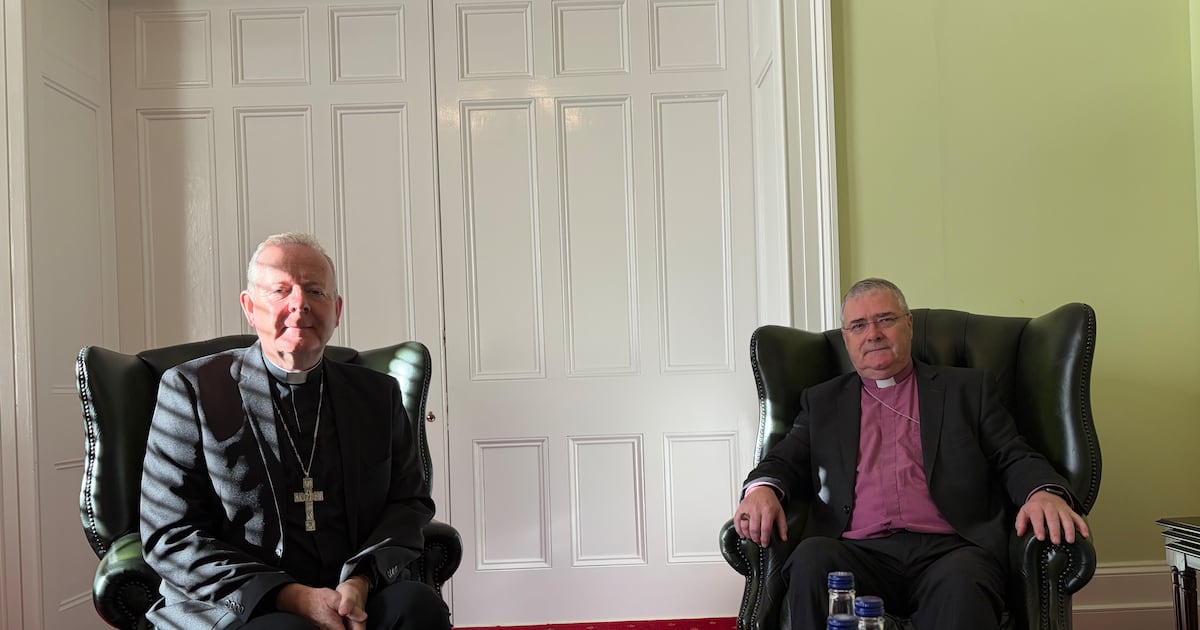
Everyone in Northern Ireland must work together, temper language and offer time for solutions to ensure the Drumcree crisis does not “derail the peace process”, two church leaders have said.In a joint interview with The Irish Times, Catholic Archbishop Eamon Martin of Armagh and his Church of Ireland counterpart John McDowell said the situation was very fragile and needed to be handled with great sensitivity.Though both men praised the lack of violence and the moderation in language used by Northern politicians since the weekend, they warned Drumcree still has the potential to derail the peace. “It’s incumbent on all of us: church leaders, community leaders, civic leaders, politicians and, indeed, people on the ground to ensure that we don’t let that happen,” said Archbishop Martin.READ MOREThe legacy left by the 1990s violence means the Portadown parade is different from hundreds of others that take place across Northern Ireland each year, said Archbishop McDowell.“It’s hard to believe when you look back that it happened. It was so intense, the violence was so great; the numbers of troops, the numbers of police – that traumatised communities,” he said.Warning of the damage that can be caused by social media, Archbishop Martin said: “It can inflame, it can teach our children and teenagers the same kind of bigotry and sectarianism that we’ve been trying to overcome for years.”Orangemen and supporters blocked by police outside Drumcree church on September 27th. Photograph: Charles McQuillan/Getty Images His Church of Ireland counterpart said he believed there was hope that most parents are insulating their children from the bigotry.“They don’t want them to be affected,” said McDowell.The two church leaders agreed the crisis has shown that most of Northern Ireland’s peace efforts over the last 30 years have been on safeguarding Stormont’s political institutions and too little on reconciliation.Good work has been done by many good people, Martin said, but too often it has “been small, it’s been local”, while British legacy moves have not helped since they were “naive and wrong”.[ There are more than two sides to DrumcreeOpens in new window ]“When you mention Garvaghy Road and Drumcree to people in Ireland and, indeed, other places around the world, they will immediately think of the parade. Drumcree is different,” he said.“It has become emblematic of the worst that can happen with parades here. It has become a crucible in which a lot of other hurts, difficulties, traditions and tribalism are vented.”“To open this one up again before we have got deeper understanding and deeper confidence and trust in each other was always going to be very difficult,” the Catholic archbishop added.This year’s crisis came out of the blue, the two church leaders said, in advance of a weekend where both have asked their parishes for special prayers.“I don’t think anyone anticipated there would be a push towards actually having a march,” said Martin.“The Garvaghy Road community believed the Orange wanted to keep point alive, but no more. People didn’t feel this was a live sore that had to be healed.”Elsewhere in Northern Ireland, communities have reached local accommodations on parades, he said. “That was a sign of a new spirit of better community relations on the ground that had emerged,” he said.People had begun to drop their “neuralgic worries” about the dangers they posed, he said.“There was a strong sense that people had reached a way of living that allowed these to happen,” he added.[ From local row to peace-process shambles: How the Drumcree standoff developedOpens in new window ]Urging tempered language, Martin said: “It is imperative on us as Christians to spread the message of forgiveness, healing, reconciliation, peacemaking – that’s our vocabulary.”Defending the local Church of Ireland rector in Drumcree, Rev Galway, Archbishop McDowell said he has built “very strong relationships” with the local community and immigrants. “He’s someone who wants to do his best,” he said.Drumcree’s church service last Sunday was a normal Sunday service, and had nothing to do with the parade.“Some of the Orangemen came in, yes, but they took their collarettes off; they came in to worship,” he said.The Orangemen did stay overnight once in the hall next door, but have since slept in cars. The hall is not owned by the Church of Ireland but held by local trustees.Significant abuse by email and online letters has been received.[ Claim Orangemen must march on Garvaghy Road because of tradition ‘a nonsense’, former SF staffer saysOpens in new window ]“The people who would email me and say: ‘Kick the Orangemen out,’ are nearly all from Dublin 4, and have no idea of what that would mean”, McDowell said.“And I have the other set of emails that say: ‘I believe you’ve knocked the Orangemen out of Drumcree church, or Drumcree hall.’ The parish is trying their best to hold a space open, so that there can be a good outcome,” he said.“The way things have been handled there has been genuinely open. They’re not pro one thing, or pro another. It’s simply a small Christian community who want to try to get a peaceful solution, and are doing all they can to do that,” McDowell added.“Most people will see that there’s no partisanship there. But it’s an absolutely incontrovertible fact that lots of small country parishes in Northern Ireland have lots of Orangemen as parishioners. “But first and foremost, they are parishioners,” he said.
Crisis must not ‘derail’ peace process: church leaders urge restraint over Drumcree
Full Article
Original Source
Read the full article at Irishtimes →KhanList aggregates and links to publicly available news content. We do not host full articles from third-party sources. Always verify important information with original sources.