
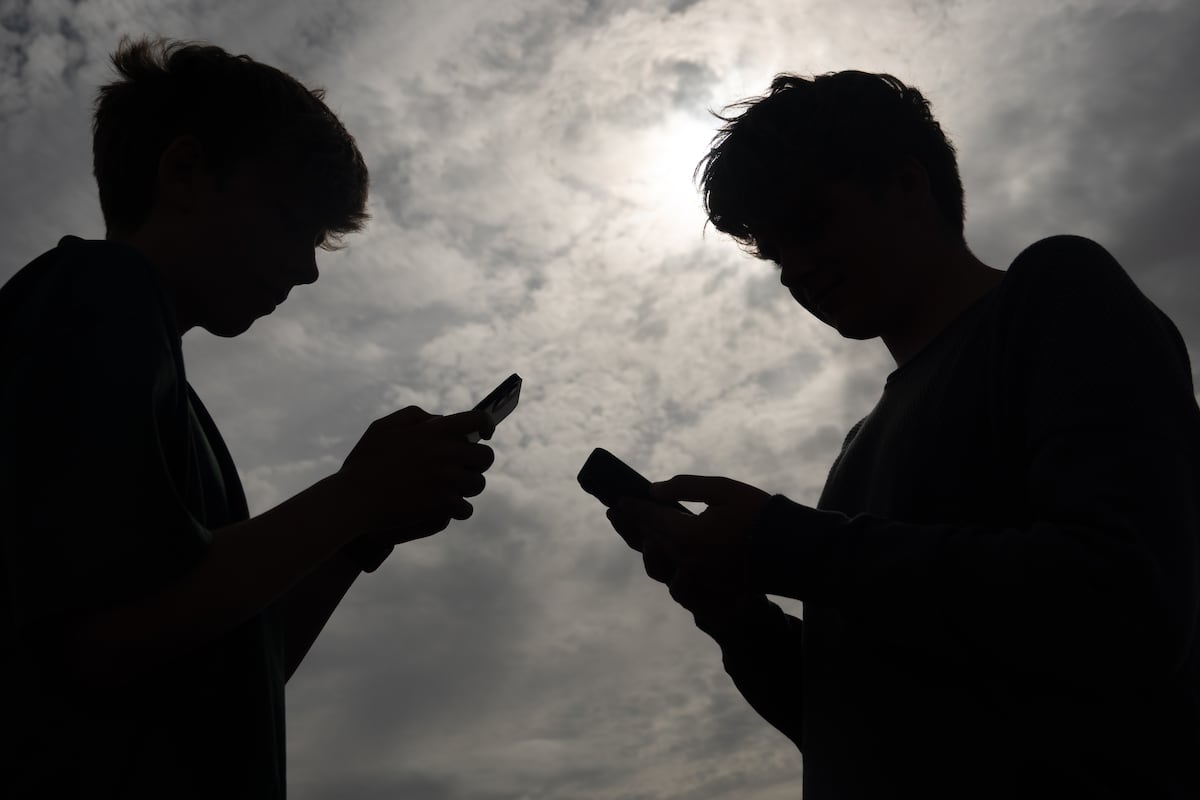
“I feel like ‘cringe’ has ruined social media,” says Toni Hernández, a design student born in 2007. “I remember, when I was nine or 10 years old, I watched YouTubers who talked about video games, graphic novels, or anime. Those creators had a cooler way of expressing themselves; they were funnier, they gestured a lot… but today, they would be considered nerds.” Hernández is very young. And yet, he already feels nostalgic for a time when every post didn’t involve (as it has for him, his peers, and his online role models in recent years) confronting and navigating an abyss: the abyss of cringe.So, what exactly is cringe? Well, the official definition is a very particular kind of embarrassment: the kind you feel when witnessing someone else’s clumsiness, ridiculous behavior, or an inappropriate comment. And that fear of causing cringe or secondhand embarrassment makes many Gen Zs freeze up: they refrain from posting certain things and meticulously fixate over what they share, fearing others’ reactions. It’s not just about avoiding controversial topics or inflammatory messages. Cringe depends less on the content of the posts than on the accompanying gestures: an overly enthusiastic way of speaking, or a level of sincerity and exposure that could — at any moment — be considered over the top. “I guess before, you didn’t really understand the side effects of posting your whole life on social media… and now you do,” says Paula Sánchez, 23. She’s also a design student. She adds that, nowadays, “when someone shares their life on social media, they’re considered very ‘millennial.’” This phenomenon is especially disconcerting for members of Gen Z. Millennials were the first online teenagers. They quickly became accustomed to sharing almost all their thoughts and memories on MySpace, then on Twitter and Facebook, and, finally, on Instagram (a platform where many of them still maintain profiles, with an endless mosaic of images that accurately depict their biographies).Many users don’t quite understand what cringe is. And they’ve never experienced that feeling of anticipatory embarrassment. However, they’ve already encountered its effects: social media profiles with no posts (DMs only); secondary accounts that branch out and link to even more exclusive ones; fleeting stories for a very small audience… Above all, cringe culture has led to a more homogenized internet, where almost no one dares to do anything. Content — once created by people — has been displaced by brand advertising (or brainrot) generated by artificial intelligence. There are now social media networks where there are hardly any humans left. For some teenagers, saying the word “cringe” is pretty cringe. But, despite this, there’s still an open debate: is the fear of being perceived as cringe ending online exhibitionism? Are we simply facing the same old harmless teenage insecurity (now a generational emblem)... or is this a powerful mechanism of social control with disastrous cultural — and even political — consequences?Shame and authenticity in times of hyper self-awareness“When someone talks about the fear of cringe, I think they’re talking about the fear of not fitting in, plain and simple. And that takes on different shapes throughout life,” Lorena Macías observes. She’s a publicist and the host of a podcast in Spain, Influ-Realismo Mágico, about the hectic lives of influencers. There’s a new awareness of the consequences of what’s published online. If, until recently, it was common to think that the virtual realm was different from reality — because it maintained a certain sense of autonomy that made it freer — nowadays, that concept has been reversed: it’s actually on social media where social norms manifest themselves most intensely. “Digital spaces [don’t] showcase the same norms that we see in the outside world; the standard of purity or impeccability is much higher [online]. There are comments that we all make in real life that we would never make on social media,” Macías explains. In Millennial Mal (“Bad Millenial”), a Spanish-language TV series released this past summer, actress, director and screenwriter Lorena Iglesias explores many generational misunderstandings. Her character, a 42-year-old librarian, is forced to live with university students who are two decades younger than her. Iglesias confirms that the fear of cringe is a constant both within her series (which reflects many of Generation Z’s concerns) and in her daily life with her younger co-stars. “It’s something that’s always been there, but now, it takes on a different form, amplified by social media. For example, Foucault already said that power is more effective when we internalize norms so much that we become our own enforcers,” the filmmaker comments. “[With cringe culture], it’s as if you incorporate the public’s gaze and monitor yourself. And that contradicts a culture that constantly demands authenticity, while socially penalizing those who reveal too much,” she continues.Cringe and authenticity are intimately related: in many cases, the former arises from failing to convincingly convey the latter. If the 1990s saw the rise of many narratives (paradoxically very profitable ones, like grunge, or the 1999 film Fight Club) in which the hero was someone who preferred self-immolation over sacrificing their authenticity for money, in our current era, success means capturing the attention of a potentially infinite audience… and somehow doing it without selling out.We live in a new decade of authenticity, as noted by sociologists like Hans Laguna — the author of Yo siendo yo (2026), a work of nonfiction translated as Me Being Me: Pop Stars and the Theater of Authenticity — and philosophers like Gilles Lipovetsky. In Lipovetsky’s 2024 book, La consagración de la autenticidad — translated as The Consecration of Authenticity — he warns that no part of society escapes the fetishism of authenticity: “The demand has even reached the sphere of everyday life. It’s about ‘being yourself’ in everyday consumption, in food [habits], travel, mobility, clothing, home decor, and in how you communicate [with others] and market products.”The most important thing about authenticity is that it feels natural… even though, as Macías observes, “We all know it’s a construct, especially on social media, where so many people exploit it. For example, I’m not saying that [an influencer] isn’t genuinely more spontaneous than [a fashion model], but I think [the influencer] capitalizes on their easygoing personality, that good-natured persona, because they know it connects with a much larger audience compared to the other’s stiff demeanor.” This relationship between the genuine and the organic (which evolves spontaneously on social media) means that, for a large part of the public, being “cringe” is associated with those who — very visibly — set ambitious goals for themselves.This is something that artists like Rosalía have rebelled against. She’s a proponent of enthusiastically sharing all the effort behind her creative process, And she’s also a fervent advocate of being herself, despite the possibility of embarrassment: “I’ve always kept going — I’ve never been afraid of being cringeworthy. I can be cringeworthy all day long, because [I’m never going to] stop doing stuff,” she recently declared. “What worries me most about cringe [culture] is [that there’s this] fear of seeming like you want something,” Iglesias elaborates. “Trying too hard to succeed can be embarrassing… but not showing enthusiasm for the things you do is even worse. Revealing desire on social media implies a certain level of vulnerability, because if you show that something matters to you, you give others the opportunity to judge you, reject you, or ridicule you. The fact that indifference or ironic distance is rewarded — the fact that this generates social capital and prestige — is something I really hate,” she concludes.The end of geek culture?“It’s impossible to appear on camera without being afraid of seeming cringey,” Hernández notes. “It’s an insecurity you can’t avoid. If social media was more chill, we wouldn’t have [this problem]… but now, everyone is chronically online. Before, only a handful of people were using it,” the design student comments. Again, while he’s very young, what Hernández is denouncing is something that numerous public figures and academics have lamented on many occasions: “Enshittification” has ruined the internet. In other words, the internet that was once a refuge for non-normative people or those with unusual tastes has disappeared. This shift is due to both technology monopolies and the arrival of ordinary people who (with their smartphones) brought the same dynamics of social judgment, popularity and norms from everyday life to social media.“The internet used to be a bit shabby; a bit dangerous, ugly. But it was also pretty unpredictable, because not everything was designed to appeal to you,” Iglesias points out. “People didn’t ask questions: they just uploaded things. Yes, there was a kind of sloppy aesthetic, but now, everything goes through a professional filter. [This means that] everything is much less spontaneous and creative. Even what seems spontaneous appears so in a strategic, very capitalist way.”“I miss feeling a little uncomfortable again,” Iglesias sighs. “[The internet] used to help you discover things. Now, you just have to put up with it.” So, while some lists — say, for instance, the ones that place films such as Camp Rock (2008) or Twilight (2008) at the pinnacle of cringe (clearly an iconoclastic move against the myths upheld by the previous generation) — are quite amusing, this whole movement is starting to have serious consequences. For instance, the online ecosystem is shaping up to be rather tedious. “The fear of being cancelled and the fear of cringe are very paralyzing,” Macías confirms. “With a few honorable exceptions — like [the Spanish musical duo] Estopa, who made a point of changing their profile picture to the LGBTQ+ flag, made with Microsoft Paint — after seeing some people’s reactions, there’s a sense of fear; people freeze up. Nobody wants to become a meme for not having the right taste.”Virtual shame is powerful. As philosopher Frédéric Gros points out in his book, A Philosophy of Shame: A Revolutionary Emotion (2025), it possesses certain tribal qualities, or those characteristic of “archaic shame,” such as “the objective nature of the opprobrium” (it’s not so much a feeling as a statistic, based on the number of followers or reactions), or the powerlessness of the victim who gets ridiculed online. So, is there any way to resist the fear of cringe? Macías believes there isn’t… at least, as long as we remain within networks whose algorithms demand an adherence to certain codes: “Even if we think that maturity allows us to view this with detachment, the truth is that we all think a lot about what we upload to Instagram. We may not always use impeccable aesthetic criteria or imitate influencers… but, consciously or unconsciously, everything on social media is filtered through our own lens of what we consider not to be cringeworthy.”For her part, Iglesias is more optimistic. She thinks the generational pendulum is about to swing. “I think that indignation is overcoming cringe. We’re seeing it in the public squares, with people taking to the streets en masse to express their outrage with shouts, chants, banners, and statements. All of that is also a form of exposure. And, because it’s collective and real, [when you’re] part of a community that validates your behavior the shame disappears.” That being said, on the internet, we’re still going to need to find a space to do useless, awkward, weird, or unexplainable stuff, without being judged. Sign up for our weekly newsletter to get more English-language news coverage from EL PAÍS USA Edition
‘Cringe has ruined the internet’: Why young people no longer want to share anything online
Full Article
Original Source
Read the full article at English →KhanList aggregates and links to publicly available news content. We do not host full articles from third-party sources. Always verify important information with original sources.