
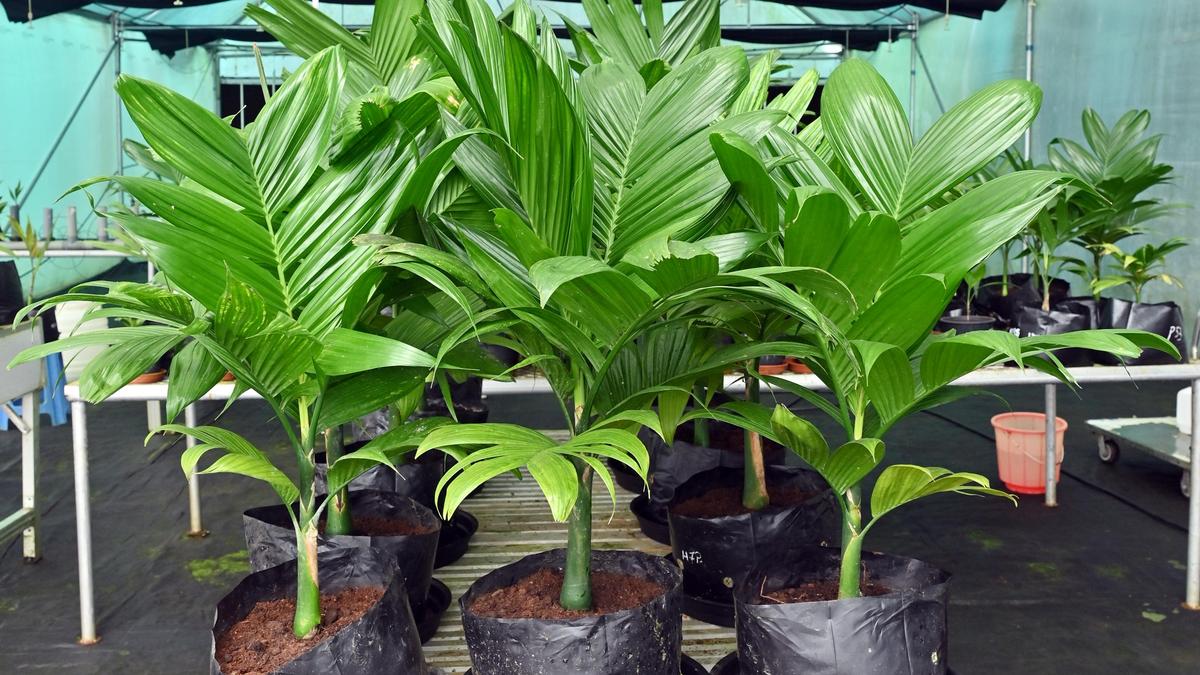
Tissue-cultured dwarf arecanut plants developed by the Central Plantation Crops Research Institute, under ICAR, Kasaragod, Keralam. | Photo Credit: Special arrangement The Central Plantation Crops Research Institute (CPCRI), Kasaragod, Keralam, under the Indian Council of Agricultural Research (ICAR), is set to conduct the first field trial of tissue-cultured dwarf arecanut plants developed by it.According to K. Balachandra Hebbar, director, CPCRI, about 100 hardened tissue-cultured dwarf plants, each one year old, are ready for planting.The first batch of 20 plants will be planted on the premises of CPCRI’s Regional Station at Vitla in Dakshina Kannada on October 5, he told The Hindu. The remaining plants will be planted in phases later this year at the same station.“It will take about two-and-a-half to three years to know the results of the field trial,” Mr. Hebbar said.He said the tissue-cultured dwarf plants are expected to start yielding within two years of planting. Each plant is expected to yield 2 kg to 2.5 kg of chali nuts, compared with 3 kg to 3.5 kg from tall varieties.Difference between hybrid dwarf and tissue cultured dwarfCPCRI had earlier released two hybrid dwarf arecanut varieties in 2007, VTLAH-1 (HD x Sumangala) and VTLAH-2 (HD x Mohitnagar).Their field trials revealed variations in yield. “There was no uniformity in yielding,” Mr. Hebbar said, adding that predicting output became difficult as plants yielded differently.The director said uniform yields are expected from tissue-cultured dwarf plants. More tissue-cultured dwarf plants can also be accommodated in a field compared to other arecanut varieties.Mr. Hebbar said that plantations of dwarf arecanut varieties would make harvesting and spraying easier for farmers. “Plant protection measures in plantations with dwarf plants will also be easier when compared to tall varieties,” he said. Published - October 02, 2026 07:53 pm IST
CPCRI set to conduct first field trail of its tissue cultured dwarf variety of arecanut plants
Full Article
Original Source
Read the full article at Thehindu →KhanList aggregates and links to publicly available news content. We do not host full articles from third-party sources. Always verify important information with original sources.