
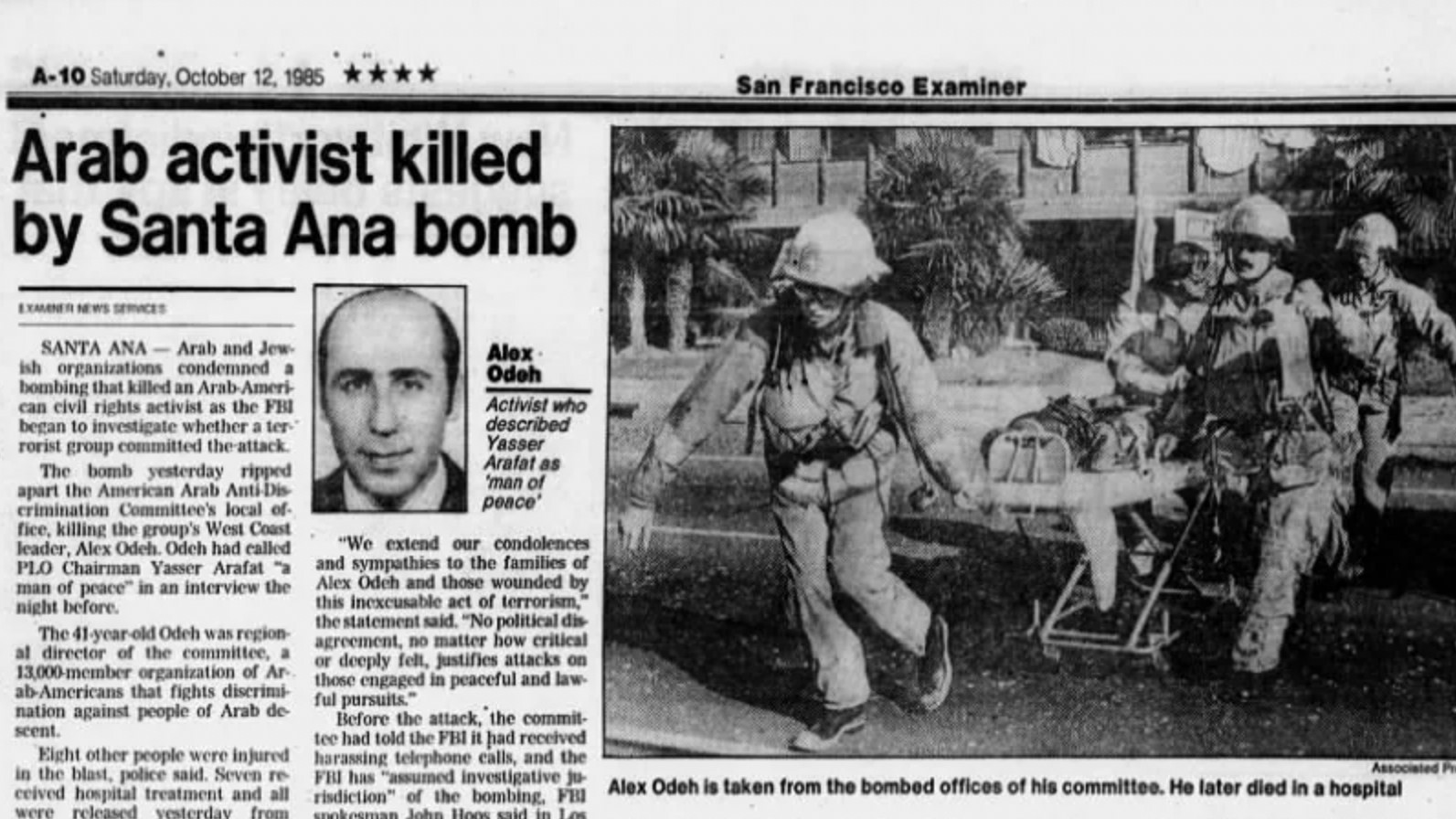
For years, mainstream media has been criticised for its failure to report accurately on Israel’s genocide in Gaza, allowing Israel to commit crimes with impunity. In July the UN special rapporteur for the Palestinian territories, Fransesca Albanese, released a report about the media complicity in genocide. Her report details how the systematic targeting of Palestinian journalists, Israeli media’s incitement, and the legitimisation from international coverage have facilitated genocide and obstructed accountability. Outlets relied heavily on Israeli sources, using the Hamas-led attack on Israel on 7 October 2023 to justify Israel’s subsequent onslaught and present the conflict as though it began exclusively with the attack. It was frustration with this narrative that prompted Maria Robles, an independent researcher and artist, to begin research into archival American newspaper stories. New MEE newsletter: Jerusalem Dispatch Sign up to get the latest insights and analysis on Israel-Palestine, alongside Turkey Unpacked and other MEE newsletters She wanted to “share the reality” of what was happening in Palestine through “public history and public memory - not based on opinion, but aggregating existing materials, existing research, existing journalism and making it as accessible as possible to the public”. Over three years, Robles collated more than 3,000 clippings from almost 700 papers dating from 1724 to 2023, using online archives and physical records, and in doing so, establishing Covering Palestine. Robles had previously worked on a research campaign to raise awareness about the history of slavery in New York using publicly available archive material. “Covering Palestine similarly is about education or access to it, being a tool. So is data,” she told Middle East Eye. “I think both of them move us toward liberation, one step at a time.” The website allows users to filter material by year, newspaper and subject, tracing patterns, names and key events. She hopes the archive will help the public understand Palestine’s history prior to 2023 and allow researchers and organisations to “look and understand, criticise and question how the information was shared, and talked about and reported on”. From 'colonisation' to 'settlement' “The media bias has always been there,” Robles explained, but the language used has changed with the times: for example, it was striking that Israel was discussed explicitly as a colonial project when the term was less of a dirty word. “Plan of colonising Palestine with Jews,” one New York Times headline announced on 6 January 1902. “Jews set up six colonies,” another said on 24 May 1939. In pictures: Life in Palestine from 1890 to 1937 Read More » In 1926, the Buffalo Jewish Review reported that “Jewish Colonisation will Extend Beyond Palestine Frontier”. Covering Palestine traces how the word “colonisation” became controversial and was replaced with “settlement”; a shift beginning in the 1920s, with the term having mostly disappeared by 1948. Today, critics accuse papers such as the New York Times (NYT) of routinely whitewashing Israeli imperialism, comparing headlines describing Israel’s illegal occupation of southern Lebanon as “cementing its foothold” or “plans to control” with much less euphemistic ones about the Russian invasion of Ukraine. In an NYT opinion piece, columnist Bret Stephens dismissed the description of Israel as a settler-colonial state as “invidious, hypocritical and historically illiterate” and called Zionism “the oldest continuous anticolonial movement in history”, contradicting how the paper he wrote in once presented it. The passive voice A 2024 study from The Intercept found a clear pro-Israel bias in mainstream media coverage, particularly the NYT, with outlets consistently applying a double standard when using emotive words such as “massacre” and “slaughter” to describe civilian deaths. During the first 100 days of the conflict following 7 October, the NYT used the word “massacre” 124 times to describe violence against Israelis and never against Palestinians; during the first year, CNN used it 225 times for Israelis and 16 times for Palestinians - despite a far higher Palestinian death toll. Palestinian deaths, meanwhile, are frequently reported on using the passive voice: a headline from the Washington Post read “Israel’s war in Gaza claims thousands of young lives”. Another stated “more than 1,000 people have been killed in Gaza during ceasefire, Palestinian authorities say”. This pattern is not new. On 29 October 1956, Israeli border police shot dead 48 unarmed Palestinian civilians, including 23 children, in Kafr Qasim, who were returning home from their fields for violating a curfew imposed by the Israeli army on the town earlier that day that they had not been informed of. Covering Palestine’s archive revealed all too familiar patterns of passive and euphemistic language The story was suppressed by Israeli military censorship for 44 days. Nothing on Kafr Qasim appears in the archive until 12 December 1956, the day David Ben-Gurion, the prime minister, broke his own ban and told the Knesset. Of the papers in the archive that carried the disclosure, not one put “massacre” in a headline, and it was not until 13 October 1958, after a military court had convicted eight border police, that the word appeared in a headline to describe the event. When reports eventually emerged, Covering Palestine’s archive revealed all too familiar patterns of passive and euphemistic language. “Israel Discloses Killing of Arabs In Curfew Tift” was how Oregon’s News Review reported on the incident on 12 December 1956. Meanwhile, the New York Newsday labelled it “Bare Slaying by Error of 48 Israeli Arabs”: indicating the event was accidental before any investigation had been opened. One New York Times headline said “48 Arabs Killed; Israel Penitent”. Alongside a scan of the clipping, Robles transcribed the headline, adding citations for researchers and linking to further context. She noted the NYT headline was the only one that led with the death toll, but used the passive “killed”, without naming the perpetrator, before turning to “the condition of Israel’s conscience”. Censorship In April 2024, a leaked NYT memo instructed journalists to avoid terms including “genocide”, “ethnic cleansing” and “occupied territory” in their reporting on the conflict. Robles noted that historical reports were often explicit about Israeli censorship: a 1980 NYT article declared “Israeli Censorship Strikes a Discordant, Insistent Note”, beginning “this dispatch has been subjected to Israeli censorship”. By contrast, she said, “now…the reporting has to rationalise, maybe not successfully…why they are reporting it the way they are”, repeating Israeli talking points without acknowledging them, such as “Israel’s right to defend itself” or claims Hamas uses civilians as “human shields”. The censorship of the Palestinian press was also reported on by the New York Times, detailing how “Israel Tightens Control Over Arab Newspapers” when Israeli authorities intercepted trucks and confiscated papers being transported for distribution in the West Bank in 1982. Today, Palestinians document the genocide committed against them directly through social media, reaching international audiences without their language being filtered through American media or Israeli censorship. However, Israel’s systematic targeting of Palestinian journalists has made Gaza the deadliest place to be a journalist. The early reports of Palestinian newspapers being shut down are reflected in Israel’s attacks on journalists today, Robles explained, “not allowing [Palestinians] the opportunity to do their own reporting or speak about what is happening”. Israel frequently labels Palestinian journalists “terrorists” to justify these attacks - lies that their western colleagues uncritically echo without adequate scrutiny. Dehumanisation Similarly, strikes on Gaza are often reported as “targeting Hamas”, regardless of civilian casualties, while death tolls are attributed to Gaza’s “Hamas-run health ministry”, casting doubt on their reliability. Yet long before Hamas existed, American papers used dehumanising language to rationalise Israel’s atrocities, diminishing their readers’ empathy for Palestinian victims. In July 1972, Palestinian novelist Ghassan Kanafani was killed alongside his teenage niece by a bomb planted in his car in Beirut. Reporting on his death, US news outlets presented him as an “Arab Militant leader”, “Revolutionary”, or “Palestinian Guerrilla”, with only one headline in 11 calling him an artist, according to Robles. Ghassan Kanafani: The life of a Palestinian writer Read More » A central motivation behind Covering Palestine was to humanise Palestinians by documenting their experiences across generations, including rare occasions when they were named or their lives and culture covered without the association with death and suffering. “That humanising of people…reminding [the public] that these are really people that these experiences are really happening to” is important to counteract the dehumanisation they face, Robles said. She also wanted to challenge Zionist myths that Palestine was a “land without people” or not a real country. The historical record reveals a people and community that existed for many years prior to Israel’s establishment: one clipping from 1891 described “the Fellaheen [peasants] of Palestine” as “an ancient and historic people”; similarly in 1910 they were referred to as “the aboriginal inhabitants of the Holy Land”. As genocide seeks to eradicate a people and their past, Robles wants to use Covering Palestine to preserve and expose the history of a place whose story began long before 7 October.
Covering Palestine: Historic news clippings reveal US media complicity in Israel's crimes
Full Article
Original Source
Read the full article at Middleeasteye →KhanList aggregates and links to publicly available news content. We do not host full articles from third-party sources. Always verify important information with original sources.