
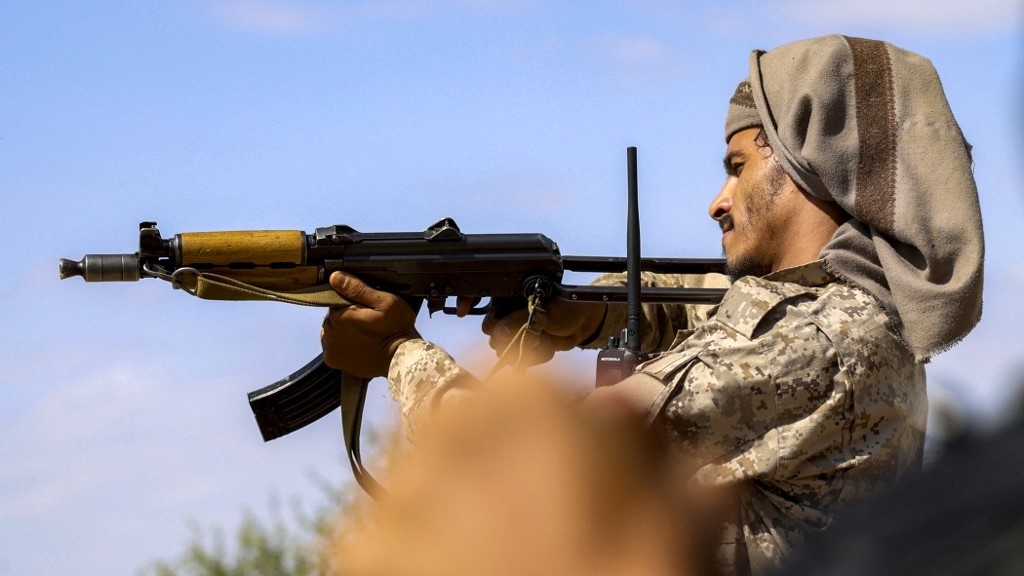
It wasn’t easy for Mukhtar, 45, to flee his home in the village where he was born and raised, 50 kilometres south of Taiz city. However, he felt forced to leave in 2019, believing that the Houthis (also known as Ansar Allah) were fighting for a noble cause in Yemen and that he needed to support them. Mukhtar had been living in an area controlled by the Saudi Arabia-backed government, and the prospect of staying there any longer had become dangerous. Many of his relatives, including his brothers and cousins, supported government forces, and he feared he might be detained, like so many others. “Many Ansar Allah supporters were detained or fled their villages; not just fighters, but civilians and sheikhs who supported them. So there was no choice but to flee my village and live in Ansar Allah-controlled areas,” Mukhtar told Middle East Eye. Back in his village, Mukhtar had worked as a farmer and part-time land broker, but he lost his livelihood when he fled. When he reached a Houthi area, he joined the group, convinced that they were driven not by money but by a desire to defend Islam. “Ansar Allah’s project is for the hereafter; they implement what is in the Quran rather than following the orders of foreign countries. Theirs is a project for the afterworld, not a project of mercenaries,” Mukhtar added. New MEE newsletter: Jerusalem Dispatch Sign up to get the latest insights and analysis on Israel-Palestine, alongside Turkey Unpacked and other MEE newsletters On 3 September, Houthi forces launched a heavy offensive against government troops in southern Hodeidah and the western district of Taiz, seizing large areas of both governorates. On 4 October they launched another major attack, capturing the remaining areas of Taiz that had been outside their control, leaving only Taiz city and parts of Jabal Sabir in the hands of government forces. Mukhtar took part in these battles gladly, seeing them as a chance to finally return home after seven years of displacement. 'One of [war's] ugliest faces is seeing brothers and cousins fight each other' – Abdulrahman, 64, an uncle of warring cousins “Ultimately, it is Allah who granted us victory because of the justice of our cause, and whoever stands with Allah, He will never forsake,” he said. Mukhtar is now back in his village. However, as soon as he arrived alongside Houthi forces, his cousin Mohammed fled. As a fighter with the government forces, Mohammed feared that if he stayed, Mukhtar would not leave him to live in peace. Mukhtar insists he would not harm him, pointing to a "general amnesty" declared by the Houthi leadership for those who lay down their arms and return home. The Houthis and pro-government forces backed by the Saudi Arabia-led coalition have been fighting in Yemen since 2015, but over the past two months Houthi forces have made dramatic advances and are now around 60km from Aden, Yemen’s temporary capital. While some government fighters have stopped fighting and returned to civilian life, many others, like Mohammed, continue to fight alongside government forces in Lahj governorate. 'We must accept different beliefs' Mohammed, 37, who spoke to MEE by phone, opposes the Houthis and believes they have come to alter the religious "doctrine" of the people in his area, accusing local fighters like his cousin of being "traitors". “It is true that the Houthi militia took over large areas in a few days, but that was only because of the traitors who helped them do it,” he told MEE. “We are still fighting, and what was lost in a few days will be taken back in a few days, and all traitors will meet their proper punishment.” As soon as the Houthis enter an area, not only fighters but many other opponents flee towards government-held areas, fearing they will be arrested if they remain under Houthi control. When asked about fighting his own cousin, Mohammed replied: “He isn’t a cousin any more, since he stood with the militias against his family. “We were in our homes and didn’t exile anyone; those who supported the Houthis fled on their own to fight alongside them, not because we forced them out,” he added. 'We were in our homes and didn’t exile anyone; those who supported the Houthis fled on their own to fight alongside them' – Mohammed, government supporter “If not for the Houthis, we would still be enjoying peace together in the same village. It is the Houthis who brought battles and hatred to our village.” Abdulrahman, 64, an uncle to both Mukhtar and Mohammed, believes the war has brought out the worst in society, saying that “one of its ugliest faces is seeing brothers and cousins fight each other”. “It isn’t easy to see my nephews fight each other, or to see other sons of the village fighting one another,” he told MEE. “This is not the life we should be living. We are one community and must accept each other, even if we hold different beliefs. Fighting only brings the worst consequences.” Abdulrahman noted that since 4 October, when the Houthis took over the village, new faces among the local youth have come from Houthi-controlled areas, while familiar faces have fled, a shift that deeply saddens him. “It isn’t easy for people to flee their homes, and it isn’t easy for us to see our relatives absent, unable to meet each other because of political affiliation,” he said. These two fighters are just one example of "enemy cousins". Even among senior government officials, some have brothers who have worked with the Houthis for years, reflecting how Yemenis within the same family hold sharply divided loyalties. Among the high-profile "enemy brothers" frequently cited on social media are the government’s chief of staff, Saghier bin Aziz, whose brother, Hamoud bin Aziz, is a Houthi leader. Another example is Najib Ghallab, undersecretary of the Ministry of Information for the internationally recognised government, whose brother, Abdel Fattah Ghallab, is also a Houthi leader. War dragged into homes Journalist Oday Al-Dukhaini, who covers the fighting in Yemen, said the war has not only divided cousins, it has torn brothers and whole families apart. “We now see members of the same family standing on opposing front lines, sometimes even taking up arms against their own relatives,” Dukhaini told MEE. ‘Death is closer than school’: Yemen’s children struggle with war trauma Read More » “This is deeply painful, because the war has dragged conflict from the political arena directly into people's homes, damaging relationships built on love and kinship over many years.” Dukhaini emphasised that numerous factors drive individuals to join the fighting, including political and ideological differences, harsh living conditions, and financial need, alongside mobilisation and incitement. Sometimes, a person may not even hold a clear political stance, yet finds themselves aligned with one side due to their circumstances or environment. “The solution begins with wise elders within the family stepping in to contain the dispute and open the door for dialogue, away from accusations and charges of treason,” Dukhaini added. "Most importantly, everyone must realise that no matter the disagreement, it is never worth turning blood ties into enmity or blood feuds that last for years." He noted that the war has not only destroyed homes and roads; it has eroded trust within the community. “Some have begun judging their relatives based on their political stance or the faction they fight for, rather than seeing them as members of their own family and community,” he said. “Today, we need to mend social relationships above all else; wars may eventually end, but the scars of hatred and estrangement can linger for years.” Blood ties Sociologist Hayel Saeed said that while the war might end militarily, its social and psychological impacts could persist for decades if left unaddressed. “Today, we don't just need a ceasefire; we also need to halt hate speech, incitement and accusations of treason, and restore the values of tolerance, solidarity and coexistence,” Saeed told MEE. He stressed the importance of reminding parents, social figures, community leaders and elders that their responsibility today goes beyond protecting their families from the physical dangers of war; it also includes safeguarding relationships among their children from disintegration and hostility. “Your cousin who disagrees with you politically remains your cousin and your relative. A difference of opinion does not cancel out blood ties, nor does it give anyone the right to assault another,” Saeed said. “Yemen does not only need the war among its people to stop; it needs its people to reconcile with one another and learn how to disagree without turning into enemies."
Cousin fights cousin as war in Yemen splits families down the middle
Full Article
Original Source
Read the full article at Middleeasteye →KhanList aggregates and links to publicly available news content. We do not host full articles from third-party sources. Always verify important information with original sources.