
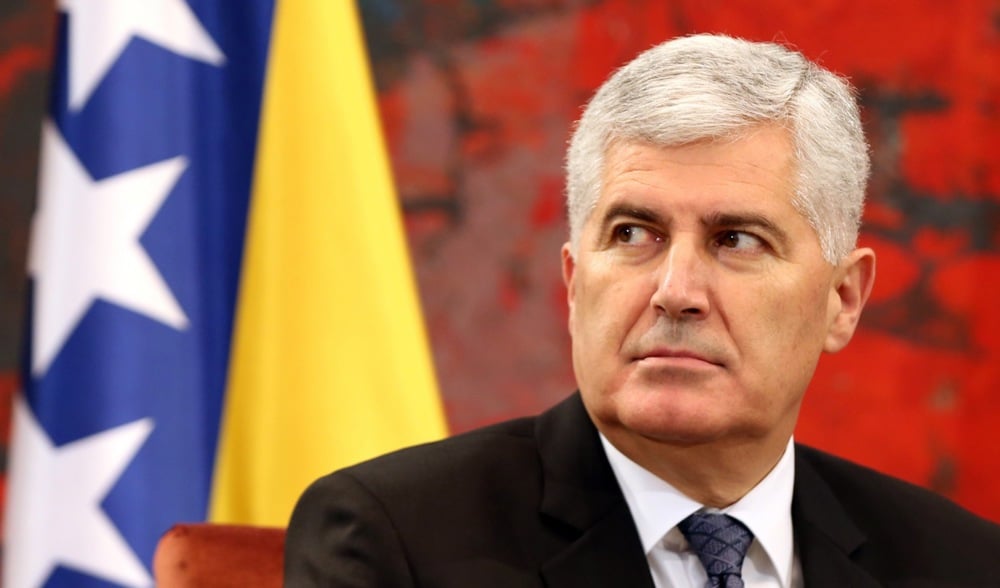
The main Bosnian Croat political party has signed a contract with an American lobbying firm as it pushes for a political power boost for Croats in Bosnia and Herzegovina - and seeks to make its voice heard on the US-backed Southern Interconnection gas pipeline project. Ahead of parliamentary elections in October, and with the Trump administration showing strong interest in energy projects in the country, the main Bosnian Croat party, the Croatian Democratic Union of Bosnia and Herzegovina (HDZ BiH), has signed an agreement with the US government relations and strategic communications firm Mercury Public Affairs. The contract, which was publicly disclosed through the US Foreign Agents Registration Act (FARA) and signed on July 24 by HDZ BiH leader Dragan Covic, states that the engagement costs $30,000 per month, excluding taxes. Foreign policy journalist Harun Karcic, founder of the Initiative for Strategic Analysis, said the contract is connected to upcoming elections in which HDZ BiH is aiming for political dominance among Bosnian Croats - as well as “strong pressure from the US administration regarding the Southern [Gas] Interconnection – a project that Washington views as a key issue of energy security and reducing dependence on Russian gas in this part of Europe.” Karcic believes that through its engagement of Mercury Public Affairs, the HDZ BiH is seeking to promote its position that a new company should be set up in Mostar - the centre of Bosnian Croat political power, where the party has its headquarters - to manage the planned gas pipeline. The party is seeking to frame its wish as a matter of constitutional balance rather than an obstruction of a US strategic project, Karcic says. Political analyst Kurt Bassuener of the Democratization Policy Council think tank, views the contract as the HDZ BiH's formal entry into the lobbying game in the US and as an attempt to influence American policies toward Bosnia and Herzegovina in line with its agenda. He noted that Republika Srpska, Bosnia and Herzegovina’s Serb-majority entity, has made use of Washington DC lobbyists since 2007. The results of such lobbying was made clear last year when sanctions against Bosnian Serb political figures such as former Republika Srpska President Milorad Dodik, his family and others were lifted. According to Bassuener’s calculations, Republika Srpska has 15 entries in the FARA registry, which he considers excessive given that it is a territory of likely fewer than one million inhabitants. The Ministry of Foreign Affairs of Bosnia and Herzegovina, in contrast, has only recently entered this lobbying sphere – without any significant results. “It is quite clear that the HDZ BiH wants to gain greater influence in the already favourable environment of the reactionary Trump administration,” Bassuener told BIRN. In February 2026, the Heritage Foundation, a prominent Washington DC-based conservative think tank, published an article by researcher Max Primorac titled “An Islamist State on NATO’s Border?” The article claims that Muslims in Bosnia and Herzegovina reject the idea of political equality with Serbs and Croats, and that the administration in Sarajevo should “stop repressing its Christian neighbours” – meaning the Serbs in Republika Srpska and the Bosnian Croats. The Heritage Foundation also published a report by Primorac in 2025 that claimed that the Office of the High Representative (OHR), the international overseer of the implementation of the peace deal that ended the 1992-95 war, is the main cause of Bosnia and Herzegovina’s political dysfunction and has become an “imperial administrator” that undermines domestic sovereignty. Bassuener said that within the European Union, much of this agenda can be pursued through the European People’s Party (EPP), of which Croatia’s HDZ is a member, together with its branch in Bosnia and Herzegovina. This plays a significant role in their agenda, he said, given that Bosnia and Herzegovina is effectively Croatia’s only major foreign policy issue. ‘American power for sale’ President of HDZ BiH Dragan Covic, member of the European Parliament Zeljana Zovko, and Croatian Minister of Foreign and European Affairs Gordan Grlic Radman. Photo: mvep.gov.hr.For political analyst Tanja Topic from Banja Luka, it is obvious that Covic listened to his political ally Dodik and followed in his lobbying footsteps. According to her, Dodik’s experience is valuable, and every opportunity to capitalise on American support for Christian values is being used. “Of course, the work of lobbying firms should not be equated with the positions of the State Department, nor should we blindly believe domestic spin masters who equate these activities with ‘friendship with Trump’,” Topic said. “The purpose of these activities is to lobby for the ‘Croatian issue in Bosnia and Herzegovina’, which implicitly points to a connection with the elections, while the second part concerns the biggest current US interest in BiH – the Southern Interconnection.” Adnan Huskic, a professor of political science and international relations at the Sarajevo School of Science and Technology (SSST), previously told BIRN that this move by HDZ BiH is logical. “It is clear that everyone has seen that American power is for sale,” Huskic said. “So they are doing this to increase their standing and their chances for any future plans.” Karcic says that what Covic wants from Mercury Public Affairs – crisis communications and public affairs experts who can navigate the corridors of Capitol Hill – is to promote the following argument: “We are not against American gas, we are for American gas, but we want it to be managed by an organisation based in Mostar in order to ensure institutional equality.” According to the signed contract, Mercury Public Affairs is also committed to strengthening the HDZ BiH’s relations with institutions and representatives of the United States, NATO, the European Union and “other relevant international stakeholders”. For Karcic, in the language of lobbying in Washington, this is a classic “pro-Western shield”. Karcic noted that the inclusion of a commitment to NATO, the US and the EU creates the impression for American decision-makers that the HDZ BiH is a stable Euro-Atlantic partner. He said this is crucial for the party because it neutralises accusations that its tactical partnership with Dodik’s Serb nationalist party SNSD is weakening the country’s pro-Western course. “This is an attempt to brand the HDZ in Washington as a bulwark of Western values in Bosnia and Herzegovina, conveying the message that internal stability – as they see it, through Dayton and the constituent peoples [Bosniaks, Croats and Serbs] – is actually a prerequisite for the overall security architecture of this region,” Karcic said. Bassuener considers the contract fairly standard and noted that it contains reference to the “equality of constituent peoples” and the “preservation of peace, stability, territorial integrity and the multi-ethnic character [of Bosnia and Herzegovina]“, as well as a target of presenting the HDZ BiH’s positions to the US government, elected representatives, the media and the wider public. “However, it is considerably less explicit than statements already publicly available regarding a third entity, the ‘discrimination’ against Croats, electoral reform and similar issues,” Bassuener said. Lobbying against Dayton Max Primorac, a senior research fellow at the Heritage Foundation’s Margaret Thatcher Centre for Freedom. Photo: US House Foreign Affairs Committee hearing. Representatives of the Heritage Foundation have lobbied members of the European Parliament, and one of these MEPs subsequently advocated for a revision of the Dayton Peace Agreement. The foundation also organised TradFest in Zagreb in April 2026, which was described on its official website as a “festival of tradition and conservative ideas, in opposition to so-called ‘progressive’ and militant-secularist ideas and policies that seek to destroy the original traditional, conservative and Christian foundations of culture in Croatia, Europe and the Western world.” One of the events at TradFest was titled “Bosnia and Herzegovina: A Failed State and the Necessity of a Third Croatian Entity”, where a map depicting the division of Bosnia and Herzegovina into three republics – Serb, Croat and Bosniak-Muslim – was presented. TradFest was supported by European Parliament member Zeljana Zovko, who is responsible for communications with organisations like the Heritage Foundation on behalf of the EPP. She told BIRN that she does not consider a revision of Dayton to be a realistic option at present. “I advocate for the full implementation and respect of the Dayton Agreement and the spirit of the Dayton Agreement. It is not being respected. If it were, Croats would have their own member of the presidency and would have a fair electoral law. To revise it, you need the other two peoples on your side. The Serbs would not agree to that, and the Bosniaks in this set-up would not agree to a more profound revision either,” Zovko said. Croatian Foreign Minister Gordan Grlic Radman said during a visit to Bosnia and Herzegovina that Zagreb would “not get tired” of its demands to amend Dayton and would continue discussing with the EU and US the need for limited constitutional changes and amendments to the election law so that Croats in Bosnia and Herzegovina could exercise their rights. Karcic says that with this move, the HDZ BiH is making it clear that it does not believe Bosnia and Herzegovina’s embassy in Washington DC or the Ministry of Foreign Affairs can or want to represent its specific political objectives. He said it shows the adoption of a model that has been used in Republika Srpska for years – where entity or party funds are used to hire FARA-registered agents to pursue a parallel foreign policy. “This is a shift toward a more aggressive, Western model of lobbying, where influence is simply bought on the market,” Karcic argued. “In the long term, when political parties conduct separate, private lobbying campaigns in Washington with competing narratives, this further undermines the cohesion of the state and creates an image among foreigners of a deeply fragmented society in which there is no minimum consensus on any strategic issue,” he concluded.
Courting Trump’s Allies, Bosnian Croat Political Party Signs US Lobbying Contract
Full Article
Original Source
Read the full article at Balkaninsight →KhanList aggregates and links to publicly available news content. We do not host full articles from third-party sources. Always verify important information with original sources.