
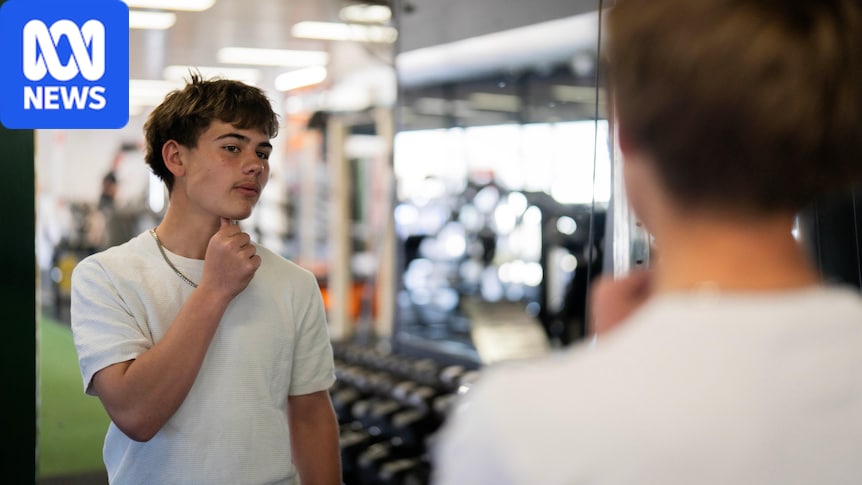
When Jackson Hoober opens his TikTok, he gets "country boy stuff".Motorbikes. Cars. Work-out tutorials. But today, the 15-year-old's phone is playing up."Broke it after taking it in the shower this morning," Jackson admits with a bashful grin. After a few scrolls, the app is back working normally, and the videos start to change. One account Jackson follows is controversial fitness influencer Shane Stoffer, known online as TOGI. (ABC News: Maren Preuss)Steroid use. Gambling. Some of it makes Jackson laugh; some he calls "stupid". But a lot of it resonates with him."Get better looking, bigger muscles, stronger," he says.Jackson works out regularly and says his weightlifting motto is "curls for the girls". (ABC News: Maren Preuss)Like his parents before him, Jackson is growing up in the regional Victorian town of Maryborough, about halfway between Ballarat and Bendigo.He is president of a local youth volunteering group and wants to be a diesel mechanic when he leaves school.Jackson is also deep into "looksmaxxing" culture, and hopes it will help him with "getting the girls".Maryborough has about 7,500 residents and has battled unemployment and disadvantage for decades. (ABC News: Maren Preuss)His mother, Kate Hoober, says there's lots to love about her small town, which has a closeness that allows kids to roam safely around town.She's more worried about virtual dangers and how they're rubbing off on her son, who lives on the spectrum and with ADHD."You walk past and he's [Jackson's] looking through a window or a mirror … checking to see whether he's up to the standard … of social media," she says."He's got to be strong … he's got to have the abs."Kate and Jefferson Hoober have upheld a family tradition of volunteering and giving back to their community. (ABC News: Maren Preuss)Jackson has showed his mother some of the more extreme elements of looksmaxxing, like "bone-smashing". The controversial trend involves deliberately striking bones in the face in an attempt to create micro-fractures to "reshape" the jaw. Jackson's friends can't get their heads around that. Jaden Gourlay (centre) and his brother Jerry moved to Maryborough about three years ago. He says expectations around physical appearance in the country are "more laid-back". (ABC News: Maren Preuss)"I don't see the point," his mate Jaden Gourlay says."What's the point in hurting yourself just to make yourself look good?"Jackson isn't opposed to the idea, but hasn't tried it. Yet."I do see the point, because pain is beauty," he saysJefferson Hoober started at his local IGA as a trolley boy as a teenager. Now he's the store manager. (ABC News: Maren Preuss)When Jackson's dad, Jefferson Hoober, was a teenager, Maryborough had a go-kart track and arcade parlour.Now, he says, kids are more likely to be glued to their phones than building bush cubbies."I never grew up with that [social media]. I don't understand it," he says."You just got to hope you've educated your children the right way, that they can speak to you."Jefferson Hoober says young men can get further in life with "their hearts" than their looks. (ABC News: Maren Preuss)Jackson thinks his dad's generation doesn't really get it."They call us girls or something when we try to make ourselves look good … I think they [used to] just scruff themselves up and say, 'Looks alright,'" he says."We've always grown up with, 'Oh, boys are gross.'"Now we want to smell good, look good, dress well, have good haircuts."Jackson watches looksmaxxing videos and says some of the advice has improved how he looks and feels. (ABC News: Maren Preuss)Misogyny creeping into classroomsAn hour's drive away in Bendigo, Emily, a mother of two boys, says she is terrified at the way the manosphere's crept into her family's life.She's banned her 12-year-old son from social media, and keeps the phone out of her 17-year-old son's room at night."It just feels like every gain that women have made in my lifetime, let alone, you know, my grandparents', my parents' lifetime, has just been completely undone before our eyes," she says.Andy is not allowed to have social media on his devices. (ABC News: Maren Preuss)Emily and her 12-year-old son Andy, not their real names, spoke to the ABC on condition of anonymity due to his young age.Andy says bullying in the primary school playground over how boys look and act is common, and he's already witnessed boys doing "bad stuff".Last year, some boys in his grade 5 class were caught ranking girls on their appearance."They [the girls] were pretty disgusted by that," Andy says."It's really sad to see that stuff happening. We're supposed to be innocent."Andy's school sent parents an email saying teachers had warned the boys the language was unacceptable."It appears that some of this language has been picked up from YouTube and other social media platforms," the email read."At school we will be reiterating the importance of kindness, respect and inclusive language."Emily says "macho" attitudes have worsened in the five-year gap between her sons."I feel like things are becoming more extreme towards misogynistic, racist, homophobic with this generation that's coming up," she says.Emily is a mother of two boys, 12 and 17, in the central Victorian city of Bendigo. (ABC News: Maren Preuss)Josh Glover, who works with young men and boys at mental health charity The Man Cave, says he's noticed the language of the manosphere creeping into the vocabularies of boys as young as 10."When we work with primary school boys, they're saying the exact same stuff that all … the manosphere guys are saying," he says."They have no clue what it means. "Often it's highly sexualised in nature and very degrading towards women."Josh Glover says parents whose boys use language associated with the manosphere should approach them with curiosity rather than judgement. (ABC New: Nico White)Emily says she's learnt to be vigilant about what her sons are exposed to, and discusses it with them regularly."I think parents 100 per cent have a responsibility to understand what kids are looking at," she says."I regret not knowing more about this earlier, to be honest."Commissioner for Domestic and Family Violence Micaela Cronin believes toxic content online is fuelling an increase in violence and sexual assault."We are seeing very fast changes in young men's attitudes that are driven by what they are being served up on social media often through their own very harmless engagement."She says the manosphere has not only played a role in the rise of violence perpetrated by young men, but also towards young men."What we are absolutely hearing … is an increase in violence. I do think that it is changing and that it is happening pretty fast."Caught in 'the rip'Talking to his mum has helped Andy learn about how algorithms guide boys into misogynistic content."That's the really dangerous thing that — it's kind of like a rip in the ocean, like you don't even realise you're in it until you're so far out, you can't swim back in," Andy says.Daniel Noble, 18, was caught in that rip.Daniel says from age 11 he was being influenced by the manosphere. (ABC News: Maren Preuss)He says he fell into a body "shaming culture" at the end of year six.Daniel started watching "healthy" and fitness-focused influencers, and says it kickstarted an obsession with working out."The kind of general undertone of, 'You should feel bad about your body,'" he says.Daniel says the influencers he followed seemed "healthy", but often espoused negative views. (ABC News: Maren Preuss)Daniel says the influencers promoted "unobtainable" bodies, and used language that "punched down".Words like chud (cannibalistic humanoid underground dweller) have become commonplace with teens, he says."It's used to describe someone who kind of struggles socially, is often a bit overweight, struggles with relationships," Daniel says."It's an insult that in general means, you know, 'What are you doing with your life?'"Daniel believes fewer diverse male role models in the country leaves regional boys more vulnerable."In urban environments, there's just so many more people, that I think the constant exposure is likely to decrease this kind of radicalisation," he says.Daniel says even joking insults can leave boys feeling like they don't fit in. (ABC News: Maren Preuss)Looking for the answerJosh Glover from The Man Cave says the trust placed upon boys in tight-knit regional communities can be a double-edged sword."Because the community's small, which is one of the gifts of the community, it's also one of the challenges that you only see a few kinds of examples of what a healthy man can look like," he says. "In country contexts where there's not a lot of resources for young men, young men are going to be more drawn to people who are going to give them answers. "And the manosphere is giving young men answers."Daniel says his world view and self-image improved when he started opening up to his parents about what he was watching. Daniel says fitness content he watched as a young teen pushed overeating to bulk up. (ABC News: Maren Preuss)"They both gave me examples of what, not just a good man, but a good person should be," he says.Josh Glover says the best parents can do is show them and discuss what healthy masculinity can be."Part of the reason young men are looking online for role models is because they're feeling an absence of role models in their real life," he says."And the more that we can recognise that and then lean into that, the more chance we have of actually being there to support the young men in our world."Josh says coaches, older relatives and friends' parents can be real-life role models that protect boys. (ABC News: Maren Preuss)Additional reporting by Molly Paynter.
Country boys coming of age in the manosphere
Full Article
Original Source
Read the full article at Abc →KhanList aggregates and links to publicly available news content. We do not host full articles from third-party sources. Always verify important information with original sources.