
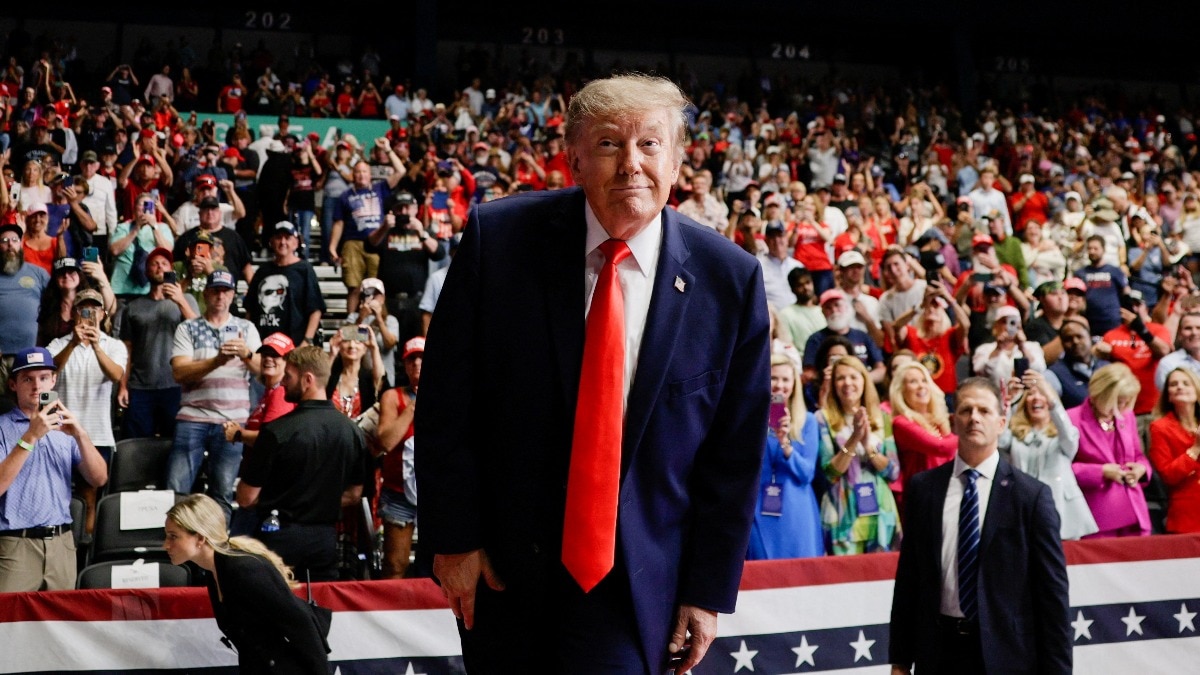
Donald Trump's remarks drew immediate criticism over factual errors. Critics pointed out that Ho Chi Minh City was then called Saigon and served as the capital of South Vietnam, America's ally.Donald Trump's claims on Vietnam War draws flak (Image: Reuters)US President Donald Trump has a message for his predecessors. It seems that he is not particularly happy with how they handled the conflicts in Vietnam and Afghanistan.Addressing a rally ahead of the US midterm elections, Trump drew attention to what he believed was a strategic miscalculation by previous US administrations, claiming that he could have won the Vietnam War within a week."I could have won Vietnam in a week," Trump said. He also criticised the use of Agent Orange during the conflict, saying, "They dropped whatever the hell that crap is that hit the forest: Agent Orange! Instead of going after Ho Chi Minh and the other cities." In addition to this, Trump claimed that he could have resolved the Afghanistan crisis within a week.Trump: I could have won the Vietnam War in a week. They kept bombing forests for years instead of going after Ho Chi Minh City. https://t.co/SZ0Jv3qSCH— Clash Report (@clashreport) November 1, 2026However, Trump’s remarks drew immediate criticism over factual errors. Critics pointed out that Ho Chi Minh City was then called Saigon and served as the capital of South Vietnam, America’s ally. The enemy capital was Hanoi in North Vietnam. The US had directly targeted the North during the war, with Operation Rolling Thunder bombing the region from 1965 to 1968. Several users on the internet also pointed it out. As the video surfaced, one user wrote, "Um? He wanted to bomb the headquarters of South Vietnam ??? I mean in a way that would have ended the war in a week I guess." Another user mentioned, "You do realise that Ho Chi Minh City back then was Saigon and was governed by South Vietnam, right, and even US troops were there. So while it's good that you spared Hanoi (maybe), you decided to bomb the thing you have created.This is not the first time Trump has made such claims. Around one-and-a-half years ago, he said that he could have won the Vietnam War within three to four months.The Vietnam War, fought between 1955 and 1975, was one of the major military conflicts of the 20th century. Despite its extensive military involvement, the United States failed to achieve its political objectives, eventually withdrawing its troops before the fall of South Vietnam.In an interview with Fox News, Trump had questioned the military strategy adopted by previous administrations, saying, "If it were me, I would have had that war done in three months, four months."HOW THE VIETNAM WAR UNFOLDED: FROM FRENCH RULE TO US INVOLVEMENTVietnam's conflict began with its struggle for independence from French colonial rule. In 1945, communist revolutionary Ho Chi Minh declared independence, but France attempted to regain control, triggering the First Indochina War (1946–1954).France's defeat at Dien Bien Phu in 1954 led to the Geneva Accords, which temporarily divided Vietnam along the 17th parallel into communist North Vietnam, led by Ho Chi Minh, and anti-communist South Vietnam, initially led by Ngo Dinh Diem.US involvement began under President Harry S Truman, who backed France financially, and expanded under Dwight D Eisenhower, who supported South Vietnam to prevent the spread of communism under the Domino Theory. John F Kennedy further increased American military advisers and assistance.Political instability deepened in South Vietnam, culminating in Diem's assassination in a military coup in November 1963.The war escalated dramatically under Lyndon B Johnson, who used the 1964 Gulf of Tonkin incident to secure congressional authority for military intervention. In March 1965, US combat troops landed in Vietnam, followed by extensive bombing campaigns against the North. The 1968 Tet Offensive, launched by North Vietnamese forces and the Viet Cong, exposed the limits of American military progress and intensified anti-war sentiment in the US. Johnson declined to seek re-election that year.His successor, Richard Nixon, introduced Vietnamisation in 1969, gradually withdrawing American troops while strengthening South Vietnam's military. However, the conflict spread into Cambodia and Laos, and peace negotiations remained difficult. The Paris Peace Accords were signed in January 1973, leading to the withdrawal of American combat troops by March.After Nixon resigned in 1974, President Gerald Ford oversaw the final phase of the conflict. North Vietnam launched its decisive offensive in March 1975, captured Saigon on April 30 and defeated South Vietnam. Vietnam was formally reunified under communist rule in July 1976, bringing an end to a conflict that had drawn successive US administrations into an increasingly costly military engagement.- Ends
Could've won in a week: Trump's bizarre Vietnam War claim draws flak on internet
Full Article
Original Source
Read the full article at Indiatoday →KhanList aggregates and links to publicly available news content. We do not host full articles from third-party sources. Always verify important information with original sources.