
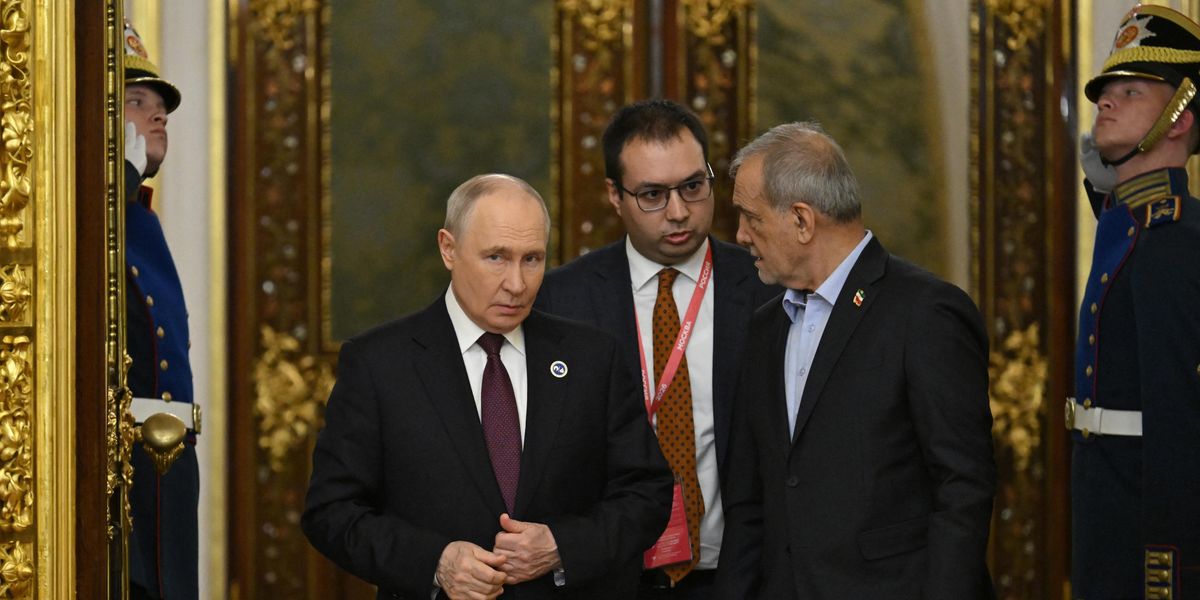
During a meeting last week with U.S. envoy Steve Witkoff, Russian President Vladimir Putin offered to help broker a deal to end the U.S.-Iran war.The proposal — the latest in a series of recent Russian offers to act as an intermediary between Washington and Tehran — has a certain logic to it. While the U.S.-Israeli war on Iran has brought Russia some economic gains through rising energy prices, Moscow fears further escalation and spillover across the Persian Gulf and parts of the former Soviet space. Russia is also one of Iran’s closest partners and one of the world’s leading exporters of enriched uranium, meaning that it could help break the impasse over domestic Iranian nuclear enrichment.Yet Moscow will struggle to gain Western and Gulf Arab acceptance as a mediator, particularly amid the Ukraine conflict and heightened threat perceptions of Iran in the Gulf Cooperation Council (GCC) while Russia is increasingly aligned with Iran.Back in 2022, the balance in the Iran-Russia partnership shifted significantly, with Tehran gaining greater value in Moscow’s eyes as a result of Iranian support to Russia in the form of drones and drone trainers amid its war on Ukraine. Yet now the relationship is shifting in Russia’s favor because of Moscow’s role as an influential power helping Iran weather the war.“Moscow is trying to provide Iran with every possible form of support,” including grain purchases, humanitarian aid, and likely intelligence sharing, Anton Mardasov, a Moscow-based Associate Fellow at the Middle East Institute, told RS. Mardasov added that this support comes on top of consultations about organizing air defense and missile-development assistance, which were taking place before February 28.Of course, Moscow’s growing ties with Tehran do not guarantee influence over Iran’s decision making. Its ability to mediate depends on offering Iran and other parties something unavailable elsewhere. According to Mardasov, one avenue is Russia’s longstanding interest in facilitating the transfer of enriched uranium from Iran, potentially followed by support for developing its civilian industrial and nuclear sectors.Such an arrangement could ease Iran-U.S. tensions, open lucrative contracts, and demonstrate Russia’s diplomatic relevance, potentially strengthening its hand in negotiations over Ukraine. However, Iran has so far shown limited interest in the proposal, constraining its immediate prospects.Beyond Iran’s reluctance to accept such proposals, other obstacles stand in the way too. Mark Katz, a professor emeritus at George Mason University, said the conditions that facilitated the 2015 Iran deal, known formally as the Joint Comprehensive Plan of Action, are no longer in place. In the lead-up to the agreement, all parties had interests in a negotiated settlement, allowing Moscow to play a constructive diplomatic role. Today, however, such willingness to compromise appears absent. As Katz explained to RS, “Everyone may want a deal, but not on terms that the opposing party, or parties, is willing to accept.”Further complicating the picture are the White House’s expectations of Russia. President Donald Trump might expect his Russian counterpart to pressure Tehran into making concessions to Washington just as Putin would want the Trump administration to pressure Kyiv to make concessions to Moscow. If Moscow can’t persuade Iran to adjust its positions, the Kremlin’s value to the White House as a potential intermediary will be limited.Another open question concerns Russia’s willingness to pressure Iran. Moscow values its partnership with Tehran, and excessive pressure could harm bilateral ties. Putin thus faces a dilemma: Russia must demonstrate enough influence over Iran to appear credible without undermining the Kremlin’s broader international objectives.Russia’s credibility in the Gulf matters too. While seeking to strengthen ties with GCC members and advance its vision for Gulf security, Russia has complicated its ambitions on the Arabian Peninsula by supporting Iran. Moscow’s opportunistic relationship with Yemen’s Houthi rebel movement, whose attacks on Saudi Arabia exacerbate the regional security crisis, further complicates the Kremlin’s efforts to balance its ties across the Gulf.“While the GCC states all want good relations with Russia, they know full well that Russian support has helped Iran launch attacks against them. They also know that Moscow is unwilling, and perhaps unable, to pressure Iran to stop attacking them. That being the case, I don't believe the GCC states see Russia as a credible mediator,” Katz told RS.“In discussions I have had with officials and scholars from the GCC states, contempt for Russia is manifest. Yet they still want to maintain good relations with Moscow for fear that Russia would help Iran even more otherwise,” he added.These dynamics limit Moscow’s ability to translate its proposed framework for collective security into a reality. When looking at the current state of Russia’s relations with the Gulf Arab monarchies, Mardasov said “Moscow is primarily trying to promote its proposed concept of collective security, which in reality has no real potential and is more of an anti-American project aimed at minimizing the U.S. presence in the region.”Moscow’s role in the U.S.-Iran conflict is shaped by a gap between Russia’s ambitions and its means to deliver diplomatic results. Although the war has benefited Russia’s economy to some extent and created unique opportunities for Moscow to elevate its partnership with Tehran while reminding the U.S. and other powers of the need to engage Russia, it would be misguided to conclude that any of these dynamics position the Kremlin to resolve this conflict.Indeed, even if Russia facilitates communication between Tehran and Washington, it is not clear how Moscow could do anything that other bridging states, such as Pakistan, Oman, Qatar, or Turkey, couldn’t if Iran and the U.S. are unwilling to compromise on their core demands.“Russia can certainly act as an intermediary, relaying messages between Tehran and Washington. But there is no shortage of such intermediaries. Iran and the United States already had fairly reliable channels of communication. In that sense, Russia is unlikely to offer anything fundamentally different from other countries,” Nikita Smagin, a non-resident expert at the state-funded Russian International Affairs Council, told RS.“The main problem between the United States and Iran is not a lack of mediators, but their inability to find a basis for compromise,” Smagin said. “I doubt Russia can do much to bridge that gap.”Given Moscow’s support for Iran and its limited leverage over Tehran, it is unclear whether the Kremlin can secure the concessions Washington seeks. Russia may facilitate arrangements, but only if both parties become more willing to compromise. Therefore, for the time being, Moscow will likely be better positioned to leverage this conflict to advance its own geopolitical and economic interests rather than help resolve it.
Could the path to US-Iran diplomacy run through Moscow?
Full Article
Original Source
Read the full article at Responsiblestatecraft →KhanList aggregates and links to publicly available news content. We do not host full articles from third-party sources. Always verify important information with original sources.