
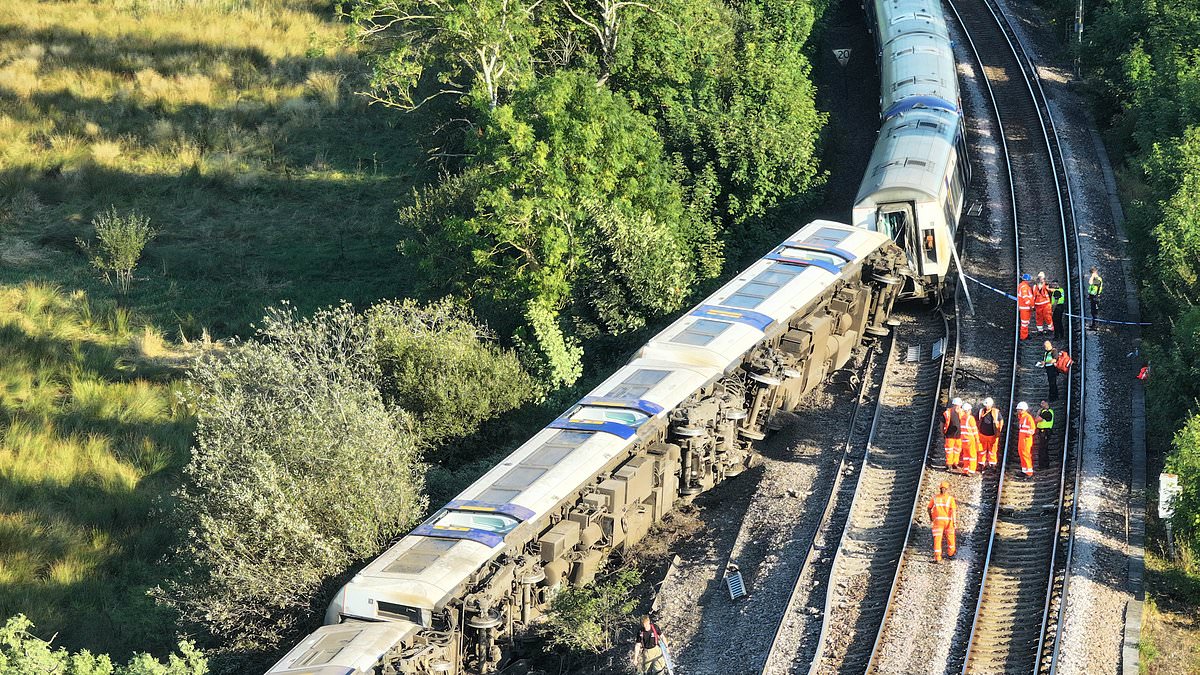
Extreme heat is bringing a 'new challenge' for Britain's railways which must adapt because the country is 'woefully behind', experts warned today after the fourth major train accident over the past year.A Southern service with 150 passengers on-board came off the tracks after rails buckled in East Sussex on the UK's fifth hottest day ever yesterday.Two people remain in hospital today while 18 others were also hurt, and investigators are looking into whether the steel tracks expanded in the heat and started to warp.Terrified passengers were left clinging on to upturned seats and handrails as three carriages came off the tracks near Lewes station, appearing to jump in the air before tipping on to the embankment and sliding some distance before coming to a halt.It came less than three months after a horrifying crash near Bedford when two East Midlands Railway trains collided in June – killing a driver and injuring 162 people.Also in June, a mother was killed and an eight-year-old girl was injured in a crash between a Northern rail service and a car at a level crossing in Hoghton, Lancashire.That followed an Avanti West Coast train derailing when it struck a landslide at 80mph on the West Coast Main Line near Shap in Cumbria last November. Some 87 people were on board the service from Glasgow to Euston and four suffered minor injuries.Record-breaking heatwaves this year have caused a series of other problems on the railways with some operators warning passengers only to travel if 'essential' at times.Heat-related issues affecting the railway can include sagging overhead electric wires, lineside fires and buckled rails – which can reach 50C in an air temperature of 30C.Another issue facing the railways is deliberate fare evasion which now costs up to £400million in lost revenue each year – with various operators including Transport for London (TfL) launching major crackdowns in an attempt to get a grip on the issue.Demand is very high on UK railways, given passengers made 1.83billion journeys on the network in the most recent year – the highest number since 1920, which was up 6 per cent on the previous year and above the recent high of 1.75billion in 2018/19.But rail expert Mark Smith, founder of travel website The Man In Seat 61, said the effects of climate change are a 'new challenge which the railways will have to rise to'. Rail staff and police at the scene near Lewes this morning after the train derailed yesterday Two people were seriously injured following the train derailment in East Sussex yesterday Rail bosses will investigate whether the steel tracks expanded in the heat and started to warp He told the Daily Mail that this included 'buckled rails in heatwaves and the effect of extreme weather on infrastructure such as bridges and embankments'.Mr Smith also suggested operators will have to invest in 'more robust air conditioning' for trains, citing the example of Eurostar recently ordering 50 double-decker trains to withstand temperatures up to 55C.But he said 'experience over the decades' would suggest the latest major incidents would not impact passenger demand.Mr Smith continued: 'The network is carrying more passengers than at any time since the end of the First World War, yet is safer than it's ever been.'In the late 1940s it was par for the course to have seven or eight fatal accidents each year, in the same way that 3,000 people die on our roads each year. Four major rail incidents in Britain over past yearYesterday: A Southern Rail service carrying 150 passengers derails near Lewes in East Sussex, with 20 people taken to hospital.June 25: Northern train hits a car at a level crossing in Hoghton, Lancashire – killing a mother and injuring an eight-year-old girlJune 19: Two East Midlands Railway trains collide near Bedford, killing the driver and injuring 163 peopleNovember 2, 2025: An Avanti West Coast train derails when it strikes a landslide near Shap in Cumbria, injuring four people. 'But each rail accident is rigorously investigated and lessons learned, closing gaps in systems and procedures.'Mr Smith also referenced the TPWS (Train Protection and Warning System) which he said has been 'more effective than anyone expected'.TPWS, which started being used in Britain in 2000, automatically applies a train's brakes when it detects it will be unable to stop before a red signal.Mr Smith continued: 'As a result, fatal accidents reduced to one a year in the 1980s, then one every 18 months in the 1990s and now a fatal accident is very rare indeed. Modern trains also feature much greater crashworthiness, too.'But even if a risk is one in a million, you only need to do something 500,001 times for that event to be odds-on.'Former rail minister Norman Baker told the Daily Mail that he hoped the recent incidents would not affect people's confidence in train travel because 'statistically rail is one of the safest forms of public transport there is'.There were 24 accidental deaths on the mainline rail network between April 2024 to March 2025, representing a five-year high.But this is just 1.4 per cent of the total number of people killed on the roads in 2024, which was 1,671.Mr Baker, who is a former Lewes MP, added: 'I wouldn't want people to be put off using the railway because I think that's the wrong conclusion to reach.'Analysing the Lewes incident, Mr Baker said it was clearly 'climate related'. The scene after two East Midlands Railway trains crashed into each other near Bedford in June Injured and bewildered passengers gather by the side of the tracks after the Bedford crash A Luton Airport Express train crashed into a stationary train, causing one death and 162 injuriesHe continued: 'It's probably either a buckled rail because of heat or a landslip because the ground is so dry and I think we have to recognise as a country we are woefully behind.'The 69-year-old added: 'Anyone who is my age will see the dramatic change in the weather and we have to deal with that. These are new circumstances.'He said Network Rail would have to 'look at the embankments more than they've done so far and see what the tolerance is to very dry and wet weather'.Mr Baker also said: 'The other thing is the rail is designed to operate within a window of temperatures, and I think we are now looking at rail being asked to operate at a different level.'Transport management expert Ioannis Koliousis, from Cranfield School of Management in Bedfordshire, claimed the incident highlighted how 'historic infrastructure design assumptions' must change.Dr Koliousis, an associate professor of logistics and supply chain management, said: 'The UK railway system has well-established procedures for managing hot weather, but it was fundamentally engineered around the range of climatic conditions historically expected in Britain.'There are limits to how far an existing network can accommodate exceptional temperatures without operational restrictions. And notably, these are extreme conditions.'The bigger strategic question is whether increasingly frequent extreme temperatures mean that historic infrastructure design assumptions need to change.'This is becoming an issue of long-term climate resilience, requiring investment in track, signalling, electrification and monitoring as well as operational responses.'He explained that train operators and infrastructure owners manage extreme heat through extra inspections, rail-temperature monitoring and precautionary speed restrictions.But Dr Koliousis added: 'Heat affects more than the rails themselves, including overhead electrical equipment, signalling systems and track foundations.'Speed restrictions and cancellations are therefore an important risk-control measure rather than, in themselves, evidence that the system is unsafe.'Ben Plowden from the Campaign for Better Transport, also told the Daily Mail: 'More people are travelling by rail than at any time since 1920. This means fewer traffic jams on the roads and lower carbon emissions. 'There have been some terrible, high-profile incidents on the railways in recent months, and reducing these must be of paramount concern to the industry. But rail remains one of the safest way to travel. 'Tragically, tens of thousands of people are killed or seriously injured on the roads each year, and much more must also be done to make our roads safer.'Meanwhile a train boss insisted today that the railway is safe in hot weather.John Whitehurst, chief executive of Greater Thameslink Railway, said derailments are 'incredibly rare', but this 'was a very serious incident and I'm deeply saddened by it'. An Avanti West Coast train derailed when it hit a landslide at 80mph in Cumbria last November Network Rail engineers assess the site at Shap in November last year after the train derailedAsked if the railway was safe in hot weather, he told BBC Radio 4's Today programme this morning: 'The railway is safe. These types of incidents are incredibly rare.'We have control processes in place that involve inspection, temporary speed restrictions or even suspending services if that's required.'Richard Bowker, the former chairman of the Strategic Rail Authority said the incidence of rails buckling in high temperatures 'has actually been steadily falling over the last sort of 20 to 30 years'.The former chief executive of Etihad Rail also told Radio 4: 'One of the reasons being that we use slightly heavier rails, we use better fastenings and stuff like that.'But physics is physics, and one of the challenges we've got as we see more extreme ranges of heat is dealing with that.'Mr Bowker spoke as dramatic images of the aftermath of the Lewes derailment incident – which left two seriously injured and a further nine people with less serious injuries – showed a long section of track had buckled.Passengers stood on top of the wreckage as they scrambled out of carriages which had upturned. Some could be seen on stretchers being taken to hospital. Many of those who did not require hospital treatment were taken to a local community centre to be triaged.The cause of the derailment of the 2.24pm Southern service from London Victoria to Eastbourne has not yet been confirmed.Early speculation has focused on the possibility that the steel tracks expanded in the heat and started to warp, but investigators have yet to establish what caused the train to leave the rails.Christian Wolmar, a transport expert, told the Daily Mail: 'Well, there are two possible reasons this has happened. Obviously, the train track might have buckled before the train arrived.'But because the first carriages didn't derail, it might be that the dryness from the heat has led to the embankment collapsing, and then the train made the rails buckle rather than the other way round.'I noticed yesterday when I was out on the heath for the eclipse – there's just great big fissures in Hampstead Heath, big openings like an earthquake, and that must be happening in many places.'So it could be that there's something like that that caused the embankment to partially collapse, and then the rails buckled under the weight of the train because the rails were unsupported. Kerry Coombes died and an eight-year-old girl was injured in a crash between a Northern rail service and a car at a level crossing in Hoghton, Lancashire, in June Level crossing barriers were raised and an alarm was not activated before the Hoghton crash 'Which could be the more likely explanation given that the first four carriages didn't go down.'Lucy McAuliffe, Network Rail route director for Sussex, said yesterday that she was 'shocked and saddened' by the derailment near Lewes.She told a press conference: 'The railway between Haywards Heath and Lewes is closed and is likely to remain closed as the emergency response continues and specialist teams carry out the complex task of assessing the damage to the train and the infrastructure.'I understand that people will have lots of questions about what has happened today.'I would like to reassure everyone that we are working closely with the Rail Accident Investigation Branch, who are on site to establish exactly what has happened.'At the moment, it would be inappropriate to comment as to the cause of this incident but more information would be provided as soon as we can.'Two people suffered serious injuries, which British Transport Police said today were not deemed life-threatening. They both remain in hospital.A further 18 people who were also treated at hospital for less serious injuries have now been discharged. The incident came 55 days after the train crash near Bedford injured 162 people, 102 of whom needed hospital treatment.An interim report published by the Rail Accident Investigation Branch found Shaun Burton, the 60-year-old train driver killed in the 49mph crash, passed a red signal moments before the collision.Mr Burton died when the East Midlands Railway train he was driving hit the back of a stationary train run by the same operator in Elstow, Bedfordshire.Investigators have said it is not yet possible to say what alert the driver received from an onboard system designed to sound a horn when a red light is being approached, and activate the emergency brake if that is not acknowledged by them pressing a button.Preliminary analysis of a data recorder recovered from the wreckage showed it was travelling at 76mph when its brakes were applied nine seconds before the crash. Its speed had reduced to 49mph when the impact happened.While the accident happened on a hot day in June with temperatures of about 24C, there has been no evidence to suggest the weather played a role in the collision. In 2024, Network Rail announced a five-year rail improvement plan worth £2.8billion on activities and technology to help it better cope with extreme weather.This included increased investment in looking after thousands of miles of drains, cuttings and embankments to make them more weather resilient.Bosses also said they would target more than 20,000 cuttings or embankments for attention, and install more 'smart' movement sensors to cuttings and embankments that will give early warning of any changes to help engineers react before a full landslip.Network Rail and the Rail Delivery Group were both contacted for comment today.
Could the Lewes train derailment happen again? Experts warn Britain's railways are 'woefully behind' adapting to extreme weather as latest major accident hits network
Full Article
Original Source
Read the full article at Dailymail →KhanList aggregates and links to publicly available news content. We do not host full articles from third-party sources. Always verify important information with original sources.