
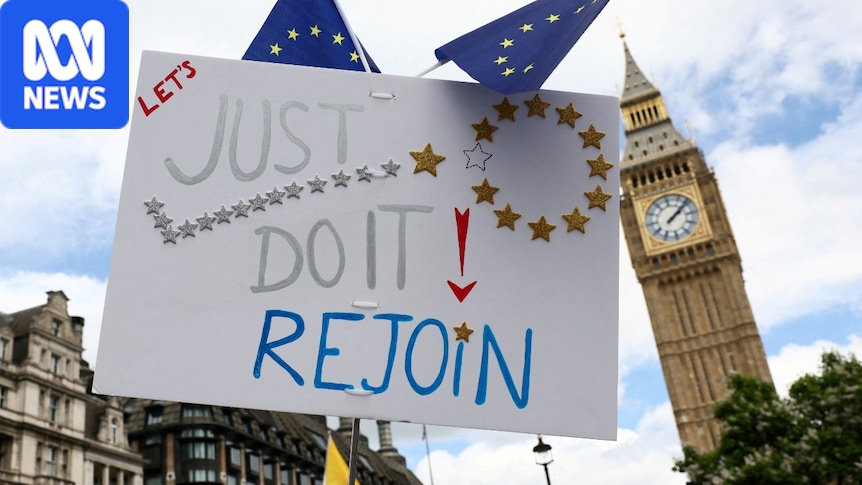
When British farmer Tim Chambers voted to leave the European Union in 2016, he thought it would be a boon for his business.Now, he has changed his mind and feels the main thing the United Kingdom's Brexit referendum delivered is empty promises."You're promised a lot of things on these votes," he told the ABC."I think I was naive to think that the politicians would come up with workable solutions. I don't know if the opportunity was squandered or if it was never there."A decade after the referendum was held, and more than six years on from when the UK actually left the EU, there is growing speculation the decision could be reversed. Could Britain, in fact, Brejoin?Some polls show public support among people in Britain for rejoining the bloc is now in the majority, and on Friday, the country's Prime Minister Andy Burnham will travel to Brussels for a landmark summit with European leaders.While Mr Burnham's predecessor Sir Keir Starmer had been laying the groundwork for a smoother trading relationship between the two sides, the current PM has been plain he wants an entire rethink of the deal struck by Boris Johnson, saying Brexit "has done more harm than good" to Britain's economy.Tim Chambers voted to leave the EU, but now regrets his decision. (Supplied)For example, leave campaigners told UK farmers Brexit would make it easier for them to sell their products to local consumers, but industry sources say that is not necessarily the case.They say Brexit has led to the loss of EU subsidies, severe labour shortages due to changing migration rules, increased operating costs and an uneven playing field when it comes to food imports under new trade deals the UK has negotiated.According to an analysis by the UK's Country Land and Business Association, more than 55 per cent of voters in rural council areas backed leaving the EU at the referendum (slightly higher than the 52 per cent nationally).A common complaint made by British farmers at the time was that the bloc was imposing too many regulations on them.Mr Chambers, who grows berries, was not exporting much of his produce to Europe in 2016, but now it's an important part of his business."Prior to Brexit, it was very straightforward; stops on the borders [in Europe] were minimal. But now you need to fill out 10 forms in duplicate," he said."And if you have one tick in the wrong box, then the whole shipment can be suspended … a delay of 10, 12 hours really can affect the quality of the product that we're trying to sell abroad."Andy Burnham's visit to Brussels is being watched closely in the UK. (ABC News: Daniel Pannett)As support for Brexit slides around the UK, Mr Burnham has made no secret he thinks his country could rejoin the EU."It's like the Emperor's New Clothes, where no one is prepared to say the obvious truth. Well, I say it as I see it. And to be frank, the emperor has nothing on," Mr Burnham said this week while giving the keynote address at a London banquet."The Brexit we were given has not worked. We have lost more than we gained."Mr Burnham's moves to bring his country closer to the EU could set up a showdown with UK opposition leader Kemi Badenoch's Conservative Party, as well as prominent right-wing populist MP Nigel Farage, who is renowned as the godfather of Brexit.Ms Badenoch says rejoining the EU would not "solve all our problems", while Mr Farage, whose Reform UK party enjoys significant support in Britain, has made opposing Europe his life's work.A June report co-authored by Stanford University's Nick Bloom with Bank of England economists estimated the UK economy was about 6 per cent smaller after a decade than it would have been had Britain stayed in the EU.Leave campaigners are quick to point out the Brexit years have been hampered by the COVID pandemic that devastated the global economy, as well as wars in Ukraine and the Middle East.Polls show some Brits have BregretOn Friday, Mr Burnham is expected to sign a series of deals his predecessor Sir Keir set in motion last year, which include a limited youth mobility scheme.But in the medium-term, the UK's PM has already started a national conversation about what his country's relationship should look like with the EU, and rejoining completely is one option on the table.Mr Burnham has floated four potential paths when it comes to Europe:Keep the current status quo (no change)Rejoin fully (the PM has described this as "going all the way")Join a customs union with the EU (no tariffs on UK-EU goods trade, with shared tariffs on imports from everywhere else)Rejoin the single market (in which goods, people, money and services can move freely between EU countries)According to multiple reports, while EU officials and diplomats remain open to talks with Britain, they are treating any re-entry bid as distant and unrealistic. Many are sceptical the UK could ever accept new terms for rejoining.Previously negotiated carve-outs, including the fact the UK would not need to use the Euro currency, could be off the table under a new deal.Publicly, EU foreign policy chief Kaja Kallas has said "all our friends are welcome to join", but that the UK people would ultimately have to make a decision for their country.Andy Burnham has made it clear he wants closer ties with the EU. (Reuters: Toby Melville)Since Brexit, the UK has negotiated its own trade agreements with more than 70 countries and territories, as well as a new deal with the EU.Jill Rutter, a senior fellow at the Institute for Government (a non-aligned London-based think tank), said the easiest options would likely be to stay out of the bloc, or rejoin it completely."The customs union means you give up some of your independent trading policy, [and] you have to apply EU tariffs for not very much gain," she said."The single market, you'd have to make a big contribution. You have to accept freedom of movement."Do we really want to be subjected across … the entire economy to EU rules and we're not in the room [having not rejoined fully]?"Pro-EU activists in Britain mowed this message into a Wiltshire field on the 10th anniversary of the Brexit referendum. (Reuters: Chris J Ratcliffe)A survey of more than 4,000 people conducted last year by YouGov for the pro-EU group Best for Britain found 53 per cent of people in the UK supported rejoining the EU.The poll found 32 per cent were opposed, while 15 per cent of respondents were unsure.Mr Burnham is expected to use the next UK general election (scheduled to be held in 2029) to gauge support for closer ties with Europe, and has said he is not proposing rejoining the EU in this parliament.Adding to the PM's predicament is the fact his constituency of Makerfield, near Manchester, strongly backed leaving the EU during the 2016 referendum. Mr Burnham has already declared any deal with Europe would need to pass "the Makerfield test".Immigration remains a major political hot potato in the United Kingdom, and analysts argue any closer ties with Europe will be linked closely to how much control the UK has over its own borders.
Could Britain rejoin the EU? There's growing speculation it may try to
Full Article
Original Source
Read the full article at Abc →KhanList aggregates and links to publicly available news content. We do not host full articles from third-party sources. Always verify important information with original sources.