
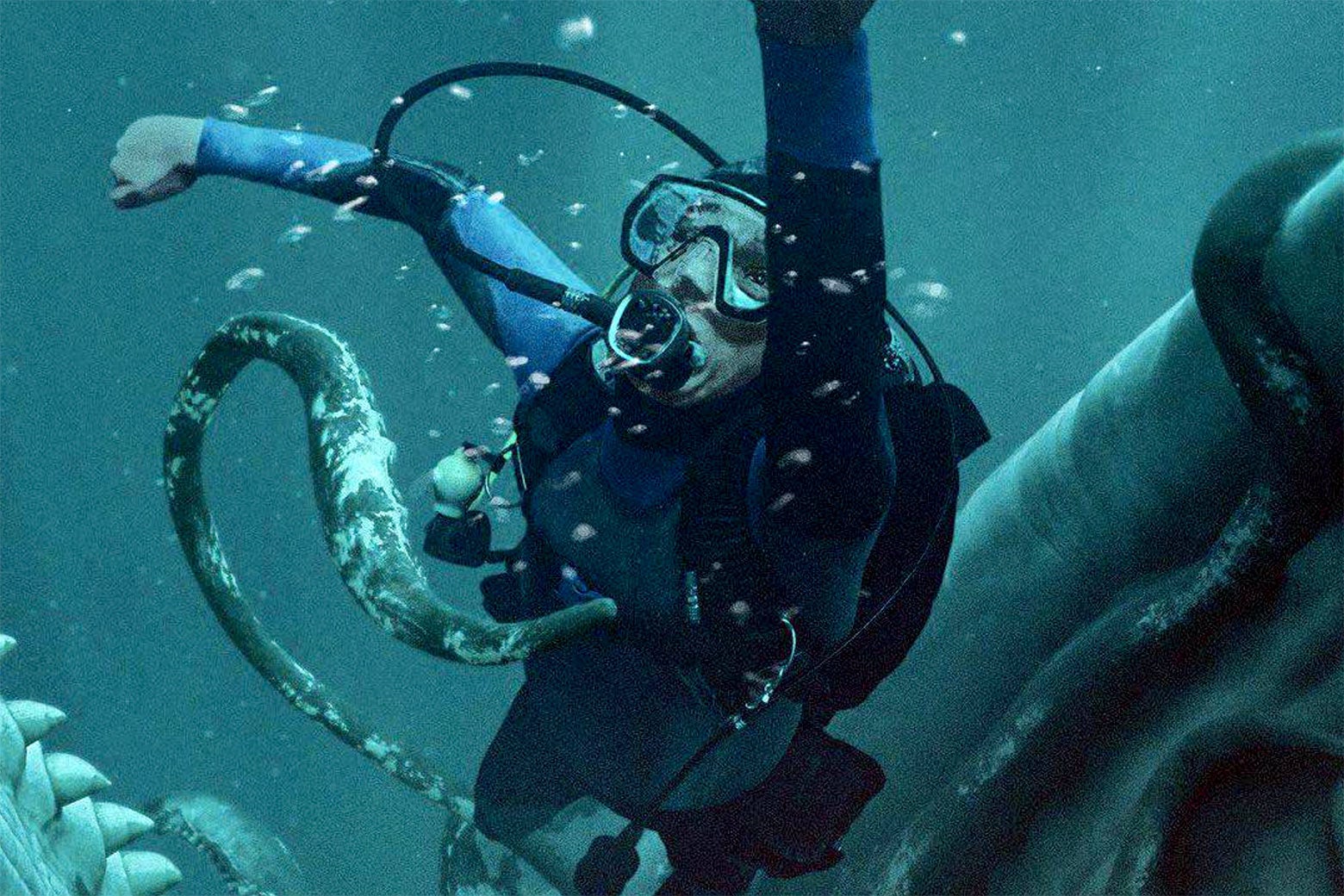
Movies A Whale Biologist Weighs In on Whalefall The movie follows a scuba diver who gets swallowed by a whale. How realistic is it? By Enter your email to receive alerts for this author. Sign in or create an account to better manage your email preferences. Unsubscribe from email alerts Are you sure you want to unsubscribe from email alerts for Nadira Goffe? Oct 16, 20263:18 PM 20th Century Studios Sign up for the Slatest to get the most insightful analysis, criticism, and advice out there, delivered to your inbox daily. In 2020, when author Daniel Kraus saw a viral video of a group of kayakers being “swallowed” by a humpback whale, he decided to find out if it was even scientifically possible. The answer? Sort of, in the right conditions and with the right kind of whale: a sperm whale, to be precise. His dedication to seeing how this traumatic encounter would hypothetically play out, and what it could come to represent in a larger story about the human condition, led to his 2023 survival thriller novel, Whalefall. The book follows a teenager, Jay, who has a complicated, near abusive, relationship with his father, Mitt, a pillar of the local scuba-diving community. Jay ultimately estranges himself from his father, refusing to talk to him even after finding out that Mitt is dying from cancer. After Mitt kills himself by jumping off of a boat while wearing diving weights, Jay returns home to wrestle with his absence during Mitt’s final moments and to recover some of Mitt’s remains from the ocean. But, while diving in search of the remains, Jay is swallowed whole by a sperm whale. Armed with only his father’s training to help him, he must escape the belly of the beast before his tank runs out of oxygen. This year has been big for Kraus. He won a Pulitzer for his most recent novel, and Whalefall has now premiered as a major motion picture, directed by Brian Duffield and starring Josh Brolin as Mitt and Austin Abrams (who is also having a big year) as a college-aged Jay. But, now that we can bask in all of Whalefall’s impressive underwater glory, one question prevails: Just how realistic is it? To dive into the mysteries of Whalefall’s deep, I spoke with certified sperm whale expert Shane Gero, biology lead at Project CETI. This conversation has been edited and condensed for clarity. Slate: I want to start off with some basic 101: What is the difference between a sperm whale and other types of whales? Shane Gero: There are somewhere between 90 and 100 species of whales, dolphins, and porpoises in the world. The main divide is that there are those with teeth, like the sperm whale or the orca, and those with baleen—which is kind of like a comb made out of fingernail material—like the humpback whale. You picture a humpback whale or a blue whale, and they open their mouth wide and engulf huge amounts of water and then spit the water out, and all the fish or the krill or whatever stay in their mouth. Now I want to break down how Whalefall’s protagonist, Jay, actually winds up swallowed by the whale. Before he even sees the whale, he hears these clicking-like sounds. Are these accurate to the sounds a sperm whale makes? When I first saw the trailer, I was actually kind of ecstatic because I think the whale looks fantastically realistic and quite beautiful, and the trailer uses real sperm whale sounds. They’ve added a bit of bass, I think, but, ultimately, yeah, the sperm whale has the most powerful natural biosonar system. They live in a part of the world’s oceans that is pretty much dark all the time. We think about them as divers, but really they’re surfacers. Most of their life is spent 3,000 feet down hunting for squid. And it’s only because they’re mammals like us that they have to come to the surface and breathe, and they’re at the surface for about 10 minutes and then they go back down. So, like bats, they have this clicking noise that allows them to see their prey in the dark. They call that echolocation because they use the echo of the sound to navigate or find the location of what they’re looking for in the dark. That whole moment of hearing the clicking before seeing the sperm whale is very real. When we leave in the morning to go out and find sperm whales, we’ll hear them before we see them because we’re pulling underwater microphones under our boat. And that sound is very powerful. It’s one of the loudest sounds that any animal can make. It’s like having a large firework go off right next to you. So we can hear them sometimes for kilometers before we actually see a whale at the surface. Behold, a sperm whale! Ventura Romero/iStock/Getty Images Plus I was also wondering how sperm whales tend to feed. What happens with Jay is that the whale is actually trying to swallow a giant squid, and Jay gets caught up with the giant squid and then, in turn, is also swallowed by the whale. When the whale is hunting, it seems like it almost rams into the squid a few times—I wasn’t sure if the whale was just trying to catch it or if it’s a part of their hunting technique to try and stun their prey this way. This battle between a sperm whale and a giant squid is sort of a mystical event that we know must be happening around the world basically every day, but we have yet to capture it on film. It’s really like a holy grail of wildlife filmmaking. We’ve started putting small cameras on the backs of whales with suction cups, and that allows us to see a little bit, but it’s really this arms race between this natural, powerful sonar system sound against these big, beautiful eyes of the squid trying to see through the bioluminescence before it gets killed. The sperm whales are picking these squids up probably over 100 meters away. And then right when the squid gets towards the whale’s jaw, which is very long and narrow and is able to produce suction, the whale sucks the squid in at the last second, regardless of how big the squid is. And so whales do have a bit of what we call raptoring. They do try and grab the prey. On the cameras you put on whales’ backs, you’ll see the head jerk forward to try and catch something, but they don’t do a lot of chewing. What were the other parts of the film that seemed, as you say, “fantastically realistic” to you? The sperm whales look fantastic right down to all of the scratching around the face. Squid tentacles have little suction cups on them, and people might think about that in terms of an octopus; it’s sort of similar, except many species of squid also have a sort of sawtooth, a sharp bit around each one of those suction cups. So a lot of the sperm whales get all these beautiful scars or even circular sucker marks on their faces and on their noses because of eating all these big squid. And in that beautiful sequence with the orca, as much as it’s a terrible moment for the sperm whale, you can see the skin is shedding. Mammals—sperm whales and humans and your dog—we all shed skin. Normally you don’t see that in the movies because the whales look, even in pictures, so perfect and sleek, right? But in reality, most of the time the whales are quite mottled and are sort of peeling, almost like they’ve had a sunburn, because the skin is shedding off all the time. To be fair, when I first saw the trailer, I emailed my colleague who’s this legendary marine mammal anatomist, and I was like, “Have you seen this trailer?” And she was like, “Oh yeah, I helped them when they were writing the book.” So they went and did their homework. You mentioned that sperm whales hunt for squid about 3,000 feet below the surface. So, in real life, this battle between a squid and a sperm whale would be happening at a much deeper level than a human can dive, right? Yeah, with scuba diving, if you go much more than a hundred feet, it becomes very technical very quickly. Whereas the sperm whales on average are feeding down over 2,000 feet for sure, and they easily go down to 3,000 feet, and some of the records for their dives are closer to 6,000 feet. So yeah, most of this is happening totally out of the reach of a scuba diver. I think the movie did a great job at trying to be as scientifically accurate as possible and representing the sperm whales in a realistic way, but it is allowing us to suspend the disbelief of this initial premise of how do you put all three of these things [the sperm whale, the giant squid, and a diver] in one place at one time. You mentioned bioluminescence. While Jay is inside of the whale, he can see because of the bioluminescence in the water and food the whale has swallowed. Obviously, it is really helpful to filmmakers who want to make a movie about a guy who gets swallowed by a whale if they can emulate some natural light source inside the whale that they don’t have to bend over backward to explain. Where does this bioluminescence inside the whale theoretically come from, and is it realistic? These animals, the squid and the sperm whale, are down there feeding in a world of total darkness. The sun never reaches there. So this bioluminescence is a part of the deep ocean ecosystem, where many of the animals that live there make their own light. Sperm whales probably ingest bioluminescent things quite regularly. How much of that endures after the squid, or whatever it may be, gets ingested into their stomach, is a great question. In fact, we probably don’t even really know. Often, when bioluminescent animals die, they don’t produce much light. But, otherwise, the inside of a stomach would be quite dark. Sperm whales tend to be very, very large. In the movie, Jay gets from what I would assume is the throat area, to the stomach, to what he thinks is the anus surprisingly quickly. Yeah, so he doesn’t get all the way to the anus. When you and I think of our stomach, it’s like one big sack sort of hanging out by our diaphragm. For a sperm whale, there are actually four different compartments. And so what you’re seeing in the movie is that first chamber, the forestomach, which doesn’t have any acid. It’s an initial sort of physical catch pocket; so that idea of water gushing in, it’s probably very realistic that they swallow water when they’re ingesting squid and other things. Then he moves to the secondary stomach, which does have—the way we would think about it—stomach acid. And then things start getting very small very quickly there, so the fact that he goes through the first two parts of the whale stomach and can’t go any further is actually pretty accurate. Now what it’s like in each of those hasn’t ever been observed by a person. So I think they have some license there to make an exciting story, but it would be filled with squid beaks, which is something that they portray in the movie, because inside the tentacles of a squid is a big hard beak made out of similar stuff as our fingernails, kind of like a big parrot beak. For the giant squid, it can be bigger than your fist. And there would be thousands of them in there because they don’t digest those. Biologists like me pick them up when they come out the other side so we can figure out which squid the different sperm whales have been eating. In parts of the world’s oceans, we know more about what squid are there because someone was collecting sperm whale poop. It’s a lot harder to go down 3,000 feet to take pictures or collect squid; these animals are diving deeper than most of our submarines are rated to go. The majority of Jay’s time in the whale takes place within about an hour, because that’s the approximate amount of minutes of oxygen that he has left in his tank. You mentioned before that sperm whales surface for about 10 minutes and then go back down to feed. How long in between surfaces can they go without having to come back up for air? On average, when they’re feeding—which I’d say is about 80 percent of their day—they dive down for, let’s say, 45 to 55 minutes, and then they’re at the surface for 10 to 15 minutes, and they just repeat, dive, surface, dive, surface, dive. They’re not the longest divers nor the deepest. There are a couple of species of whales that can hold their breath over two hours and go more like 3 kilometers or 9,000 feet. But, when they’re socializing, sperm whales do spend more time at the surface, or certainly if they’re trying to defend themselves from an attack or whatever it might be. These are animals that live in long-term stable families of grandmothers, mothers, and daughters, who live together for life. Jay meets a huge solitary male. This is the biblical Leviathan Moby Dick, the size of two school buses, and weighs as much as 10 of them. They tend to roam the ocean alone. That’s actually a really cool parallel of this young guy leaving his family and embracing the lone Leviathan sperm whale vibe. I’m glad you mentioned that, because I wanted to ask about the moment in the film when the sperm whale is under attack by a pod of orcas and it “calls” for help. The overarching takeaway from this movie, for me, is that family is critical to survival, and, when it gets bad, rely on your family. That’s a very true sperm whale lesson. They live in these really supportive families. In some parts of the world, not all of the animals are even related. So it might be two or three different female lines that aren’t genetically related at all that choose to live together and they’ll communally raise and defend their babies. And then the teenagers get to a certain age and mom has a new baby and they get pushed out. We’ve spent some time with these juvenile males; there was one named Alan in Dominica. A couple years ago, we spent a whole day just with Alan and he was just laying there waiting in transition from growing up in this hyper-social family to becoming this sort of lone Leviathan who we know switch ocean basins and swim from pole to pole. A male sperm whale is so hard to study because they move around so much. There is this big divide between female life as a sperm whale and mature male life. I guess the most important question left is: Would Jay have actually survived being swallowed by a whale? Would you survive for an hour inside of a sperm whale? Stomachs have not evolved to keep things alive in them. But it makes for an amazing story, and much of what you take away from both what a sperm whale looks like and what it sounds like, and ultimately who a sperm whale is in terms of how important their families are to them, is pretty well maintained in the movie. I hope people go and enjoy this thrilling adventure and then leave the theater excited to learn about real sperm whales, because this isn’t just a movie villain. It’s not just a monster that was created to be scary and to tell a story. These are animals that are out there right now. Alan is out there, a young male swimming around eating squid today as we talk. I don’t even think the movie sees the whale as a villain. By the end, I think it is very much on the whale’s side, especially because Jay—who suffers from nitrogen narcosis when the whale dives deep—begins to talk to the whale and his late father as one being. I think the movie is on the side of life, ultimately. Absolutely. I had a very similar take on that. And his father’s line of “the whale is forever” and the title, Whalefall, both hit home. In my somewhat of an outlier experience of the world, where I’ve spent a lot of time with sperm whales, that is very true. The families endure because they support and protect one another. Animals Movies Science Nature Ocean
Could a Scuba Diver Actually Get Swallowed by a Whale—and Live? A Whale Biologist Weighs In.
Full Article
Original Source
Read the full article at Slate →KhanList aggregates and links to publicly available news content. We do not host full articles from third-party sources. Always verify important information with original sources.