
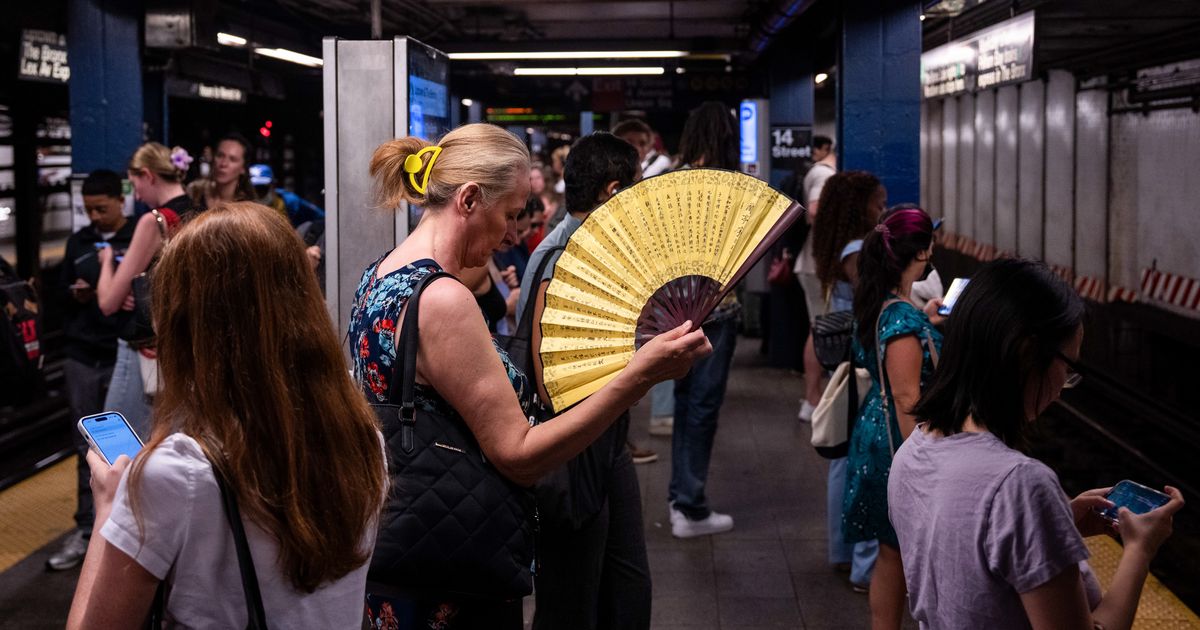
Could a 1,000-Foot Hole in the Ground Cool Off Your Subway Station? Photo: Adam Gray/Bloomberg/Getty Images As much as we might fantasize about it, we can’t air-condition the New York subway’s platforms. It would cost billions to partition off every one so you’re not pouring cold air into the tunnels, and then billions more for the electricity per year. It’s money better spent on almost any other need, starting with repairs and rehabilitations of the most dilapidated parts of the system. (Have you seen the state of the Chambers Street station? It is finally, mercifully slated for renovation.) New elevators and better signals and new cars deserve priority over five or ten minutes of air-conditioned comfort any day. And yet: Those platforms are really hot in the summer, and more so than ever. Even setting aside the changing climate, our air-conditioned trains contribute quite a bit to the sauna conditions, as they ever more efficiently expel hot air. Their compressors fire up when in the stations, cycling as the doors open and close. Relief doesn’t come even when the hot weather ends. In my experience, the temperature down there lags the outdoors by a month or so. Place your hand on a tiled subway wall on a warm day in May, and it will be cooler than you expect. Do the same in November, and it will still be warm. A version of that phenomenon lies behind a plan, newly under exploration by the MTA, to pump some of the heat out of its stations and put it to productive use — and the proving ground will be that very Chambers Street station as it’s rehabbed. To laypeople, this scheme may sound bizarre, and, admittedly, it’s at an extremely early stage — little more than an agreement between state and city to look into whether it might be worth looking into. But a few experts I spoke with this week suggest that it is not only possible but realistic; similar systems exist around the world, though not in transit systems, and their benefits are real. “I do think it’s a plausible idea,” says Jeffrey Pepin, a hydrologist at the U.S. Geological Survey. “I mean, the science is there.” It’s called a thermal energy network, or TEN, and it takes advantage of a natural phenomenon: Drill several hundred feet into the bedrock, where the temperature stays around 55 degrees Fahrenheit, summer or winter, north or south. It gradually gets cooler the deeper you go (before things start to warm up again, but that’s many miles down). So here’s what the MTA would do: Drill a deep borehole — actually a big grid of boreholes — down into the Manhattan schist. “Usually it’s 100 to 200 meters deep — you design how deep you want to go to reach the target temperature,” says Wanju Yuan, a research scientist at the Geological Survey of Canada. Then you run pipes around the walls of the station and into those wells, fill the whole business with fluid (probably water), and pump that liquid around and around, down and up, in a sealed loop. When it’s in a hot subway station, the liquid soaks up heat. When it’s down below, the cold rock drinks up that heat energy, and the fluid gets chilled. Around and around that water goes, pulling heat out of the station on each cycle and warming up the bedrock. When winter comes, it works the opposite way. The local bedrock — which has been soaking up heat all summer, and might be up to 70 or 80 degrees in the vicinity of those wells — now warms the water rather than cooling it. When it’s pumped back up, that heat can be used to either warm up the station or (more likely) to heat the buildings above. The result would not be like a fully climate-controlled space, but even if all of this just takes the edge off in the summer, that’s worth considering, especially if it’s a source of warmth in winter. The agency could sell that heat energy to the buildings above, which would bring in a bit of money and potentially take a little pressure off Con Ed as well. If you couple a system like that with a heat pump, explains Guangdong Zhu, a researcher at the National Laboratory of the Rockies, you can get a lot more out of the energy you have to buy: With a borehole’s boost, “one kilowatt’s energy can provide four kilowatts of heat.” A perhaps obvious question that comes to mind: Doesn’t the heat just dissipate into the earth while it’s down there? Not so much, explains Pepin: “You lose some of it,” he says, but “when they design these systems, it’s common for the wells to be maybe ten feet from each other,” so there is a concentration and it stays put. “When you don’t have a lot of ambient groundwater flow” — which Manhattan does not, once you get down into the schist bedrock — “it’s not that big of an issue.” These systems are not new; lots of buildings use this borehole technology, notably in Europe and Canada, though some use it just to drain heat into the ground without actively trying to pull it back later on. The most prominent system was probably at Drake Landing, a planned community in the suburbs of Calgary, which for about 15 years took solar-generated power and stashed it underground during the long, cold Canadian winters. (The solar equipment aged out of efficiency and was recently decommissioned.) In New York, these systems are rarer. At 1515 Surf Avenue in Coney Island, a 2019 condo building sits atop 153 geothermal wells. At least one Manhattanite tried to install one, too: The late Ted Kheel, the labor lawyer (and occasional New York contributor), spent several years in the 1990s trying to install an experimental system under a building his foundation was putting up on East 64th Street. It was a huge headache to get online, although it finally did in 1999. And there are lots of small private systems. “I have one colleague who used to run a geothermal program here years ago,” says Zhu, “and he retired and built a new house in the mountains with a borehole coupled with a heat pump. It’s beautiful — it worked really nice.” There are a ton of questions left unanswered in the MTA’s announcement, probably because this is so early in the process. Zhu notes that “there’s a couple of derivative additional things you can do to improve efficiency, technical performance, economic performance, things like that.” There are also real obstacles. Boring into the ground is a lot easier on an empty lot in the countryside than on a station platform built in 1913. A drilling rig is not small; you’d have to get it in there, and then there are cables, sewers, and God knows what else underneath. “But it’s just more expensive,” Zhu says, “not that it cannot be done.” (For example, he mentioned to me that if you can’t drill straight down, you can do it at an angle; the bedrock doesn’t care.) “It’s not mission impossible.” Could a 1,000-Foot-Deep Hole Cool Your Subway Station? Your product is saved! You’ll receive emails when your saved products go on sale. Manage preferences.
Could a 1,000-Foot-Deep Hole Really Cool Your Subway Station?
Full Article
Original Source
Read the full article at Curbed →KhanList aggregates and links to publicly available news content. We do not host full articles from third-party sources. Always verify important information with original sources.