
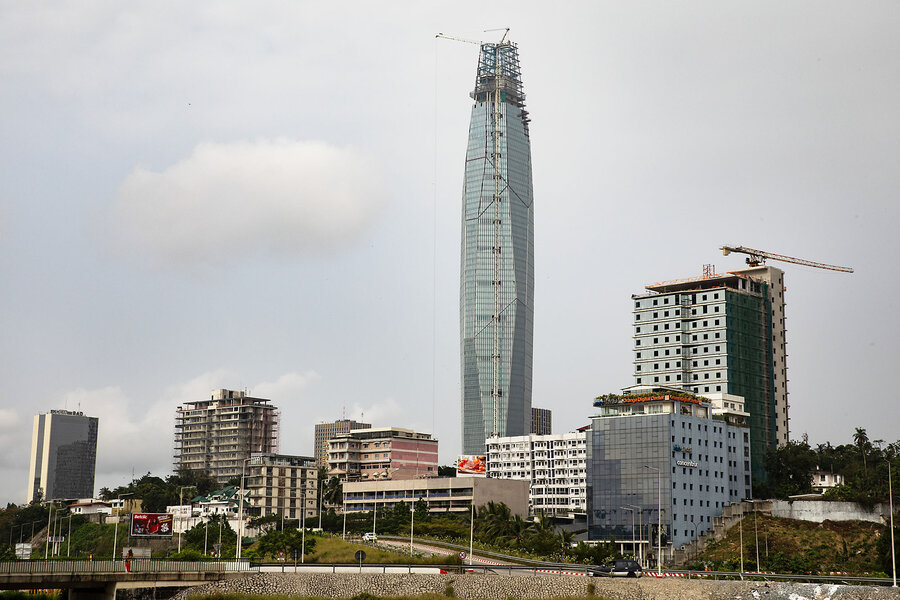
For locals, who lovingly refer to the downtown of Côte d’Ivoire’s capital Abidjan as “Little Manhattan,” the city’s skyline is about to get one step closer to the real thing.Construction is expected to be completed later this year on the 75-story Tour F. At 1,381 feet, the skyscraper will tower over the next tallest building in the city by 987 feet, and will surpass Egypt’s Iconic Tower to become the tallest building in Africa.But the Tour F – a slender column laced with 16,000 glass panels and an observation deck at its peak – is more than an architectural wonder. It is a steel-and-concrete announcement of Côte d’Ivoire’s aspirations. Why We Wrote This Around the world, super-tall buildings are often an announcement of a country's ambitions. Think New York, Dubai, Kuala Lumpur – and now, Abidjan. “The Tour F is proof that after all its struggles, Côte d’Ivoire is able to pick itself up and, quite literally, stand tall,” says Hyacinthe Bley, a historian at Félix Houphouët-Boigny University in Abidjan. Melanie Stetson Freeman/Staff The construction of Tour F in Abidjan, Côte d'Ivoire, began in 2021 and is expected to be finished later this year. A decade of rebuildingPart of understanding what the Tour F means to Ivorians, says Mr. Bley, is understanding the challenges of the country’s recent past.In 2011, Côte d’Ivoire emerged from a decade of civil war and its aftermath economically and politically fragile. But in the years that followed, it rebounded. Thanks in part to its thriving cocoa industry, the country has posted one of the most rapid rates of economic growth in sub-Saharan Africa over the last decade.The Tour F is part of this recovery story. The Ivorian government, which is funding its construction, intends to use the sleek, modern Tour F to centralize government offices currently scattered across the city. While the government has said the Tour F was envisioned to fulfill a concrete need for space, its height also points to President Alassane Ouattara’s ambitions for the country.“Urban projects like this one are not just functional pieces of infrastructure, they represent how a country wants to be perceived from the outside,” says Yacouba Doukouré, an Abidjan-based architect. “The Tour F is an architectural image that can be seen within Abidjan and beyond. ... In this way, it becomes a tool of soft power.”Novelty or utility?Not all Ivorians see the Tour F in a positive light, however. In a country where 20% of the population lives on less than $3 per day, the skyscraper’s hefty construction costs – upward of 250 billion CFA francs, or about $450 million – have raised eyebrows.Côte d’Ivoire has around 800,000 fewer housing units than it needs for its rapidly growing population, and much of the deficit is in Abidjan, where rental prices have skyrocketed.Some residents have questioned whether public money could be better spent serving the needs of local communities instead, including creating more affordable housing, “or building more schools, hospitals or roads,” says Abdoulaye, a taxi driver from the Treichville neighborhood. Melanie Stetson Freeman/Staff The developer of Tour F is the Ivorian Ministry of Construction, Housing, and Urban Planning. Others express reservation over the Tour F’s ability to project Côte d’Ivoire’s economic power.“Will it entice outsiders to come to Côte d’Ivoire to invest?” wonders Mamadou Koné, a cleaner at a residential building facing the Tour F. “Will tourists from West Africa come to see this attraction?”However, architectural historians say the risk of any new skyscraper is that it remains empty or serves no practical value, and that some level of public apprehension is normal.“The construction of super-tall buildings always creates controversy,” says Mathieu Lours, a French architectural historian who studies the world’s architectural race for height. Paris’ Eiffel Tower, for instance, was ridiculed for decades before becoming arguably one of the most iconic and well-loved pieces of architecture in the world.For now, many locals consider the Tour F a source of pride.“Some say it’s too lavish and are worried about the cost,” says Herman Kouakou, who works next door. “But when the sun reflects off the building and it turns the same color as the sky, it’s beautiful.”
Côte d’Ivoire’s ambitions are sky high. Now, it has a building to match.
Full Article
Original Source
Read the full article at Csmonitor →KhanList aggregates and links to publicly available news content. We do not host full articles from third-party sources. Always verify important information with original sources.