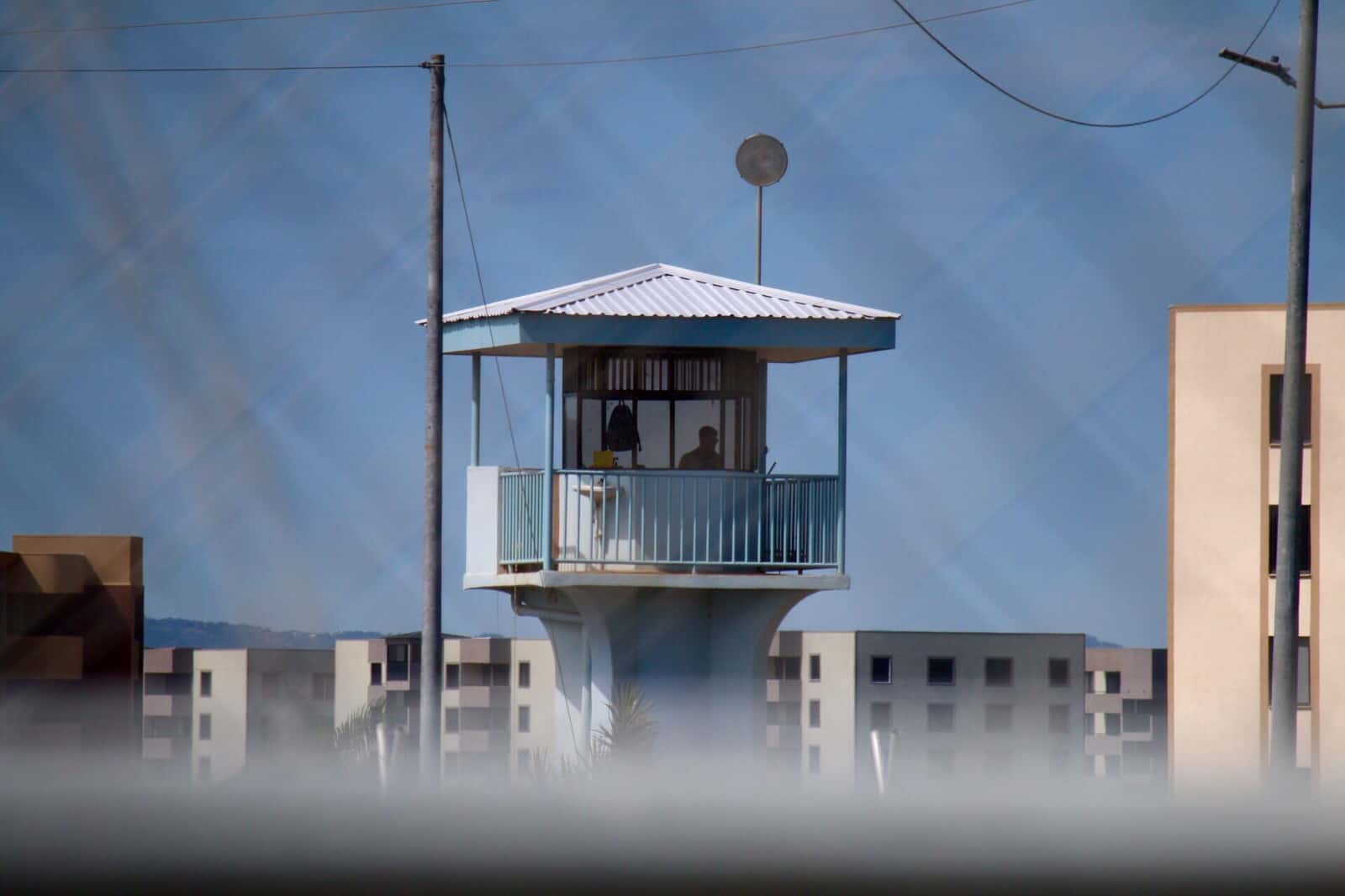
A criminal court judge in Pococí has struck down part of the isolation regime the Justice Ministry imposed on Alejandro Arias Monge, the man Costa Rican authorities described until last Friday as the most wanted fugitive, opening a direct confrontation between the Executive Branch and the Judiciary over who decides how a detainee awaiting trial is held. Justice and Peace Minister Gabriel Aguilar announced Wednesday afternoon that the judge ordered the restoration of one hour of daily sunlight, weekly telephone calls with family and family visits for Arias Monge and for Jonathan Pérez Méndez, both held in individual maximum-containment cells at the Jorge Arturo Montero Institutional Care Center in Alajuela, the prison complex known as La Reforma. The ministry had prohibited all three since the two men arrived at the facility on Friday night. Aguilar said the ruling represents a risk to national security. President Laura Fernández, appearing alongside him, questioned the fact that the attorney representing Arias Monge previously worked as a prosecutor in the Public Ministry. Neither man has been tried or convicted in the cases that brought them to La Reforma. Both are held under preventive detention, a precautionary measure a court may order to keep a defendant available to the process, and both remain presumed innocent of the charges under investigation. That distinction is the legal hinge of the dispute now unfolding. Aguilar said several restrictions survive the ruling. Contact with defense counsel continues to take place only through partition booths, with no physical contact permitted. Transfers to outside medical facilities remain prohibited, and the minister said any care the two men require will be delivered inside their cells under security protocols. Fernández instructed Aguilar to bar prison officers from carrying mobile phones inside the maximum-security area. The minister also said the prison system has removed 238 microwaves and 352 televisions from inmate cells across the country since May. The reversal follows a formal complaint filed by defense attorney Cristian Rodríguez after Monday’s precautionary-measures hearing at the First Judicial Circuit courts in San José. Rodríguez argued that denying his client sunlight and telephone contact fell below the standards the Inter-American Court of Human Rights has set for the treatment of people in state custody, and that he had been prevented from speaking with his client at the courthouse. Under the regime the ministry announced on Friday, Arias Monge was placed in an isolation cell in the maximum-security module with no light hour and no access to the yard, which in practice meant twenty-four hours a day inside a concrete room. Rodríguez, a criminal defense lawyer who previously served as a prosecutor in Hatillo and who also represents a sister of Arias Monge in a separate money-laundering file, has said he is prepared to take the matter to the Constitutional Chamber if the conditions are not adjusted. For those unfamiliar with how Costa Rican institutions divide this authority, the mechanics matter more than the sunlight. The prison system belongs to the Executive Branch: the Ministry of Justice and Peace runs the facilities, sets internal security protocols and decides where a given inmate is housed. But a person in preventive detention is not serving a sentence. Detention at that stage exists to secure the criminal process, and the court that ordered it retains oversight of how it is carried out. That gives defense counsel a route straight back to the same judge, through a complaint alleging that the executing authority has gone beyond what the detention order permits. The judge is not reviewing prison policy in the abstract; the judge is deciding whether the treatment of a specific pre-trial detainee stays within constitutional limits and within Costa Rica’s obligations under the inter-American human rights system, which treats prolonged solitary confinement as a measure requiring justification rather than a default. A ministry cannot outvote that finding. It can appeal it, and it can seek relief from a higher court, but it cannot simply decline to comply. The two men were detained on July 24 during an operation by the Judicial Investigation Agency at a property in Río Frío de Sarapiquí that ended in an exchange of gunfire. Eight officers were injured and a third suspect died. On Monday the Pococí court ordered three months and 22 days of preventive detention against Arias Monge in a case involving two homicides, an attempted homicide and alleged illicit association, running to November 16. Pérez Méndez received five months and 26 days in the same file, to December 27. Both cases were formally declared organized-crime matters, which changes the rules that apply to any future extension. Attorney General Carlo Díaz has said Arias Monge met with two agents of the United States Drug Enforcement Administration on Monday at the San José courts, a meeting Díaz said was intended to inform him of Washington’s interest in seeking his extradition and to gauge his willingness to cooperate. Today’s ruling lands on top of a week of institutional friction. Fernández, Aguilar and Minister of the Presidency Rodrigo Chaves all publicly criticized the decision to hold Monday’s hearing in person rather than by video link, and Fernández questioned why Arias Monge was moved from the prison hours before it began. The Judicial Branch responded that in-person hearings are the standing norm under court protocols and that virtual proceedings are the exception. The Public Ministry, for its part, asked publicly why an in-person hearing had drawn so much government attention while a claim the detainee made at the moment of his capture, that police officers had assisted him, had drawn so little. The text of the ruling has not been published. Its contents are known so far only through the Justice Ministry’s account of the notification it received, and the Judicial Branch had not issued its own statement or responded to press questions about the decision by Wednesday evening. Whether the ministry appeals, and how quickly the restored hour, calls and visits actually take effect inside the maximum-security module, will determine how far this confrontation runs.
Costa Rica’s government and courts collide over prison rules for Diablo
Full Article
Original Source
Read the full article at Ticotimes →KhanList aggregates and links to publicly available news content. We do not host full articles from third-party sources. Always verify important information with original sources.