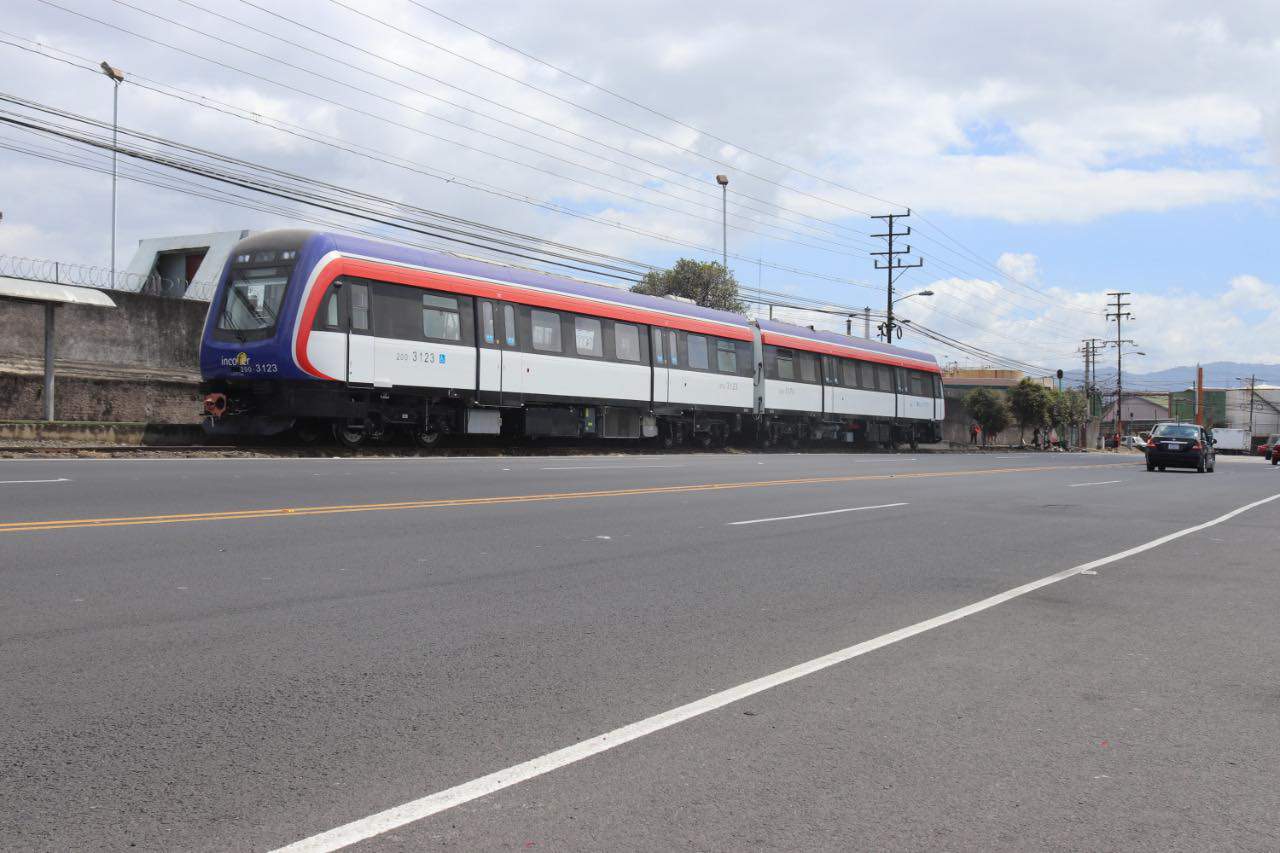
If you need to move between San José and Cartago this weekend, the train just became the easiest way to do it, and the highway is about to become the hardest. Passenger service on the Cartago line will run without a break for 27 hours, starting at 9 a.m. on Saturday, August 1, and ending at midday on Sunday, August 2. Trains leave both ends of the line — the central station in Cartago and the Atlántico station in San José — once an hour from 9 a.m. until 7 p.m. After 8 p.m. the frequency tightens to every 35 minutes and stays there all night and through Sunday morning. The last train in each direction leaves at 11:50 a.m. on Sunday, and nothing runs after that, so if you are relying on the train to get home Sunday, treat late morning as your deadline rather than your cushion. The overnight frequency is the point of the whole operation. Pilgrims walk to the Basílica de Nuestra Señora de los Ángeles through the night and finish at all hours, and almost none of them want to walk back. Doubling the departures between 8 p.m. and dawn is how the line absorbs a crowd that arrives on foot and leaves by rail. The fare is ₡710 (about $1.55) each way, the same as any other day. Trains stop in both directions at Cartago, Tres Ríos, UACA, CFIA Curridabat, Ulatina San Pedro, UCR San Pedro and Atlántico. Total capacity across the full 27 hours works out to roughly 26,000 passengers, which sounds generous until you remember the crowd walking to Cartago is many times that number. Expect to queue, and expect the busiest trains to be the ones leaving Cartago between midnight and mid-morning Sunday. The road side of the weekend is less accommodating. On Saturday, around 4 p.m., a four-kilometer (2.5-mile) stretch of Ruta 2, the Florencio del Castillo, closes to vehicles between the Fuente de la Hispanidad in San Pedro and the antigua Galera. Cross traffic will be allowed through the corridor near the San Pedro de Montes de Oca church so you can get from one side to the other, but you will not be driving along it. Central Cartago gets its own restriction, a ring of roughly three blocks around the basilica with no vehicles at all. People who live inside that ring can still get in when they need to. That 4 p.m. figure is a plan, not a promise. Officers will close the road earlier if enough people are walking to make sharing the asphalt unsafe, and they have already been running ahead of schedule this year. Around 150 traffic officers are working the weekend, and not only on the Cartago corridor — pilgrims arrive from Guanacaste, Limón, the northern zone and the south, so Ruta 1, Ruta 27, Ruta 32 and Ruta 10 are all in the operation, along with Tibás, Heredia and central Cartago. You may also hit contraflow between Cartago and San José, with lanes flipped to run one direction. It is worth understanding why, because it changes how you plan. After Sunday’s celebration ends, essentially everyone who walked to Cartago wants to leave at the same time, heading the same way. One direction carries almost the entire load while the other sits nearly empty, so borrowing a lane from the empty side is the only way to clear it. If you are driving toward Cartago on Sunday afternoon, you are the direction that gets squeezed. Two alternates are open. Ruta 218 through Ipís, Vista de Mar and Rancho Redondo takes any vehicle. Ruta 212 through Patarrá and Coris to La Lima is for light vehicles only, so leave it alone if you are in anything heavy or towing. What you should not do is take Ruta 251, the old road to Cartago. That is precisely where walkers are being directed for the final stretch between the antigua Galera and Taras, because the speeds are lower and there is somewhere to step off the pavement. Driving it puts you in a slow river of pedestrians instead of around the congestion. For those visitors among us who are flying this weekend, there are a few practical and important things to keep in mind. If you are staying anywhere on the Cartago side and have a flight out Saturday evening or Sunday morning, build in hours rather than minutes and pick a route that does not depend on Ruta 2 at all. If you have a rental car due back, confirm the return time now — a car you cannot physically deliver is still a car you are being charged for. If you booked a driver, ask them which route they intend to use, because a transfer priced on a normal Saturday will not survive a closed highway. And from 6 a.m. Sunday, enforcement on the Florencio del Castillo tightens specifically around speed, illegal parking and overloaded vehicles, so this is not the weekend to improvise. Our best advice is the oldest advice. Between Saturday afternoon and Sunday midday, take the train, walk, or stay where you are. Anyone who tries to drive that corridor on its busiest weekend of the year is choosing the slowest option available.
Costa Rica Trains Will Run 27 Hours Straight for the Romería
Full Article
Original Source
Read the full article at Ticotimes →KhanList aggregates and links to publicly available news content. We do not host full articles from third-party sources. Always verify important information with original sources.