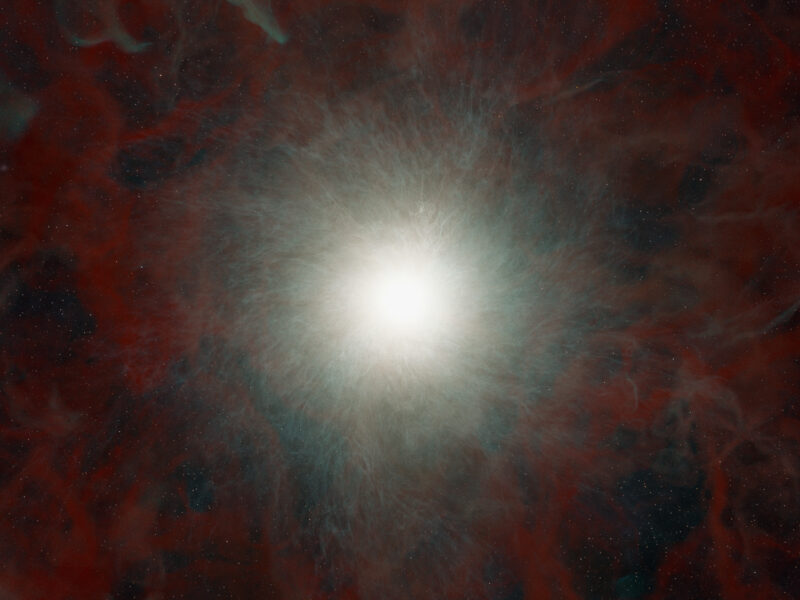
Observations of a black hole’s gas consumption have provided a more complex understanding of the cosmic phenomena.(CN) — Black holes are big eaters on an extragalactic scale. No other known interstellar entity comes close to absorbing as much matter as these astronomical bodies can, thanks to their reaction to the all-governing forces of time and space as flexible suggestions.But a new study from the University of Warwick shows black holes may be more peckish, and more flatulent, when consuming matter than previously supposed.Astronomer Noel Castro Segura led researchers in observing the black hole system Swift J1727.8−1613, which was discovered in 2023 after it emitted an “outburst,” or an expulsion of light and matter on a massive scale.Use of the European Southern Observatory’s Very Large Telescope, located in northern Chile, allowed Segura’s team to carefully analyze this outburst, which lasted 10 months, according to a prior research study from Spanish astrophysicists.During that time, Swift J1727.8−1613 fed off a nearby star, drawing in and consuming gas. But it also expelled much of that material — potentially close to the same amount it actually consumed — back into space as powerful jets and winds.Astronomers contend this form of matter ejection happens particularly within “faint,” lower-activity black holes.“People often imagine black holes simply swallowing everything around them,” Castro Segura stated. “What we’re seeing is a much more complex process. Matter falls in, the system processes it, and a surprising amount is expelled again.”The findings come with obvious comic relief, as the factoid that black holes can apparently pass gas is one that science journalists and school field trips alike can surely enjoy.More importantly, though, the study heightens humanity’s understanding of the universe’s most inscrutable celestial objects.A key revelation came after the Swift J1727.8−1613 outburst, which created a bright, dramatic light show for scientists viewing telescopically, had mostly mellowed. The black hole was still emitting gas, even at an estimated 1% of its peak activity.“If black holes can continue shedding material even after their largest outbursts, it means they may be much less efficient eaters than we previously assumed. A significant fraction of the meal may never reach the black hole at all, changing our understanding of how binary stars in galaxies evolve,” said Castro Segura.Subscribe to our free newslettersOur weekly newsletter Closing Arguments offers the latest about ongoing trials, major litigation and rulings in courthouses around the U.S. and the world, while the monthly Under the Lights dishes the legal dirt from Hollywood, sports, Big Tech and the arts.Additional Reads
‘Cosmic digestive systems’: Black hole appetites surprise scientists
Full Article
Original Source
Read the full article at Courthousenews →KhanList aggregates and links to publicly available news content. We do not host full articles from third-party sources. Always verify important information with original sources.