
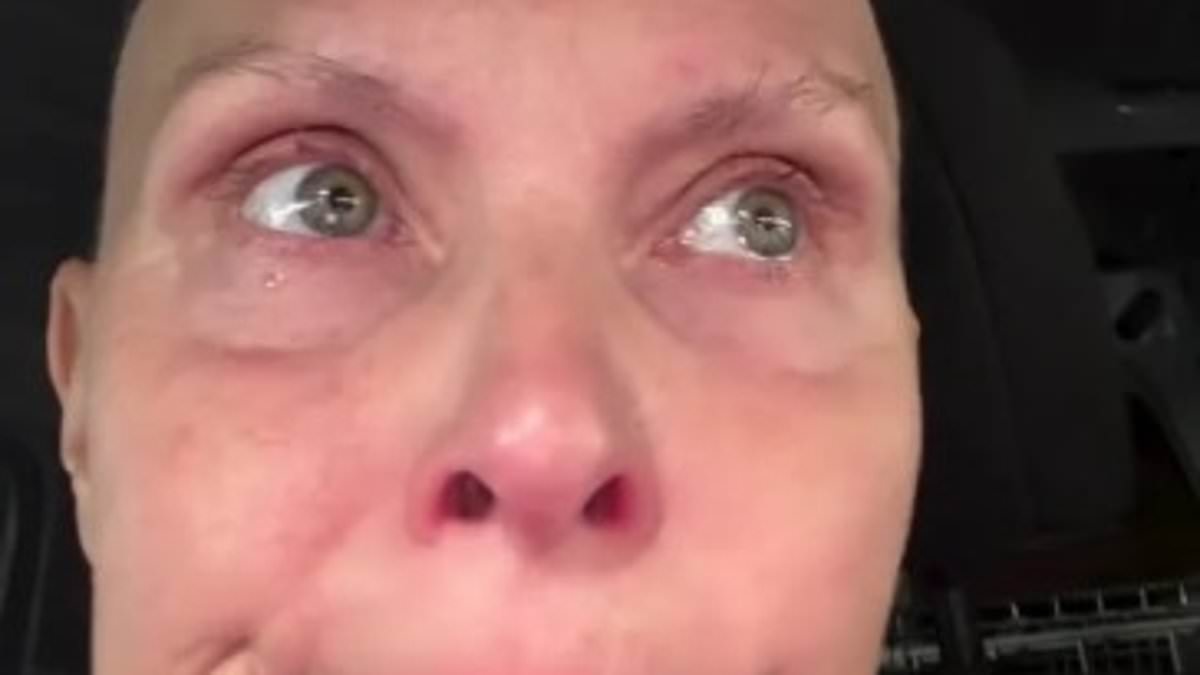
Former Coronation Street star Tracy Shaw fought back tears after missing an important breast cancer appointment because she couldn't find a parking space at the Royal Berkshire Hospital. The actress, 53, who played Maxine Peacock in the ITV soap, said despite arriving really early, she couldn't find anywhere to park after spending 45 minutes driving around. Tracy was diagnosed with the disease in April after finding a lump in her breast and had her fourth round of chemotherapy last month. In a teary Instagram story, Tracy said: 'So, my update is I'm sat in the car park and I missed the appointment.'I rang them and they said because it was the first appointment, they're not sure [if] the doctor can see me now.'I arrived really early and I've been driving around the car park now for 45 minutes. Former Coronation Street star Tracy Shaw fought back tears after missing an important breast cancer appointment because she couldn't find a parking space the Royal Berkshire Hospital'The advice I was given was, 'Could you go out and park on the road?' and I said, 'The likelihood of me finding a space is so slim.''Everyone who knows, [or] comes to Royal Berkshire [Hospital], knows there's a real problem for finding a space.'The anxiety it's brought up is horrendous and the one appointment I'm looking forward to having, I couldn't make.'I haven't got anyone to drop me off. Luca's gone back to Uni now.'This happens all the time… I was late 45 minutes for chemo, once. Car parks, hey?'Tracy later said the appointment will now have to be rearranged and thanked fans for their suggestions and messages. Last month, Tracy fought back tears as she revealed her breast cancer is currently inoperable until her tumours shrink in size. Tracy shared the video after going for an ultrasound to check on her current condition, sharing her hopes that chemotherapy would have shrunk the lumps. The actress, 53, who played Maxine Peacock in the ITV soap, said despite arriving really early, she couldn't find anywhere to park after spending 45 minutes driving aroundHowever, during the teary clip, Tracy explained that while the lumps have changed shape from round to oval, they haven't got any smaller. Speaking to the camera, she said: 'Good morning, everyone. So as I told you all, I had my ultrasounds today to find out if the lesions had shrunk.'I also needed to check a lump that I'd found on the other breast, which is on the right breast.'The good news is that the lump, well there's actually quite a lot, are all cysts, so that's good news and the lesions on my left breast… erm…'Tracy continued: 'Well, my expectations were that judging by what personally I've gone through and what the chemo does...'I thought they'd shrunk but basically they've gone from being circular to oval but not really shrunk in size. I don't know what I was expecting.'I think I'm just expecting some results of what I've felt, some results of what the body has had to go through too!'Tracy played her character Maxine from 1995 as the friend of Fiona Middleton, played by Angela Griffin.Her character went on to betray her friend by having a one-night stand with Fiona's boyfriend, Steve McDonald.Tracy was awarded the Rear of Year title a year after making her debut on the show.Maxine married butcher Ashley Peacock, played by Steven Arnold.She also had a child with the local doctor, despite being married to Ashley.Maxine died when she was viciously murdered by Richard. She was hit by a crowbar after she returned home from the pub.Tracy also launched a pop career in 1998 and released two singles: Ridin' High and a cover of Lonnie Gordon's Happenin' All Over Again.After she left the soap, she played smaller roles in ITV dramas. She has spent most of her time in the theatre.Breast cancer is one of the most common cancers in the world and affects more than two MILLION women a year Breast cancer is one of the most common cancers in the world. Each year in the UK there are more than 55,000 new cases, and the disease claims the lives of 11,500 women. In the US, it strikes 266,000 each year and kills 40,000. But what causes it and how can it be treated?What is breast cancer?It comes from a cancerous cell which develops in the lining of a duct or lobule in one of the breasts.When the breast cancer has spread into surrounding tissue it is called 'invasive'. Some people are diagnosed with 'carcinoma in situ', where no cancer cells have grown beyond the duct or lobule.Most cases develop in those over the age of 50 but younger women are sometimes affected. Breast cancer can develop in men, though this is rare.Staging indicates how big the cancer is and whether it has spread. Stage 1 is the earliest stage and stage 4 means the cancer has spread to another part of the body.The cancerous cells are graded from low, which means a slow growth, to high, which is fast-growing. High-grade cancers are more likely to come back after they have first been treated.What causes breast cancer?A cancerous tumour starts from one abnormal cell. The exact reason why a cell becomes cancerous is unclear. It is thought that something damages or alters certain genes in the cell. This makes the cell abnormal and multiply 'out of control'.Although breast cancer can develop for no apparent reason, there are some risk factors that can increase the chance, such as genetics.What are the symptoms of breast cancer?The usual first symptom is a painless lump in the breast, although most are not cancerous and are fluid-filled cysts, which are benign. The first place that breast cancer usually spreads to is the lymph nodes in the armpit. If this occurs you will develop a swelling or lump in an armpit.How is breast cancer diagnosed?Initial assessment: A doctor examines the breasts and armpits. They may do tests such as a mammogram, a special X-ray of the breast tissue which can indicate the possibility of tumours.Biopsy: A biopsy is when a small sample of tissue is removed from a part of the body. The sample is then examined under a microscope to look for abnormal cells. The sample can confirm or rule out cancer.If you are confirmed to have breast cancer, further tests may be needed to assess if it has spread. For example, blood tests, an ultrasound scan of the liver or a chest X-ray.How is breast cancer treated?Treatment options which may be considered include surgery, chemotherapy, radiotherapy and hormone treatment. Often a combination of two or more of these treatments are used.Surgery: Breast-conserving surgery or the removal of the affected breast depending on the size of the tumour.Radiotherapy: A treatment which uses high energy beams of radiation focused on cancerous tissue. This kills cancer cells, or stops them from multiplying. It is mainly used in addition to surgery.Chemotherapy: A treatment of cancer by using anti-cancer drugs which kill cancer cells, or stop them from multiplying.Hormone treatments: Some types of breast cancer are affected by the 'female' hormone oestrogen, which can stimulate the cancer cells to divide and multiply. Treatments which reduce the level of these hormones, or prevent them from working, are commonly used in people with breast cancer.How successful is treatment?The outlook is best in those who are diagnosed when the cancer is still small, and has not spread. Surgical removal of a tumour in an early stage may then give a good chance of cure.The routine mammography offered to women between the ages of 50 and 71 means more breast cancers are being diagnosed and treated at an early stage.For more information visit breastcancernow.org or call its free helpline on 0808 800 6000
Coronation Street star Tracy Shaw breaks down in tears after missing breast cancer appointment because she couldn't find a parking space
Full Article
Original Source
Read the full article at Dailymail →KhanList aggregates and links to publicly available news content. We do not host full articles from third-party sources. Always verify important information with original sources.