
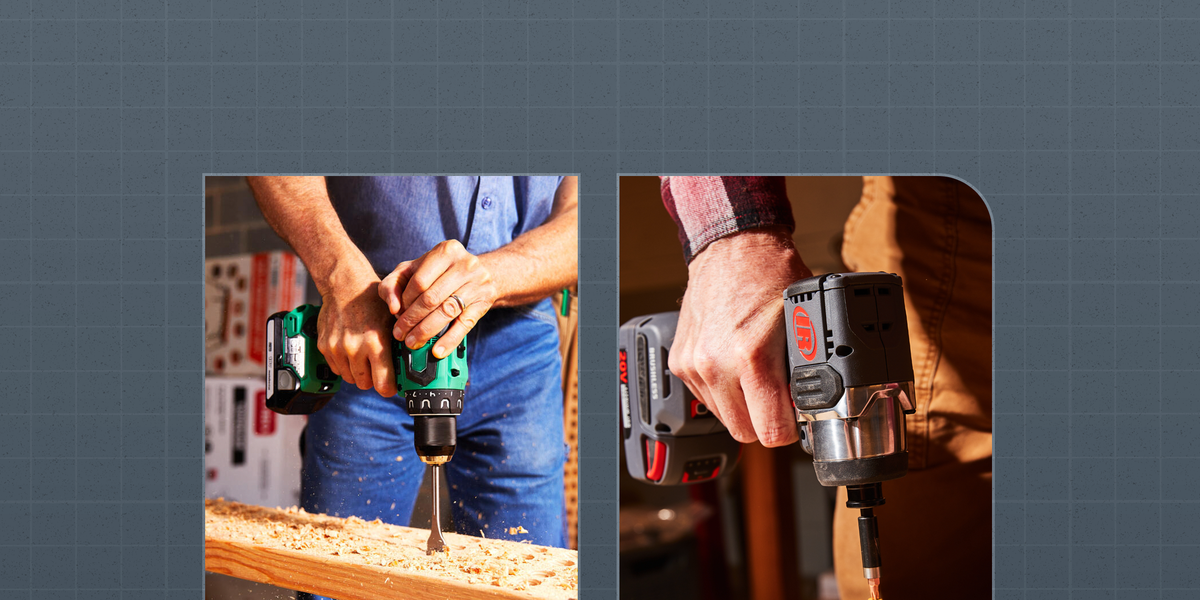
5 min readMy cordless drill/driver and my impact driver always travel together. In fact, I happen to have two of each. One pair takes up permanent residency in my truck, and the other lives in a closet at home. The fact is a lot of jobs, whether I’m contracting or working on my own home, call for using both. It’s rare I only need one of the two, unless I’m really just doing a quick, singular task.And I know, they look a lot alike, but the reason why each of these tools offers something unique relates to the mechanisms, both internal and external, by which they actually drive fasteners into material. It can be a little confusing to know when to reach for one over the other, so below is a quick primer on the functionality and proper use case for each tool.How Cordless Drill/Drivers WorkA cordless drill/driver is a conventional drill that doubles as a powerful driver of fasteners. The drivers on these tools operate in a smooth, continuous rotation and employ a lower, more controllable amount of torque—about 400 to 1,400 inch-pounds of maximum torque, compared with roughly 1,500 to 2,000 for impact drivers. Most drill/drivers have multi-speed settings as well as an adjustable clutch—indicated by a series of numbers on a rotational collar near the bit—which gives you a higher degree of power versatility when it comes to drilling or running fasteners.Let’s say you’re using Milwaukee’s M18 FUEL hammer drill/driver—our pick for Best Overall Cordless Drill—and you want to drill a few holes in masonry to mount an outdoor television. Turning the collar to the “Hammer” icon will automatically bypass the variable clutch settings. In addition to drilling, the hammer setting alters the smooth motion of the drill’s rotation, where it incorporates a back-and-forth tapping of the drill bit. The hammer mechanism fractures masonry ahead of the bit, allowing the flutes to remove the debris. Once the holes are drilled to the proper depth, the drill can be converted to a driver simply by turning the collar from the “Hammer” icon to the “Drill” icon, where fasteners like Tapcon screws can be installed using the appropriate bit and recommended torque.Again, these drill/drivers are extremely versatile. I use my DeWalt 20V Max drill for everything from running in drywall screws to boring plumbing holes through framing with a hole-saw bit. I find this type of tool especially useful if I’m assembling furniture from IKEA or Wayfair. I even use mine to stir paint, and I’d be lost without it when it comes time to mix grout for a tile project.Where I don’t typically use a drill/driver is when I’m running longer and stronger fasteners—like decking or construction screws—through sturdier material. At some point in the driving process, the drill/driver may stall, trigger the clutch, overheat, or strip the screw if the bit slips. If you’ve ever rounded out the “+” head of a Phillips fastener—a situation known as “cam out”—you fully understand the frustration that follows. So if I’m consistently running construction fasteners, I try to reach for a more powerful impact driver.How Impact Drivers WorkAt first glance, an impact driver bears a striking resemblance to a standard drill/driver, with one obvious difference: the bit holder. Instead of a three-jaw chuck and numbered clutch collar, an impact driver typically uses a quick-release hex collet that accepts 1/4-inch hex-shank bits. While impact drivers can drill with impact-rated, 1/4-inch hex-shank drill bits, they’re primarily designed for driving fasteners to secure a fit with greater torque than a drill/driver.The internal workings of an impact driver are actually kind of fascinating. Inside the tool, the motor spins a hammer assembly. When the fastener creates enough resistance, the hammer rides up angled ramps where it briefly disengages from an anvil, storing energy in the mechanism’s spring. It then drops back down and strikes the anvil with a sharp rotational blow. This cycle repeats many times per second. Those impacts are delivered in the direction of rotation, helping the driver overcome resistance while reducing the twisting force transmitted to your wrist.It’s different from a hammer drill, whose mechanism produces rapid forward-and-back impacts to help drill into masonry. An impact driver’s blows are primarily rotational—not axial—where their energy is transferred into higher torque at the bit, giving it the power to drive those longer fasteners. For fastening lumber together, you might reach for Milwaukee’s M18 FUEL 1/4-Inch Hex Impact Driver for driving those long screws through the framing members.That extra torque makes matching the bit to the screw particularly important. Many construction fasteners used today employ a star-shaped drive with the size identified by a number. Structural screws frequently use a T25 bit, while smaller finish screws may use T8, T10, T15, or another size. Cabinet screws also commonly use T20 or T25 drives, although the exact size varies by brand and fastener. Check the fastener package before you start—the wrong bit can cam out and damage the screw head in a hurry.If I’m doing some light framing or building a quick project in the garage, I’ll reach for the impact driver every time, mainly because the risk of cracking the lumber is significantly minimized (compared to using a nail gun), and the fixed results can be undone in the event that I make a mistake. More importantly, though, with an impact driver I know I’m going to create an extremely tight joint with little effort and even less risk of inflicting cam out on the screw if it meets resistance.Final TakeawayThere have been so many instances in my life as both a homeowner and a contractor where I’ve reached for both a cordless drill and an impact driver in the same project. Maybe that’s the reason companies like DeWalt sell them as a packaged kit. The tools share batteries and a charger, and you generally save money buying them together.My advice is to own both. Use the drill/driver for boring holes and fastening delicate pieces like ready-to-assemble furniture with finesse, and grab the impact driver when you need to fasten things together with authority such as framing members and deck boards.Drill/Impact Driver Kits We RecommendPaul Russell Smith is a former NYC ironworker turned screenwriter (Grace Point) and home renovation specialist. He lives in a crooked old farmhouse in Stockton, NJ, where he’s just as likely to be clearing a clogged pipe as rewriting a third act. When he’s not working, he enjoys hiking, pedestrian beer, and cooking over a live fire. His self-proclaimed spirit animal is the English Bulldog.
Cordless Drills vs. Impact Drivers: When to Use Each and Why You Need Both
Full Article
Original Source
Read the full article at Popularmechanics →KhanList aggregates and links to publicly available news content. We do not host full articles from third-party sources. Always verify important information with original sources.