
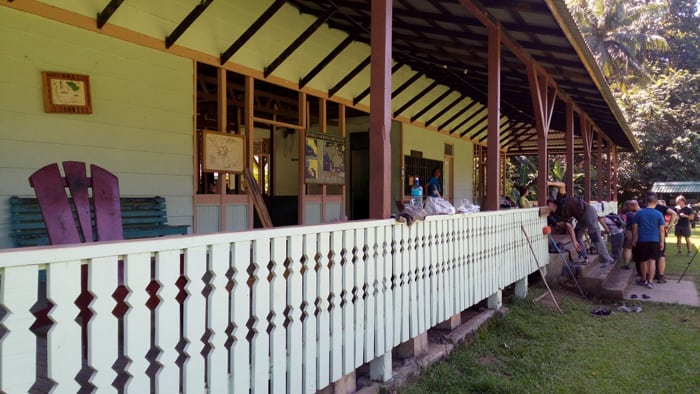
A coalition of Costa Rican environmental organizations has placed Corcovado National Park under what it calls a red alert, warning that sewage discharges, decaying infrastructure and chronic underfunding at our most popular protected area point to a wider breakdown across the national park system. The Parlamento Cívico Ambiental, an umbrella body grouping environmental organizations from across the country, issued the manifesto on August 10 under the title “For our protected areas: Corcovado on red alert.” The document is dated July 31 and is framed around the first 100 days of President Laura Fernández’s administration, a mark her government reaches on August 16. “Corcovado is not only a national park. It is water, forest, biodiversity and a promise Costa Rica has made to the world and to future generations: that nature can stand above abandonment and economic interest,” the manifesto states. “One hundred days into the Fernández administration, as with our entire system of protected areas, that promise is at risk.” At the center of the complaint are discharges of wastewater and fecal matter from the Sirena Biological Station into water bodies inside the park. The manifesto says the discharges were verified by the Costa Rican Institute of Aqueducts and Sewers (AyA) and the Ministry of Health. The groups argue the contamination cannot be written off as an isolated technical fault. They describe it instead as the visible signal of a deeper crisis in how protected areas are managed, maintained, financed and supervised. What the signatories call most alarming is that the situation appears to have persisted despite health warnings, technical reports and prior institutional knowledge of the problem. “When controls arrive late and responsibilities are diluted, conservation ceases to be a guarantee and becomes a discourse,” the document states, arguing that this compromises the right to a healthy and ecologically balanced environment recognized in Article 50 of the Constitution. The wastewater treatment plant at Sirena discharges into Quebrada Camaronal, a stream that runs behind the station inside the park boundaries. Ministry of Health inspections concluded that wastewater was being released without quality control or operating records, and the ministry ordered the situation corrected by December 31, 2025. That deadline passed without compliance. A December 2025 report by AyA and the National Water Laboratory found the remedial plan had not been carried out and described the condition of the plant as limiting to the operation of all services at the station. An earlier AyA inspection in November 2025 found the discharges into Quebrada Camaronal exceeded legal limits for biochemical oxygen demand, chemical oxygen demand and total suspended solids. When AyA applied the Ministry of Health’s technical guide for evaluating treatment systems, Sirena failed slightly more than 80 percent of the criteria assessed, including signage, operating and maintenance manuals, approved plans and a numbered operations log. The same report found the discharge point had never been registered with the Water Directorate, that no operational reports were filed, and that no payments were made toward the environmental levy owed on wastewater discharges. The Ministry of Environment and Energy (MINAE) has said the plant was designed in 2017 to handle roughly 100 people per day but had been receiving more than 200 since 2022. The ministry also acknowledged the plant had gone without continuous electricity for about eight years, a serious problem for a system whose aerobic stage depends on powered blowers to keep treatment bacteria alive. The question of how many visitors Sirena should receive has swung back and forth this year. On June 26, the then director of the Osa Conservation Area, Juan José Jiménez Espinoza, cut the daily limit at Sirena to 150 people, split between 100 day visitors and 50 overnight guests, citing the sanitary crisis. Six days later, Environment Minister Mónica Navarro Del Valle reassigned him to a desk post at SINAC headquarters, a move that drew protests along the southern Pacific coast. His replacement raised the ceiling again on July 9, to 225 people per day through September, with 175 day visits and 50 overnight stays. That resolution leaned on an AyA finding that restroom batteries installed in recent weeks at the Los Naranjos sector could operate independently of the treatment plant. SINAC acknowledged in the same document that rehabilitation of the plant itself had not been completed. The reversals follow a Constitutional Chamber ruling issued on August 8, 2025, which struck down a 2023 resolution that had raised Corcovado’s daily visitor ceiling from 560 to 700. The court found the increase lacked explicit technical grounding. SINAC has requested more than 2.63 billion colones (about $5.8 million) from the Rural Development Institute to finance comprehensive infrastructure improvements at Sirena, and has assigned a further 50 million colones (roughly $111,000) through a REDD+ master plan covering 2026 to 2028. Sirena closes each October for seasonal maintenance, and most of the repair work is expected during that window. The manifesto sets out four demands. The first is a comprehensive investigation into what happened at Corcovado, with responsibilities assigned, technical reports and sanitary orders made public, and damaged infrastructure repaired immediately and effectively. The second is a public, transparent national audit of sanitary, operational and environmental infrastructure across all protected areas, differentiated by management category, visitation levels and actual needs. The third calls for a real and verifiable increase in SINAC’s budget, with sufficient staff, adequate equipment, continuous maintenance and genuine capacity to prevent, correct and penalize environmental damage. The fourth demands a review of permits, concessions and commercial activities inside protected areas, alongside open data, accountability, citizen participation and consequences for unjustified non-compliance. “Corcovado is not the problem: it is the alarm,” the manifesto concludes. “We cannot normalize places called upon to receive the greatest protection operating with deteriorated infrastructure, precarious services, insufficient controls and late responses.” Corcovado covers 424 square kilometers (164 square miles) on the Osa Peninsula and was declared a protected wilderness area in 1975. SINAC figures put annual visitation above 60,000, with Sirena the most heavily used sector and the focus of a longer argument over how much tourism the park can absorb. The document carries the signatures of Bernardo Aguilar González, Victoria Rudín Vega, Oscar Moya Cantero and Melanie Pérez Vargas on behalf of the Parlamento Cívico Ambiental. It closes with an appeal aimed less at any single ministry than at the public: defending Corcovado, the group argues, means defending water, biodiversity and ecological democracy, and it cannot wait.
Corcovado National Park Placed on Red Alert Over Sewage and Crumbling Infrastructure
Full Article
Original Source
Read the full article at Ticotimes →KhanList aggregates and links to publicly available news content. We do not host full articles from third-party sources. Always verify important information with original sources.