
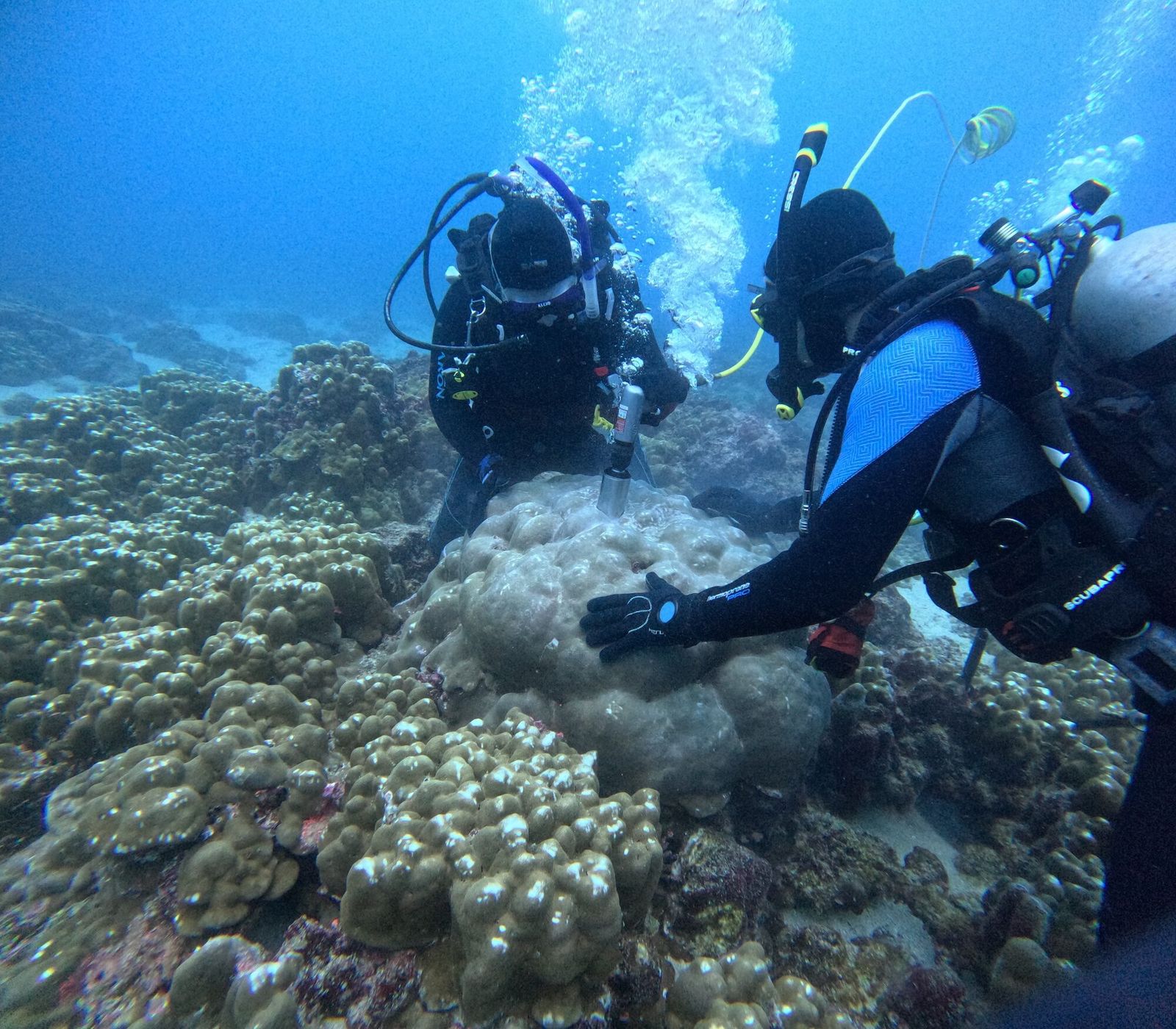
Researchers used elements trapped within Galápagos corals to understand natural swings in the climate over the past millennium. They hint that variability has gone up over the past 40 years compared to preindustrial times September 2, 2026 10:00 a.m. The researchers have collected thousands of coral samples since 2006. Julia Cole / University of Michigan As the world braces for the “super” El Niño currently gathering strength in the Pacific Ocean, scientists have found that the events have been intensifying as the world warms. That’s according to an analysis of records preserved in corals from the Galápagos Islands. It hints that El Niño climate swings have grown stronger since we started burning more fossil fuels—releasing planet-warming carbon dioxide into the air—in the mid-19th century. While the findings, published in the journal Science on August 27, don’t go as far as blaming human-caused climate change for this trend, they do suggest it is the most likely culprit. “This is a timely and important addition relevant to the question of climate change impacts on El Niño strength,” says Kim Cobb, a climate scientist at Brown University who was not involved in the work, to Andrew Freedman at CNN. “While we wait to see just how large the 2026 El Niño will become, this study provides fresh evidence that man-made global warming may be responsible for a portion of its chart-topping size.” The El Niño-Southern Oscillation (ENSO) is a natural climate phenomenon in the Pacific Ocean. It moves between two extremes: El Niño, characterized by warmer-than-average surface water temperatures in the central and eastern tropical Pacific Ocean, and La Niña, defined by cooler-than-average water temperatures in the region. ENSO involves interactions between the atmosphere and the ocean, and it’s a major driver of changes in the global climate. The El Niño phase, for instance, generally brings wetter and cooler winters to the southern United States, while parts of South America, South Asia and Australia experience hot, dry weather. Quick fact: The looming “super” El Niño Last month, the National Weather Service announced that there’s a nearly 70 percent chance the El Niño currently brewing could become the strongest one on record, which dates back to 1950. Because of those far-reaching effects, scientists want to know whether rising global temperatures are affecting ENSO. However, computer simulations struggle to replicate the delicate dance between the atmosphere and ocean, and reliable preindustrial temperature measurements from some parts of the tropical Pacific are scarce, reports James Dinneen at Nature. Enter corals. These animals offer a precise window into the ocean’s past. “The chemistry of the coral skeleton preserves a record of the environment in which it grew, and certain aspects of the chemistry are especially sensitive to temperature changes,” study co-author Julia Cole, a climate change scientist at the University of Michigan, tells New Scientist’s Madeleine Cuff. Since 2006, she and her colleagues have collected thousands of coral samples from the Galápagos Islands, an area key to El Niño’s formation, per Nature. The specimens collectively hold a record of the past millennium. Within the corals’ layers, levels of the element strontium and different forms of oxygen can reveal past weather patterns. When ocean waters are warmer, the animals tend to pull less strontium into their skeletons and use more of a lighter version of oxygen, called O16, compared to the heavier O18. Chemical analyses of these elements in the time capsules revealed that ENSO variability over the past 40 years was about 36 percent greater than that during preindustrial times. The recent swings are also roughly 16 percent greater than those that took place between 1851 and 1982. “We are looking at a system that has been perturbed,” Cole tells CNN. “We can see that it’s not behaving the way it used to.” Study co-author Diane Thompson, a marine researcher at the University of Arizona, collects a sample from an ancient coral. Courtesy of the University of Michigan The findings add to a growing body of evidence suggesting the ENSO cycle is getting more intense with climate change, though there is still some uncertainty among scientists. Some studies have failed to find a strong link between global warming and ENSO variability. Nevertheless, “the evidence is better than 50-50 that climate change is affecting El Niño,” Mark Cane, an oceanographer at Columbia University, tells New Scientist. Cole suspects that human-driven climate change is the strongest explanation for her team’s findings. “That’s the thing that has changed over that time,” she tells Julia Vaz at Science. “So, if I get pushback on that, I would like to know what the alternative is.” You Might Also Like Get the latest stories in your inbox every weekday. More about: Climate Change Coral Reefs Fossils Global Warming Weather
Corals Reveal El Niño Events Have Become Stronger in Recent Decades, Probably Because Humans Have Been Heating Up the Planet
Full Article
Original Source
Read the full article at Smithsonianmag →KhanList aggregates and links to publicly available news content. We do not host full articles from third-party sources. Always verify important information with original sources.