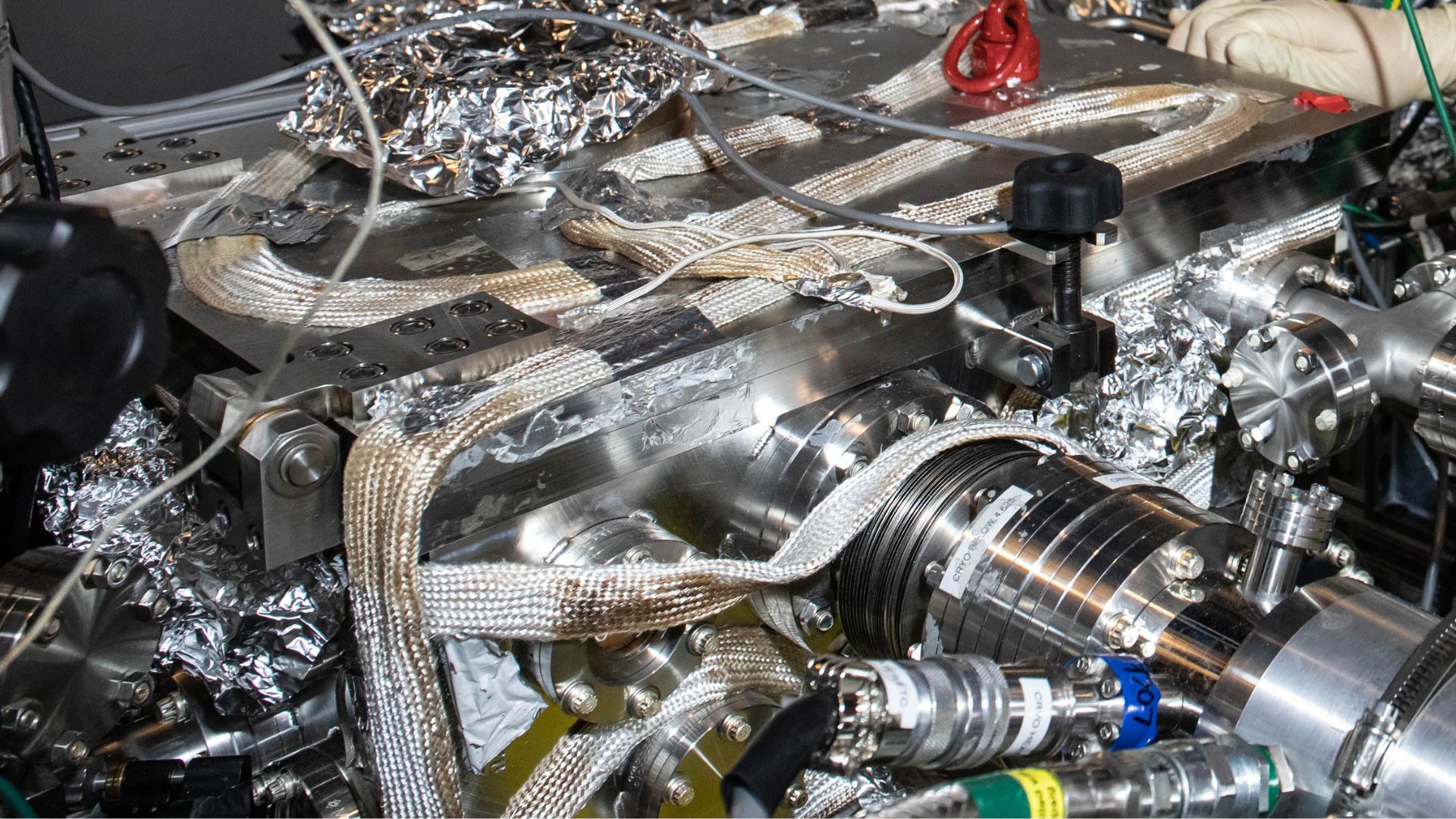
Scientists have discovered that copper melts gradually rather than collapsing all at once under extreme heat. The finding challenges earlier computer models that predict how nuclear fusion reactor materials handle extreme thermal loads. The study was published in Nature Communications. It was led by researchers at the Department of Energy’s SLAC National Accelerator Laboratory, working alongside teams from several European universities. Standard materials testing often uses a “cook and look” method. Researchers blast a sample with extreme heat and inspect the melted residue after it cools. However, this approach leaves only a metallic puddle, making it impossible to see the step-by-step physical changes that occur during heating. To solve this problem, the team used SLAC’s MeV-UED instrument. This electron camera can track atomic movements down to the femtosecond, which is one quadrillionth of a second. The researchers hit a thin copper film with laser heat to trigger rapid temperature increases. “They blasted a thin copper film with laser heat, then sent an electron beam to image the sample as it heated,” said an SLAC press release. “What they saw surprised them.” Defying predictions at superheating limit Past computer models predicted a very different outcome for copper during rapid heating. According to these simulations, the sample would start melting at its surfaces around 1,085°C (1,985°F). “The sides and edges would continue melting with increasing temperature, while the central area of the sample, which is subject to higher pressures, would retain its crystal lattice structure for longer,” explained the press release. Those simulations indicated that once the core reached about 1,424°C (2595.2°F)—roughly 1.25 times the normal melting point—the remaining crystal structure would suddenly break down into liquid. This point is known as copper’s superheating limit. Instead, the real-time images revealed that copper retained order in its crystal lattice and melted steadily past this theoretical limit. The experiments also detected pre-melting, where atomic disorder formed along nanoscale grain boundaries before the metal reached its standard melting point. The team discovered why older computer simulations failed to match the experiment. Computer models often use assumptions to manage complex atomic calculations. “In this case, existing simulations had assumed the melting copper would face static conditions, with uniform pressure on all sides keeping the atoms fixed in place,” noted the researchers. Refining simulations for fusion energy applications In reality, the experiment involved dynamic pressure conditions. These dynamic conditions allowed the copper atoms to relax and shift, which helped the material retain structural order past the superheating limit. Once scientists included these dynamic conditions in their computer calculations, the simulation results matched the experimental data. “This is a major improvement to modeling capabilities and their predictive power going forward,” said Siegfried Glenzer, High Energy Density Science division director. “The precision and resolution with which we are able to see these things demonstrates how remarkable this technique is at unveiling these ultrafast, ultrasmall dynamics.” These findings will directly support the development of future fusion power plants. Fusion reactors aim to recreate the energy processes of stars. While the core plasma reaches hundreds of millions of degrees, the components surrounding the chamber must endure sudden, extreme heat spikes similar to spacecraft entering Earth’s atmosphere. Engineers use computer models and artificial intelligence to screen materials for these harsh environments. “With a stronger grasp on copper’s behavior, they plan to study the more complex dynamics of copper alloys and their potential for absorbing heat in fusion systems,” concluded the press release. The SLAC-led team now plans to test copper under balanced pressure conditions. They will also use their electron imaging method to study more complex copper alloys. Get the latest in engineering, tech, space & science - delivered daily to your inbox.An active and versatile journalist and news editor. He has covered regular and breaking news for several leading publications and news media, including The Hindu, Economic Times, Tomorrow Makers, and many more. Aman holds expertise in politics, travel, and tech news, especially in AI, advanced algorithms, and blockchain, with a strong curiosity about all things that fall under science and tech.
Copper endures 2,595°F in US nuclear fusion reactor material test, defies earlier models
Full Article
Original Source
Read the full article at Interestingengineering →KhanList aggregates and links to publicly available news content. We do not host full articles from third-party sources. Always verify important information with original sources.