
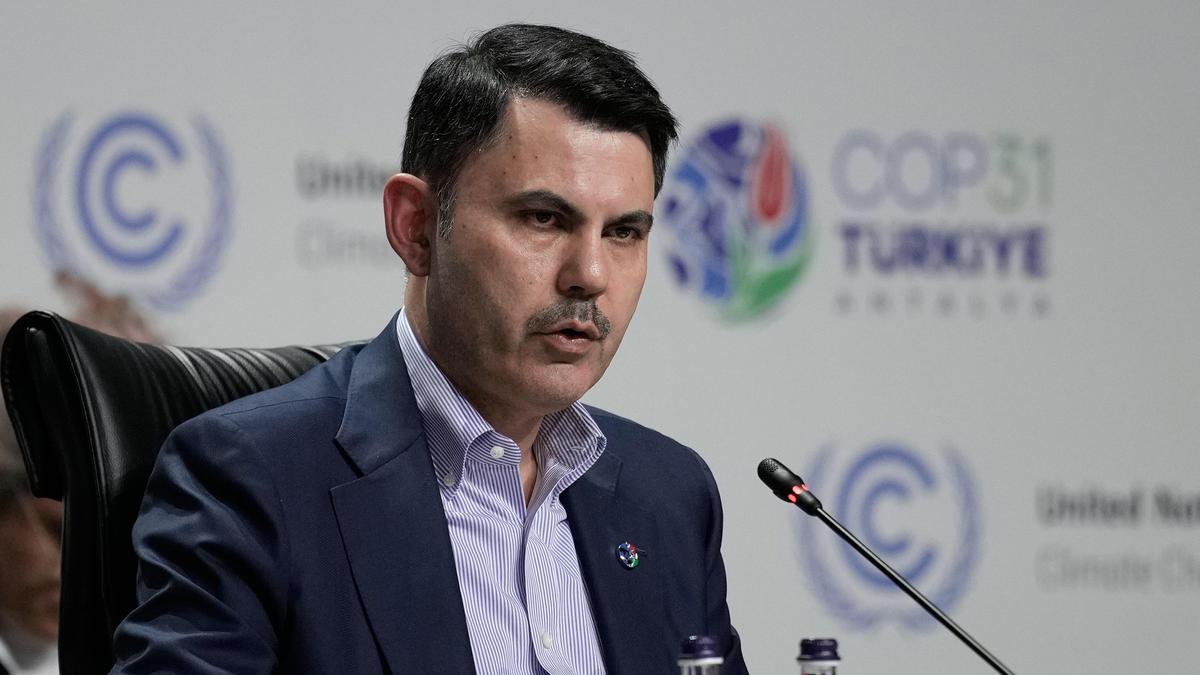
The draft from Turkish Environment Minister Murat Kurum, president of COP31, was released in the wee hours of November 22 morning. | Photo Credit: AP The newest and possibly final proposed agreement to come out of United Nations climate talks doesn't contain the words fossil fuels, the chief cause of global warming, or specifically call for transitioning away from the coal, oil and gas that spew carbon dioxide and other greenhouse gases into the atmosphere.The draft from Turkish Environment Minister Murat Kurum, president of the two-week conference in Antalya, Turkiye, called COP31, was released in the wee hours of Sunday (November 22, 2026) morning. Mr. Kurum gave negotiators only about three hours to make objections or ask for changes before the wording goes before the conference plenary.There must be near-unanimous consensus for approval and several countries earlier in negotiations made vociferous objections to omitting a call to phase out fossil fuels. But the proposal does put a specific goal on a technology, supported by the oil industry, of capturing carbon pollution and storing it.Because the text went to negotiators and the public after 3 a.m., countries and activists did not immediately respond to the newest version. The conference was scheduled to end Friday (November 20, 2026) and is now in double overtime. Organisers worry that as negotiators depart there may not be a voting quorum of 2/3 of the delegates, which would prevent passage of the draft.Earlier in the week, Panama vowed to formally object to a final agreement that didn't put a cap on oil production, acknowledge failing goals to limit warming and beef up finance for nations to adapt to warming's harms. Panama Environment Minister Juan Carlos Navarro said the talks were being held hostage by a “petroleum mafia” and need to be reformed.Fossil fuels also went unmentioned in final decisions for more than 25 years, mostly because of objections by Saudi Arabia, said Alden Meyer, a longtime analyst with the European think-tank E3G. He added, however, that the world agreed to “transition away from fossil fuels” in Dubai in 2023.“It would be a real setback if we come out of here with no signal that we were serious about what we agreed to do three years ago,” Mr. Meyer said.The proposed final agreement makes a reference to the Dubai agreement in the first line, saying it is “recalling the United Arab Emirates Consensus in its entirety,” but the words “fossil,” “oil” or “coal” or “phase out” do not appear anywhere in the 10-page text.The agreement also calls for countries to increase the share of total final energy consumption, which includes switching transportation such as cars, trucks and planes to electricity from gas, to 35% from about 21% now by 2035. This has been Turkiye's signature effort.Climate activists also have sought a provision stating the electricity should only come from renewable energy, such as wind and solar, arguing that allowing electricity powered by fossil fuel in the goal defeats the purpose of lowering emissions.“Electrification that runs on coal and gas does not limit warming,” said climate scientist Bill Hare, CEO of Climate Analytics. “Continued reliance on coal and gas risks shifting where fossil fuels are burned and locking in further emissions.”But Turkiye and the head of the International Energy Agency said because 80% of the new electricity is fueled by renewables, it will work to reduce carbon emissions just the same.Many developing countries wanted more details on past conferences' pledge to triple financial aid to poor countries to help them adapt to warming's harms. Past conferences talked of tripling previous adaptation funding, but never mentioned a baseline and some nations wanted an explicit baseline. They didn't get it.The new proposed deal includes the controversial idea of carbon capture and storage with a specific goal of 1 billion metric tons. The proposal is aimed at industrial polluters and those that can't easily switch to renewables, finding a way to capture the carbon dioxide in their emissions and then finding a way to bury it. The plan is more localised and different from large-scale, global carbon removal efforts. Published - November 22, 2026 10:43 am IST
COP31: Turkiye's final draft doesn't mention the words ‘fossil fuels’ that cause global warming
Full Article
Original Source
Read the full article at Thehindu →KhanList aggregates and links to publicly available news content. We do not host full articles from third-party sources. Always verify important information with original sources.