
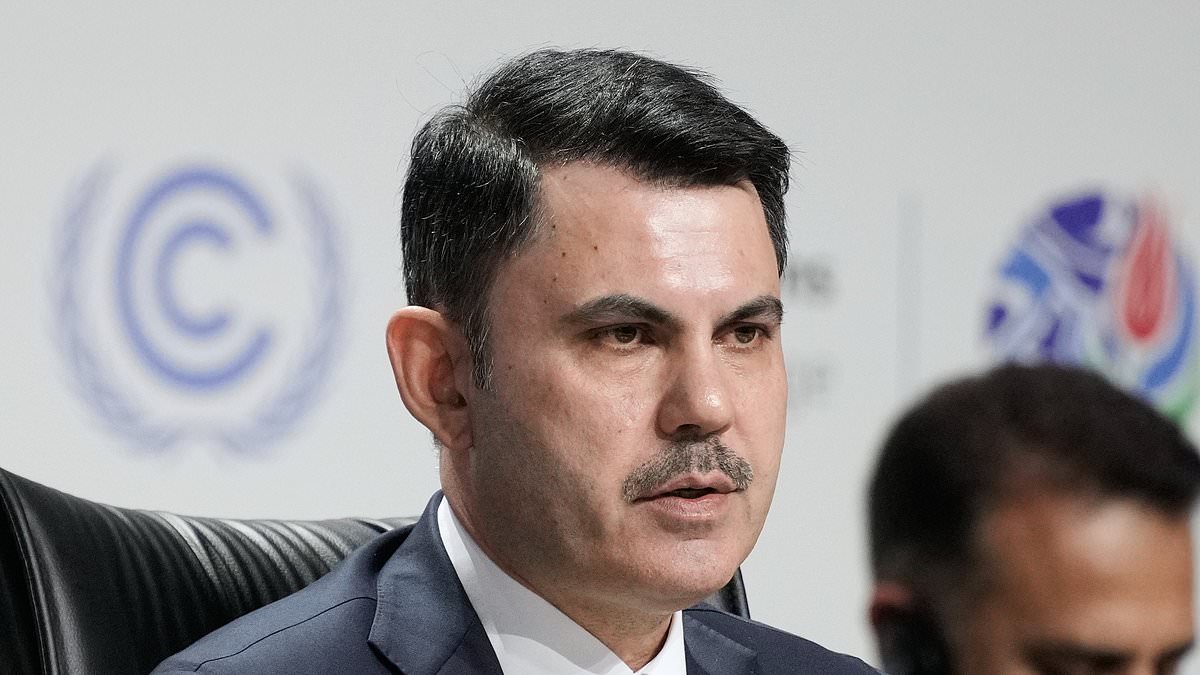
UN climate talks have collapsed after a draft deal was rejected by the EU following days of rows with Saudi Arabia and other oil states over fossil fuels.The EU has accused oil states of 'hijacking' COP31, as they refused to agree to fossil fuels being written into any draft agreements.A fourth deal was drafted this morning by co-hosts Turkey and Australia in the hope of bridging the divide between nations.But it still included no specific reference to transitioning away from fossil fuels, an omission which previously sparked threats of walkouts.After more than two weeks of negotiations, which had been due to end on Friday but stretched deep into the weekend, Turkey's COP31 President Murat Kurum said at the closing plenary that a deal was not approved.'It is clear that there are parties in this hall who oppose this text. We recognize that there is no consensus on this document. Therefore, these decisions have not been adopted,' he said.He confirmed that no new draft agreement would be proposed by COP officials in Turkey as 'we will not be carrying out work on a new text in an environment where there is no consensus'. The last major breakdown in UN climate talks came in Copenhagen in 2009, when countries failed to adopt the Copenhagen Accord by consensus in a setback for multilateral climate diplomacy. COP31 President Murat Kurum (C) spoke during the Closing Plenary session on what was meant to be the final day of the COP31 UNFCCC Climate Conference on November 20 Maina Vakafua Talia, Tuvalu's Minister for Home Affairs, Climate Change and Environment, speaks to journalists during a press conference at the COP31 UN Climate Change Conference in Antalya, Turkey, on November 21The EU delegation rejected the final draft deal, saying it would 'not accept a COP that greenwashes fossil fuels'. The EU's representative and Ireland's Climate and Energy Minister, Darragh O'Brien said the latest draft 'fails to meet the moment the world faces'.Speaking at the closing Plenary session, Mr O'Brien said: 'The drafts put before us does not begin to address the climate emergency that we face and therefore the European Union cannot accept it.'He said the draft 'fails to meet the moment the world faces'.'At a point where the world urgently needs action to avert disastrous levels of global warming, the draft cover decision falls well short.'Mr O'Brien said the EU would not endorse a draft that did not even mention fossil fuels.'We will not accept a COP that greenwashes fossil fuels,' he added. The hosts had issued multiple drafts of a text that sought to find compromise between the needs of nations most vulnerable to climate change and those whose economies depend on either the production or consumption of fossil fuels.The text acknowledged for the first time that global warming is on course to exceed the 1.5 degree Celsius threshold countries had sought to preserve, while calling for faster development of carbon-removal technologies to eventually reverse the overshoot.But the bid to win consensus backing proved unsuccessful, with critics of the text calling it unambitious.The conference in Antalya was scheduled to end on Friday, but both sides proved unyielding in their fight over words used in an agreement.It has now broken the record for the longest ever UN climate conference - spanning more than 44 minutes past the scheduled closing time.The session was repeatedly delayed by last-minute shuttle diplomacy.Tuvalu's climate minister Mania Talia said it seemed like they are 'negotiating with the Saudis'.Mr Talia, whose low-lying Pacific nation is threatened by rising sea levels, said if the world cannot address fossil fuels 'then we are wasting our time here'. The summit follows a string of climate-linked disasters from Europe to Nepal and Indonesia and unfolds as a super El Nino pattern heightens the risk of further extreme weather.A draft climate deal unveiled earlier this week called for a faster phase-out of fossil fuels, but a second, reduced version released Thursday stripped away all mentions of coal, oil and gas.Fossil fuels are the main driver of climate change but a flashpoint at the UN talks.The fallout led to the summit being extended long past the original deadline of Friday.On Saturday, negotiating teams were forced to reschedule flights with little confidence of a deal being reached.The EU and Saudi Arabia were brought together on Saturday as hosts desperately fought to come to a compromise. People protested outside the plenary ahead of the Closing Plenary session on what was the scheduled final day of the COP31 UNFCCC Climate Conference on November 20Speaking on condition of anonymity due to the sensitive nature of the ongoing talks, several delegations raised the prospect of leaving without a deal.Jennifer Morgan, former German climate minister and a senior fellow at The Fletcher School at Tufts University, said: 'After the presidency ignored the views of 150 countries and tabled a very weak text, negotiations are on the brink.'Environmental group 350.org said it was disappointed by the draft's failure to mention fossil fuels explicitly, as well as its encouragement of carbon-removal technologies.'Carbon capture is one of the biggest scams of the overshoot era, and our leaders are on the verge of falling for it,' said Sara Shaw, the group's campaigns and networks director, referring to the practice of trapping carbon dioxide before it reaches the atmosphere.Critics say the technologies are expensive and unproven at scale, and that including them in a deal opens the door to continued oil and gas development.The new draft text followed intensive consultations between Australia, which is leading the talks, Turkey, which is hosting the meeting, and nearly 200 delegations from many of the world's richest, poorest, largest and smallest nations.The presidency gave delegations several hours to raise any objections to the deal, with a session scheduled later on Sunday to begin approving it.Australia's task, supported by Turkey, has been to find a deal that balances the needs of nations most vulnerable to climate change with those whose economies depend on either the production or consumption of fossil fuels.This year's COP is the first since the UN's environmental body confirmed that the rise in global temperature was set to blow past 1.5 degrees, a threshold all countries agreed over a decade ago to try not to exceed, and beyond which extreme weather impacts intensify.With expectations low, negotiations chief Australia had sought an overarching political agreement to capture what countries agreed at COP31 and send a signal about the future course of climate action.But the latest version of its proposed 'cover decision' failed to mention fossil fuels at all. Houses lie partially submerged in muddy water along a riverside after flash floods at Trishuli Bazar in Nepal's Nuwakot district after deadly floods in AugustSuch language is fiercely opposed by petrostates and fossil fuel-reliant countries such as Saudi Arabia. A Saudi official declined to comment.'The situation is difficult, and the outcome is uncertain. The oil-producing countries are putting up a fierce fight,' a German official said.Threats of a walkout Saturday prompted Turkey and Australia to convene a hurried meeting between the EU and Saudi Arabia but a compromise remained elusive.The latest text introduces an oblique reference to a previous global deal in 2023 to shift the world away from fossil fuels - but stops short of naming them explicitly.'We are very disappointed with how the text looks,' the environment minister of Antigua and Barbuda, Michael Joseph, told AFP after leaving the COP31 presidency's offices.'I can't honestly say that I'm okay with it passing' in its current state, Joseph said.The text also retains a contentious push to expand carbon capture and storage, a technology championed by the fossil fuel industry but criticised as costly and ineffective in cutting emissions.A call to ramp up carbon capture – a contentious technology championed by the fossil fuel industry – in the last draft also faced staunch opposition.Critics point to its high cost and meagre record in cutting emissions, warning it risks prolonging fossil fuel use.A dozen European and developing countries – from France to Panama and the Solomon Islands – released a letter Friday insisting that the deal include 'a clear transition away from fossil fuels'.Panama's environment minister, Juan Carlos Navarro, accused a 'petroleum mafia' of blocking progress and threatened to walk away from the talks unless a stronger deal was made.Meanwhile, the OPEC oil cartel wrote on X that its head, Haitham Al Ghais, had met with Russian presidential climate envoy Ruslan Edelgeriev at COP31 on Friday. A man checked his phone near a building collapsed due to an earthquake, in Reok, East Nusa Tenggara province, Indonesia, in AugustAround one-third of global electricity is produced using coal and another fifth using fossil gas.Attempts by Saudi Arabia, India and Kenya to delay the next set of reports by the UN's Intergovernmental Panel on Climate Change have been another major source of friction.The draft text 'highlights the importance' of these reports for an upcoming stocktake of global carbon-cutting efforts in 2028.Dozens of countries across Europe, Africa and the Pacific want these assessments by the global scientific authority on climate change published in time for that crucial stocktake.Countries have also disagreed over how to respond to the looming breach of the 1.5C warming target set under the Paris climate accord.The latest draft expressed 'deep concern' over missing the goal but dropped an earlier call to return warming below 1.5C as soon as possible this century.The talks are also jammed over long-running complaints that rich nations are shirking their obligations to help developing nations confront climate change.The removal of a $120billion (£91.74billion) target for climate adaptation angered developing nations.
COP31 talks collapse as EU rejects 'greenwashing' UN climate deal amid row with Saudi Arabia and Russia over fossil fuels
Full Article
Original Source
Read the full article at Dailymail →KhanList aggregates and links to publicly available news content. We do not host full articles from third-party sources. Always verify important information with original sources.