
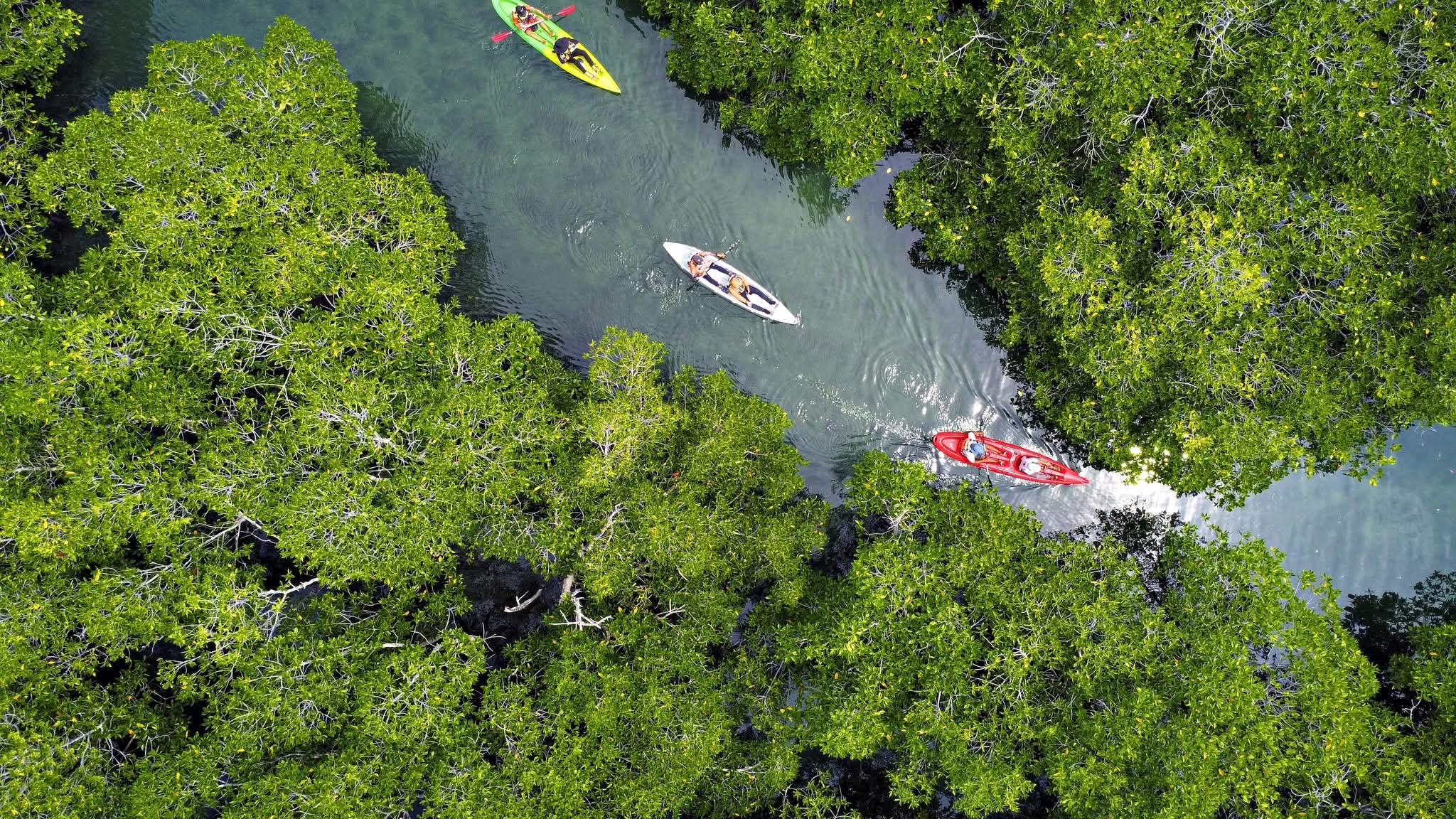
KAYAKING. A tourist kayaks through the mangrove maze in Sagay City, Negros Occidental, part of an effort to promote awareness of the role of mangrove forests in biodiversity conservation. Sagay City Information and Tourism Office Sagay City Information and Tourism Office Coastal communities are supposed to be at the heart of the public process that allocates space for human activities in the waters Philippine officials at COP31 emphasized the importance of marine spatial planning to balance marine biodiversity protection with the development of offshore wind energy. The Philippines has significant offshore wind potential, targeting 19 to 50 GW of capacity by 2050, which is crucial for achieving climate goals and enhancing energy security. Coastal community involvement is essential in the planning process, ensuring their knowledge and benefits are integrated into sustainable development efforts. This is AI-generated. Read the article for full context. Report any errors. MANILA, Philippines – Philippine energy and environment officials present at the UN Climate Change Conference (COP31) in Turkey hammered on the need for marine spatial planning to balance protection of marine biodiversity, coastal communities, with the need for renewable offshore wind and maritime economy. Marine spatial planning is defined by UNESCO as a “public process” of “allocating the spatial and temporal distribution” of human activities, considering the impact on communities, the environment, and the economy. A primary development concerning the ocean is offshore wind. The Philippines has a vast potential capacity for this, with 178 gigawatts (GW) of technical offshore wind potential. The national energy plan targets 19 to 50 GW of offshore wind capacity by 2050 under clean energy scenarios. Energy Undersecretary Felix William Fuentebella said at a forum held in the Philippine hub at COP31 that they were working to strengthen “our offshore wind marine spatial planning goal and mitigation framework.” Fuentebella emphasized the need to include coastal communities at the heart of this enterprise. “Their participation should be made early, their knowledge must be part of decisions, and their communities should share clearly in the benefits of sustainable development,” said Fuentebella. This was echoed by Shanelle Napoles of the Department of Environment and Natural Resources’ biodiversity management bureau during the forum: “[E]ffective marine spatial planning is guided not only by scientific evidence, but also by sound policies, clear institutional responsibilities, and meaningful participation of coastal communities.” The process takes into account other sectors: maritime transport and shipping, tourism, fisheries, and conservation. Not only will offshore wind help enable the Philippines to achieve its climate targets and speed up its green transition, this will also bolster the country’s energy security. There is a push now at COP31 to integrate the ocean into the climate summit’s negotiations and final text. Alongside these efforts is the COP31 presidency’s electrification agenda in response to the global oil and fuel crisis. A recent analysis from the World Resources Institute shows that coastal and island countries are leading the way. Their analysis found that 95% of the nationally determined contributions of coastal and island countries include ocean solutions. WRI categorized the Philippines as including coastal and marine conservation in its climate targets. – Rappler.com This story was produced as part of the COP31 Climate Change Media Partnership, a journalism fellowship organized by Internews’ Earth Journalism Network, Informed Earth, and the Stanley Center for Peace and Security. How does this make you feel? Loading
COP31: Coastal areas must have a voice in ocean use, say PH officials
Full Article
Original Source
Read the full article at Rappler →KhanList aggregates and links to publicly available news content. We do not host full articles from third-party sources. Always verify important information with original sources.