
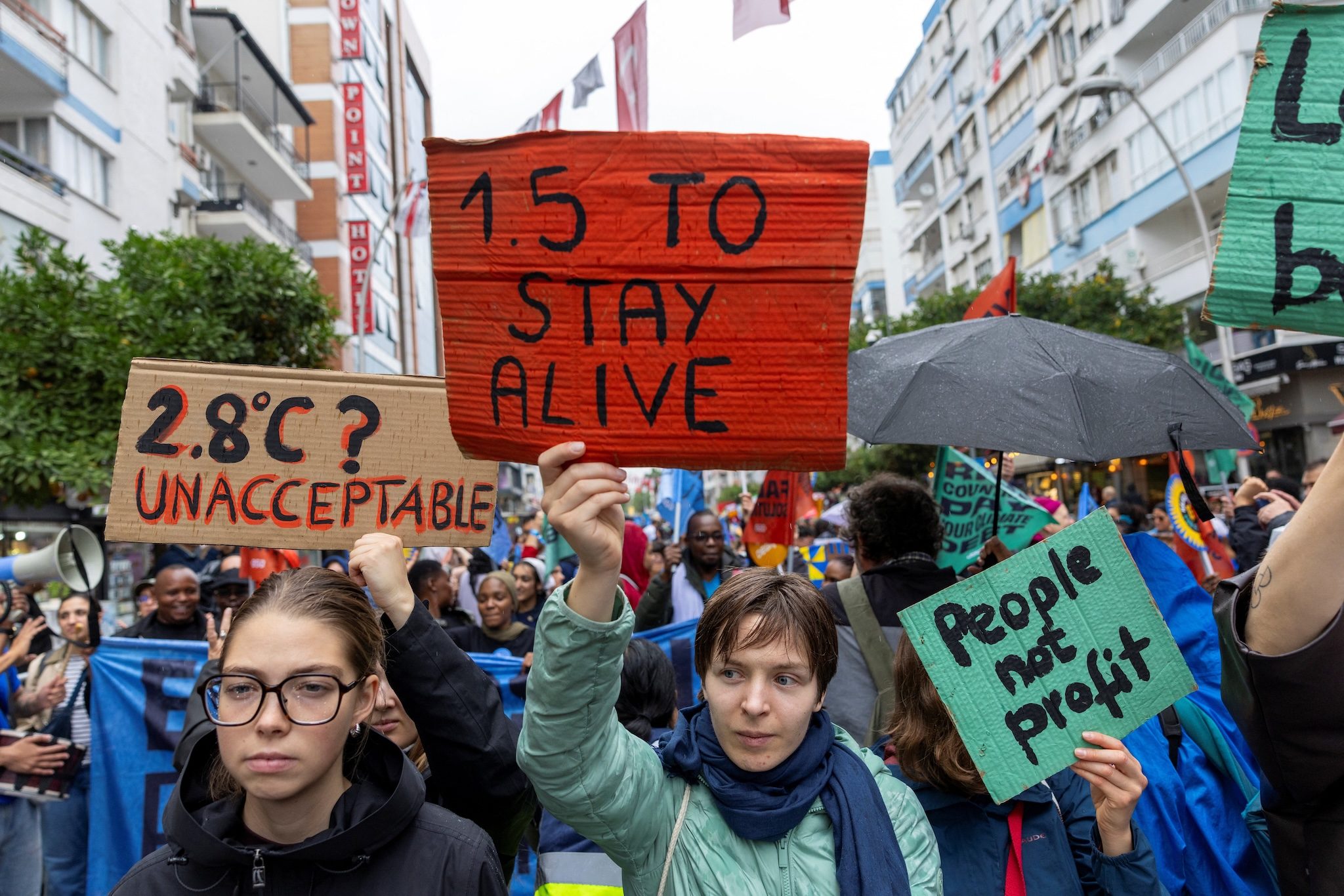
PROTEST. Activists and locals attend the People’s Climate March as part of a global day of action, “demanding climate justice, an end to fossil fuels and a just transition that puts people and the planet before corporate profit”, where the UN Climate Change Conference (COP31) is also taking place, in Antalya, Turkey, on November 14, 2026. Umit Bektas/Reuters Climate campaigners say the AI pledge would only work if the US hyperscalers signed up and if it were mandatory China's Alibaba is the only major tech company to sign the UN-backed Antalya AI Pledge aimed at reducing the environmental impact of artificial intelligence, while major US companies have not participated. The pledge encourages governments and companies to use cleaner energy for AI, improve infrastructure efficiency, track emissions, and enhance AI access in developing countries, attracting 90 endorsements including nine countries. This is AI-generated. Read the article for full context. Report any errors. ANTALYA, Turkey – China’s Alibaba is the only big tech company so far to have signed a UN-backed promise to reduce the environmental impact of artificial intelligence, as major US companies have stayed away. The Antalya AI Pledge, launched on Monday, November 16, by Turkey, the host of COP31 climate talks until the end of this week, calls on governments and companies to take voluntary measures to power AI with cleaner energy. Signatories are also urged to support more efficient infrastructure, track emissions, and improve access to AI in developing countries. Publicized for weeks in advance of the summit on Turkey’s Mediterranean coast, the promise attracted 90 endorsements at its launch, including just nine countries and Chinese e-commerce and technology conglomerate Alibaba. Private companies, think tanks and nongovernmental organizations were also among those to back the pledge. Meta, Microsoft, and Google, which operate global data-center networks, AI, and internet infrastructure at enormous scale, and chipmaker Nvidia did not respond to requests for comment. Amazon declined to comment on the pledge, but said it had a new target to reduce the carbon intensity of its electricity consumption by 65% by 2030 from a 2019 baseline and reiterated its commitment to net-zero carbon emissions by 2040. A report released on Monday found the United States’ more than 400 hyperscale data centers emit roughly as much carbon dioxide as Denmark. South Korea and small countries sign South Korea, a significant user of AI, was among the countries that signed, but the other government signatories represented small countries. The United States has stayed away from the UN climate talks for a second year in succession after President Donald Trump withdrew from the UN climate process. Trump has championed both untrammeled expansion of AI and the continued use of fossil fuel. But companies such as Amazon also face a different pressure from some shareholders concerned about the growing environmental impact and social opposition to the data centers their business requires. The UN’s technology agency, the International Telecommunication Union, said it is engaging with major tech companies as part of its outreach effort, and would keep the pledge open to signatures until the next UN climate talks, COP32, at the end of next year. Tech firms had been among the most visible corporate participants at previous UN climate summits, promoting goals, including carbon-negative operations and net-zero emissions. But the rapid expansion of AI and data centers has complicated those ambitions. While still investing in renewable energy, some of the companies have supported new natural gas generation. Climate campaigners said the AI pledge would only work if the US hyperscalers signed up and if it were mandatory. “Voluntary standards alone are not enough,” Julie Cerqueira, chief program officer at the Natural Resources Defense Council, said. – Rappler.com How does this make you feel? Loading
COP31 AI pledge fails to lure US Big Tech
Full Article
Original Source
Read the full article at Rappler →KhanList aggregates and links to publicly available news content. We do not host full articles from third-party sources. Always verify important information with original sources.