
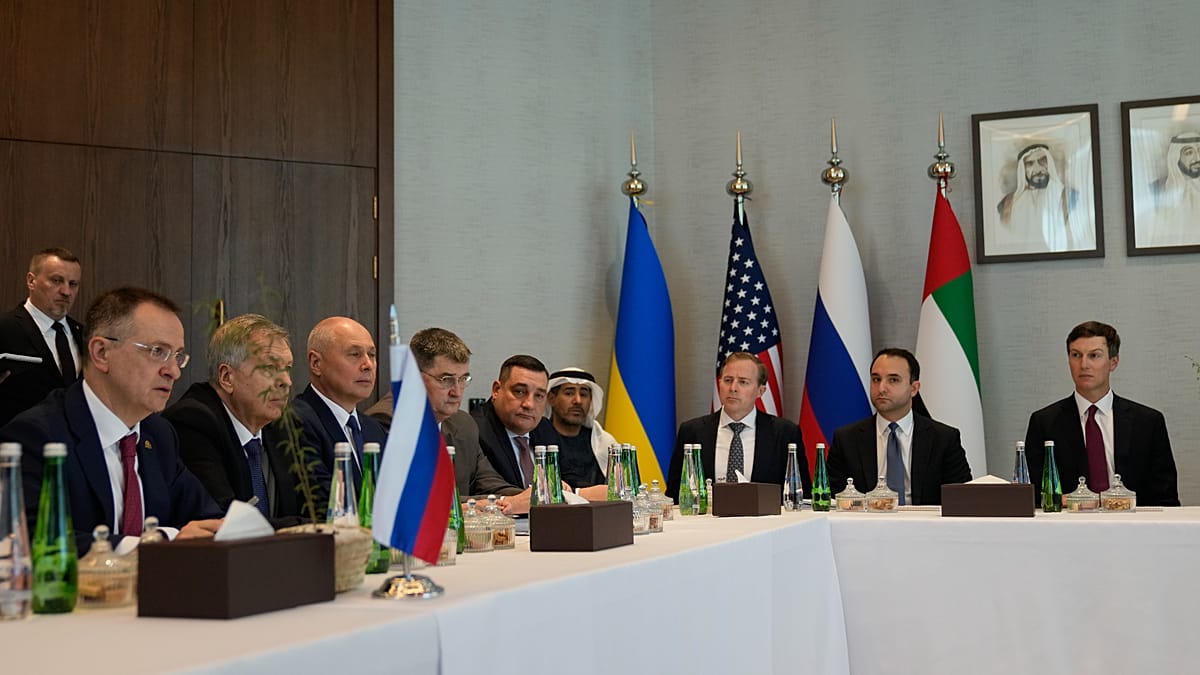
Back at the table. Ukrainian, Russian and US negotiators return to the table in Abu Dhabi today after a first day that produced contrasting messages, Sasha Vakulina reports. ADVERTISEMENT ADVERTISEMENT Kyiv and Washington both praised yesterday’s discussions, with Ukrainian President Volodymyr Zelenskyy calling them “constructive and quite substantive” and US Secretary of State Marco Rubio “very productive”. The talks covered prisoner exchanges, security guarantees and possible de-escalation. Moscow, however, struck a different tone: Russian Foreign Minister Sergei Lavrov rejected a ceasefire and accused Europeans of seeking a truce to deploy troops to Ukraine. He also brushed off the European officials’ presence in Abu Dhabi: “Well, they flew to Abu Dhabi. Let them sit there in the hotel.” The Europeans held separate consultations with Kyiv and Washington but remain shut out of the trilateral negotiations, despite US signals that they could eventually join. The question now is whether the warm words can translate into progress while fundamental disagreements on territory and security remain unresolved. Territory is the main sticking point. A senior US official told American media that Ukraine and Russia have reportedly shown some private flexibility, although both remain publicly far apart. The same official said the territorial question cannot be settled before agreeing on Ukraine’s post-war security arrangements. Moscow still demands control of the entire Donbas, including areas it has failed to capture, while Kyiv refuses to surrender territory. The prospect that a deal with Russia could redraw Europe’s security architecture has also unsettled the Europeans, who see it as Moscow’s attempt to re-establish its sphere of influence in Eastern Europe and sow divisions among Western allies. An absolute win. NATO is represented in Abu Dhabi by senior officials, including the alliance’s top military commander, Alexus Grynkewich. Euronews NATO correspondent Shona Murray spoke to Deputy Supreme Allied Commander Europe Sir John Stringer at NATO headquarters. He praised Ukraine’s successful strikes on Russian diesel refineries, which US President Donald Trump has urged Kyiv to stop, blaming them for rising energy prices. Stringer said Western allies should “salute” Ukraine’s success in “hurting Putin”. “What Ukraine has been able to do through imagination, innovation and will is quite incredible and we should salute it,” he added. That didn’t take long. German Chancellor Friedrich Merz’s attempt to make approval of the EU’s next long-term budget conditional on fresh financial support for Ukraine has backfired within hours. As Europe Today predicted just yesterday, the move was always likely to provoke Slovakia, Czechia, Hungary and Bulgaria, which are poised to opt out of what looks like an inevitable top-up of the Ukraine Support Loan. As expected, Slovak Prime Minister Robert Fico was the most vocal, accusing Merz of political “blackmail” and threatening a veto, arguing that Slovakia has the same voting rights as Germany. Czech Prime Minister Andrej Babiš, who met Fico in Bratislava on Tuesday, also rejected the German initiative, pointing to the €100bn he says the proposed EU budget already earmarks for Ukraine, money that would only become available from 2028. Hungarian Prime Minister Péter Magyar said linking the two issues was unacceptable for domestic political reasons and argued they should be negotiated separately. Bulgarian Prime Minister Rumen Radev also signalled resistance, citing his country’s high deficit as a reason to avoid further credit lines for Kyiv, while saying Sofia would keep supporting Ukraine by other means, including energy supplies. The four countries’ opposition adds a new layer to the battle between the EU’s so-called Friends of Cohesion and the frugal countries pushing for cuts to the next long-term budget. All four belong to the 17-member cohesion group, which wants to protect funding for agriculture and regional development. Merz’s strategy is to use Germany’s position as the bloc’s largest net contributor to secure a broader commitment to Ukraine’s financing. But tying the two issues together risks alienating countries that already oppose cuts to cohesion spending. European Council President António Costa tried to reassure Merz in a letter seen by Euronews, agreeing to “make time for a broad discussion on Ukraine at the upcoming informal European Council in Dublin.” Rutte draws Portugal’s ire. The Portuguese Foreign Ministry hit back at NATO Secretary General Mark Rutte on X, telling him he should “know better” than to overlook countries that have stood firmly by Ukraine, and should not speak “so lightly on such a serious matter.” What did he say? On a Dutch TV programme, Rutte said he sometimes talks to Portuguese and Spanish allies, who consider Russia very far away. “Russia’s newest missiles take five minutes longer to reach Lisbon than to reach Warsaw. So we all have to deal with this,” he said. The NATO chief clearly struck a nerve on the diverging perceptions of the Russian threat. How much each EU country contributes to Ukraine’s support is becoming ever more sensitive, especially as it gets tangled up with the budget negotiations. Speaking of Ukraine aid. Denmark has pledged a new €643 million military support package for Ukraine, plus €20 million for its energy sector, as Zelenskyy met Nordic leaders in Copenhagen on Tuesday. Danish Prime Minister Mette Frederiksen hosted the leaders of Sweden, Norway and Finland, with talks focused on military support, air defence and protecting critical energy infrastructure. One flies, one crashes. While the Nordics keep the aid flowing, the next arms package for Kyiv is becoming a headache for Italian PM Giorgia Meloni. It could turn into a diplomatic debacle just as she has secured a place among the European delegations in Abu Dhabi. Meloni’s coalition has always been split over military aid to Ukraine, but **Matteo Salvini’**s League is hardening its line as elections due next year approach, as it is losing consensus to the new hard-right party of former general Roberto Vannacci, which is also gaining ground by opposing further support to Kyiv. Battle royale for online safety. Harry and Meghan visited the European Parliament as part of a campaign to protect children from online harassment. In an emotional speech, Harry accused social media companies of failing to make their platforms safer, leaving children exposed to harassment and bullying, sometimes with fatal consequences, Vincenzo Genovese reports. Meghan did not join any meetings with MEPs beyond the official presentation of the “Lost Screen Memorial” and reportedly pulled out of delivering a speech because of the emotional charge of recent days, after her father was arrested in the US and charged with possessing child sexual abuse material. Make digital fair again. The European Commission is due to publish today its draft Digital Fairness Act, which updates EU consumer law for new digital technologies. The bill covers dark patterns, influencer marketing, unfair personalisation, addictive design, dynamic pricing and digital contracts. A leaked draft obtained by Euronews pointed to 10 design features that would be directly classed as unfair consumer practices. However, the leak has drawn criticism for watering down some of the initial ambition, such as reversing the burden of proof onto companies or mandating a “safety by design” approach. Who's who from Ukraine and Russia at the Abu Dhabi peace talks? The composition of the Ukrainian and Russian delegations at the Abu Dhabi peace talks offers clues to what could be discussed behind closed doors as US-mediated negotiations resume for the first time in nine months. Ukraine and Russia will return to the negotiating table in Abu Dhabi on November 10–11, nine months after their last round of US-mediated talks. The composition of their delegations offers clues about what each side hopes to achieve. Kyiv is sticking largely with the same team that took part in previous rounds, signalling continuity in its push for a ceasefire as a first step towards a broader peace agreement. Moscow, meanwhile, is bringing senior military and diplomatic officials, including Deputy Foreign Minister Sergei Ryabkov, who helped draft Russia's sweeping security demands to NATO shortly before its full-scale invasion of Ukraine in 2022. Sasha Vakulina has the story. More from our newsrooms EU candidates will not have a say on anti-Orbán safeguards Montenegro is the first to test the EU's new safeguards, with member states expected to reach a position as early as next week. But contrary to the other negotiating chapters, Podgorica is finding out that the safeguards, including the possibility of suspending voting rights, are non-negotiable. Read more. Five EU countries demand UK pays for electricity market access The leaders of Belgium, Germany, Denmark, Luxembourg and the Netherlands want Britain to contribute to EU regional development funds in return for closer energy ties, adding a new hurdle to negotiations ahead of the 20 November summit. Marta Pacheco has the details. Russia’s ‘unfriendly countries’ list now targets property, child custody and debts Moscow’s list of states it deems unfriendly was set in March 2022 for foreign economic policy, but decrees and court rulings now apply it to child custody, vehicle registration and debt repayment. Knarik Papoyan has the report. We’re also keeping an eye on Commission President Ursula von der Leyen and Energy Commissioner Dan Jørgensen travel to Antalya to attend COP31. EU foreign policy chief Kaja Kallas and Commissioner for the Mediterranean Dubravka Šuica meet Yemeni Foreign Minister Afrah Al-Zouba in Brussels. Economy Commissioner Valdis Dombrovskis takes part in the Munich Security Conference’s Technology Security Roundtable in Brussels. Executive Vice-President Henna Virkkunen and Justice Commissioner Michael McGrath present the Commission’s Digital Fairness Act. The European Parliament’s mini-plenary session starts in Brussels. MEPs will debate, among other topics, cyber resilience and the protection of critical infrastructure after recent attacks on supermarkets across Europe, and Ukrainian children forcibly deported to Russia. That’s it for today. Sasha Vakulina, Shona Murray and Vincenzo Genovese contributed to this newsletter.
‘Constructive’ Abu Dhabi talks resume, but a ceasefire is nowhere near
Full Article
Original Source
Read the full article at Euronews →KhanList aggregates and links to publicly available news content. We do not host full articles from third-party sources. Always verify important information with original sources.