
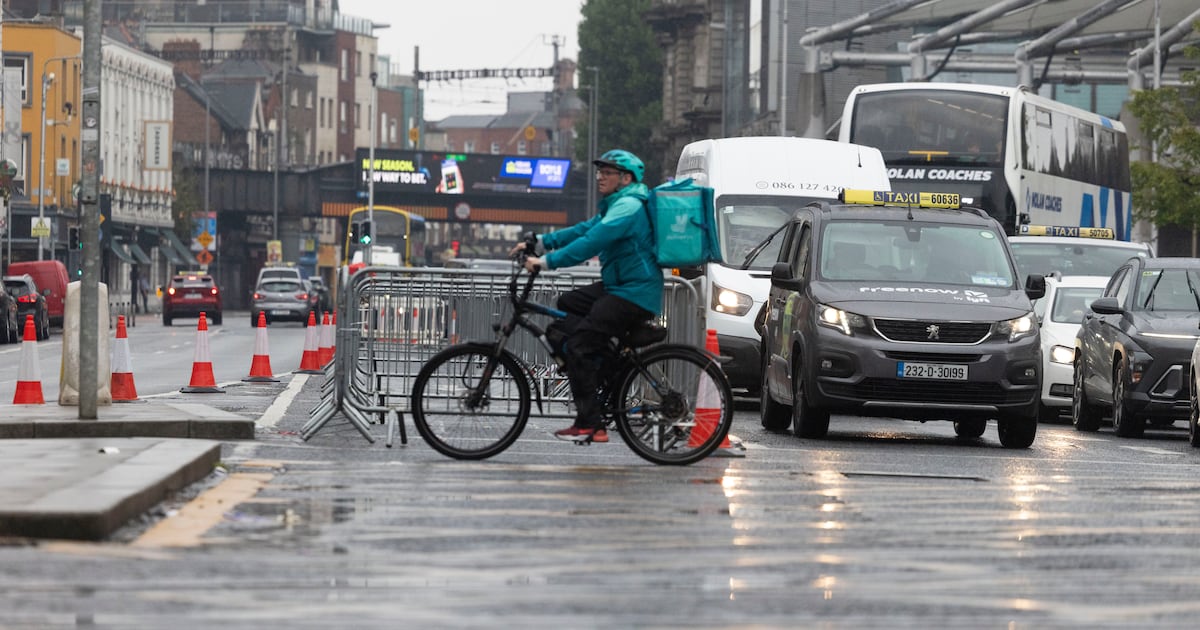
Construction of Ireland’s first cycle path to be built down the central median of a road, flanked by traffic on both sides, will get under way in Dublin this month.The two-way cycle path will be built in the middle of Amiens Street and will connect Dublin City Council’s flagship Clontarf to city centre cycle route, opened two years ago, to the Liffey cycle paths on both sides of the river.The council has already installed steel barriers to cordon off a traffic lane in the centre of Amiens Street, on what is currently the southbound/citybound side of the road, to accommodate the new path, and will shortly begin construction.The new cycle route will run from the junction of Talbot Street in front of Connolly Station to Custom House Quay and across the river on the west side of Talbot Memorial Bridge to reach George’s Quay, a distance of just over half a kilometre. READ MORECurrently the segregated kerbside cycle path from Clontarf and north Dublin Bay ends abruptly at Connolly Station, leaving cyclists to enter the bus lane to continue south. Once they reach the quays, if heading east towards Dublin Port, cyclists can access cycle paths, but if they plan to cross the river and turn right to head west towards the city centre, they must cross several lanes of traffic.For cyclists heading north from Beresford Place, between the back of the Custom House and Busáras, there are no cycle lanes, or even bus lanes. Cyclists are mixed with general traffic on Amiens Street until they reach Talbot Street where the northbound section of the segregated cycle path to Clontarf starts.The new two-way central median path will be accessed at signalised junctions at Talbot Street, allowing cyclists to cross from or to the kerbside paths. The new path will continue in the middle of the road to the east of the Custom House, where general traffic becomes one-way southbound, and the cycle route is then on the right-hand or western side of the road, where it remains to cross the river.Central median cycle paths have increased in use in European cities, but have never before been installed in Ireland, making it an “innovative approach” for Dublin cycling design, the council said.“A new cycle lane layout will be installed which has not previously been implemented elsewhere in the country. This involves the creation of a protected two-way cycle lane located in the centre of the roadway between traffic lanes.”This section of Amiens Street was “particularly suitable”, the council said, because of the absence of right-hand turns on either side of the road. Constructing a median path meant bus stops would remain unaffected and cyclists would not require separate “green time” at traffic lights as there would be no interactions with cars turning across their path.The council has already installed steel barriers to cordon off the traffic lane on Amiens Street. Photograph: Sam Boal/Collins Photos “While this arrangement would not be appropriate in most parts of the city, the layout at this location makes it well suited.”The new route is the latest phase of the 2023 Dublin City Centre Transport Plan designed to reallocate road space from cars to public transport, cyclists and pedestrians, while still retaining access to the city centre and its car parks for private motorists.The first phase came into force in August 2024 with a ban on private cars and commercial vehicles travelling directly east or west along the Liffey at either side of O’Connell Bridge from 7am to 7pm daily.Last year general traffic was banned from turning left from Westland Row into Pearse Street, and Parliament Street in Temple Bar was made traffic free.
Construction begins on Dublin’s first middle-of-the-road cycle path
Full Article
Original Source
Read the full article at Irishtimes →KhanList aggregates and links to publicly available news content. We do not host full articles from third-party sources. Always verify important information with original sources.