
It is hard to imagine South Africa without the Constitutional Court, which, over the past 30 years, has been called on to decide some of the country’s biggest questions, from whether the state can take a person’s life to whether two people of the same sex can marry, whether government can be forced to provide healthcare and housing, and how far those occupying the highest political offices can exercise their power.These cases have often made it to the court through the lives of ordinary people. Others reached the court because of battles over corruption, government power and whether a president could be held accountable.Under the apartheid government, Parliament was supreme. In democratic South Africa, the Constitution is supreme, giving the courts the power to test laws and government decisions against it.Lawson Naidoo, Executive Secretary of the Council for the Advancement of the South African Constitution, said this fundamentally changed the role of the judiciary.“They exercise their functions independently, and what that means is that they have the power and the authority to overturn decisions or decisions of Parliament that are inconsistent with the Constitution,” Naidoo said.“That, I think, is a significant power and responsibility that the court has.”We look at seven landmark judgments (in no particular order) that show how the Constitutional Court has changed South African law, protected rights and held power to account.1. The case that ended the death penaltyS v Makwanyane and Another was the first case heard by the newly established Constitutional Court in 1995, and it resulted in one of the most important decisions of the new democracy – the abolition of the death penalty in South Africa.The case involved two men, Thembile Makwanyane and Muntu Mchunu, who had been sentenced to death for murder. The judges, led by the court’s first president, Arthur Chaskalson, unanimously found that the death penalty was unconstitutional, emphasising several rights and values contained in the Constitution, including the right to life and human dignity.The judgment was important not only because it ended the death penalty, but because it came at a time when South Africa was moving away from an apartheid legal system in which the law had been used to repress and punish people. It was an early indication of the kind of court the Constitutional Court would become, and the weight it would place on human dignity and the protection of rights.Ropes that were used to hang prisoners on show during the official launch of the Gallows Exhumation Project on 23 March 2016 at the Kgosi Mampuru II Correctional Centre (Gallows Museum) in Pretoria, South Africa. A total of 130 political prisoners were hanged on the gallows of the correctional centre between 1960 and 1990. (Photo: Gallo Images / Beeld / Lisa Hnatowicz)“The case laid the foundation for a new criminal justice system shaped around the value of human dignity, a ringing departure from the previous system, which was used as a means of political repression and dehumanising and silencing large sections of the population,” said Danwood Chirwa, Professor of Law at the University of Cape Town.Mbekezeli Benjamin of Judges Matter agreed, saying the court abolished the death penalty at a time when South African society was strongly in favour of the death penalty. “The court found it irreconcilable with the values of human dignity and the sanctity of human life, which lie at the heart of the new South Africa. The court articulated a values framework that would set the course of the next three decades. Significantly, the judgment also tested the then Mandela government’s commitment to the constitutional project, even in the face of public pressure. The government’s respect for the court’s judgment strengthened the foundations of our nascent democracy,” Benjamin said. 2. The case that made the right to healthcare realIn 2002, the Constitutional Court made a decision that helped save thousands, if not millions, of lives. This was at the height of the HIV/Aids epidemic when the government had restricted the use of nevirapine, a drug that could reduce the risk of mothers passing HIV to their babies. The Treatment Action Campaign (TAC) challenged the government’s policy, arguing that restricting the drug violated the right to healthcare. The Constitutional Court ultimately ordered the government to remove the restrictions and make nevirapine more widely available. A Treatment Action Campaign protest in Durban in 2002. (Photo: Gideon Mendel / TAC)The judgment did more than open access to the nevirapine drug. It also put the government’s responsibility to provide healthcare in the spotlight, and showed that the government could be taken to court when its policies failed to deliver on the socio-economic rights promised in the Constitution.Naidoo said the impact of the judgment could still be seen more than two decades later.“The TAC judgment saved thousands of lives by making preventive treatment available to pregnant mothers, and has helped South Africa in rolling out probably one of the largest HIV treatment programmes in the world – and it’s been a huge success,” he said.“It had immediate consequences in the early 2000s but continues to have consequences in terms of the kind of policy and programmes that we have in place now that have made a real dent in the spread of HIV/Aids in South Africa.” TAC members walk over the Nelson Mandela Bridge in Braamfontein, Johannesburg, to the Constitutional Court as part of their 25th anniversary commemorations to thank the court for what it’s done to help people living with HIV. (Photo: Felix Dlangamandla)Writing about the judgment in 2003, constitutional law scholar Charles Ngwena said the court had been right to intervene.“To the extent that the government was unreasonably delaying access to patently affordable life-saving therapy for the prevention of mother-to-child transmission of HIV to a class of persons that was largely vulnerable and indigent, it is submitted that the case was correctly decided.”3. The case that tested the right to housingFive years after the Constitutional Court abolished the death penalty, it faced another case that went to the heart of the promises contained in the Constitution, this time over the right of South Africans to have access to adequate housing.The case was brought by Irene Grootboom and hundreds of other adults and children who had been living in poor conditions in Wallacedene, an informal settlement in the Western Cape. After waiting for low-cost housing, they moved onto nearby private land, but were later evicted and left without adequate shelter. In 2000, the Constitutional Court found that the government’s housing programme was failing people who were in desperate need of shelter and ordered the State to make provision for those facing a housing crisis.The judgment was important because it showed that the rights promised in the Constitution had to mean something in people’s everyday lives, and that the government could be held accountable when it failed to take reasonable steps to provide for people in need.For Grootboom herself, however, the victory did not bring the home she had fought for. She died in 2008 while still living in a shack, but the case that carried her name went on to influence housing policy and strengthen protections for people living in informal settlements.Irene Grootboom was a South African housing rights activist whose court case changed housing law and access to socio-economic rights in South Africa. (Photo: Kraailove / Facebook) “While Ms Grootboom ultimately died without a brick-and-mortar house, the judgment led to a revision of the National Housing Code and protection for millions of people still living in informal settlements today.“It set the standard for the government’s obligation to give meaning and content to socioeconomic rights, which were a revolutionary inclusion in the South African Constitution and which many subsequent constitutions around the world have followed,” said Benjamin. 4. The case that opened marriage to same-sex couplesIn 2005, the Constitutional Court handed down one of its most historic judgments in a case involving two women, Marie Fourie and Cecelia Bonthuys, who wanted to marry but could not because the law did not recognise marriage between people of the same sex.Their fight eventually reached the Constitutional Court, which unanimously ruled that excluding same-sex couples from marriage was unconstitutional and violated their rights to equality and dignity.The court gave Parliament one year to change the law to address the discrimination. In 2006, Parliament passed the Civil Union Act, allowing same-sex couples to legally marry or enter into civil partnerships.Cecelia Bonthuys and Marie Fourie at the Constitutional Court on 17 May 2005. (Photo: Gallo Images / Beeld) The judgment changed the law, but its significance went further than marriage. It affirmed that the equality and dignity promised by the Constitution also protected LGBTQ+ people, at a time when same-sex relationships remained deeply contested in South Africa and across much of the continent. This, according to Benjamin, was both courageous and principled. “The Constitutional Court has pushed global frontiers of understanding what an inclusive, democratic and constitutional society looks like,” he said. Professor David Bilchitz, Professor of Law at the University of Johannesburg, said the judgment helped establish South Africa as an important defender of the rights of vulnerable groups.“This ruling paved the way for Parliament to recognise same-sex marriages in South Africa and represented a very strong recognition that the South African Constitution would seek to protect the equality and freedom of all who live in South Africa. It affirmed the dignity of a vulnerable minority – LGBTQ persons – in society, rendering it a leading defender of the rights of vulnerable groups on the African continent (and beyond) even in the face of strong opposition,” Bilchitz said. 5. The cases that tested presidential accountability Over the past decade, a series of cases brought by the EFF have tested the powers of the president and Parliament’s responsibility to hold the country’s highest office to account.The first came in 2016 over upgrades to former president Jacob Zuma’s Nkandla home. The Constitutional Court found that Zuma had failed to uphold, defend and respect the Constitution by not complying with the Public Protector’s remedial action, while the National Assembly had also acted inconsistently with the Constitution.Former president Jacob Zuma’s Nkandla property in KwaZulu-Natal in July 2021. (Photo: Leila Dougan) A year later, in what became known as EFF II, the court found that the National Assembly had failed to put proper rules in place to determine whether a president had committed conduct that could lead to impeachment.Almost a decade later came EFF III, this time involving President Cyril Ramaphosa and the Phala Phala matter. The Constitutional Court again considered Parliament’s role in holding a president accountable, setting aside the National Assembly’s decision not to refer an independent panel report on Phala Phala to an impeachment committee.In May 2026, the Constitutional Court made a landmark ruling on Parliament’s role in holding the president accountable. (Photo: Per-Anders Pettersson / Getty Images) For Benjamin, the three judgments have been important in strengthening presidential accountability, from the political events that eventually led to Zuma’s resignation to the ongoing process involving Ramaphosa and Phala Phala.“These judgments have proven vital for democracy, and arguably set in motion the events that ultimately led to the resignation of former president Zuma. Even President Ramaphosa is now having to account to Parliament for what happened at his Phala Phala farm. This is vitally important as we see democratic backsliding around the world. In more established democracies like America, Hungary and the Philippines, we see presidents amass unfettered power while eroding accountability mechanisms,” Benjamin said.Bilchitz agreed on the significance of the first judgment, saying it went beyond the powers of the Public Protector and reinforced the principle that those occupying the highest offices are not beyond constitutional scrutiny.“The significance of the judgment was that it not only upheld the authority of the office of the Public Protector – it significantly sought to hold the president and Parliament to account, and was a ringing affirmation the importance of good governance and the rule of law,” he said. 6. The case that put limits on government powerA dispute over property rates in Johannesburg in 1998 ended up giving South Africans an important tool to challenge the way the government uses its power.Fedsure Life Assurance and nine other companies that owned property in Johannesburg had challenged increases in property rates introduced by local government. The dispute came at a time when Johannesburg was still dealing with the changes that followed apartheid, including bringing previously divided municipalities together and addressing deep inequalities in services.The Constitutional Court found that the rates were lawful, but the judgment went much further than deciding what property owners had to pay, with the court finding that government institutions and public officials could only use powers given to them by law and had to stay within those limits.The finding became the basis for what is known as the principle of legality, which has since been used in cases challenging decisions taken by public officials, including members of the executive. This means that when a president, minister, municipality or other public body makes a decision, a court can consider whether they had the legal power to make it and whether that power was used lawfully.After the opening of Parliament in Cape Town in 1996, Chief Justice Arthur Chaskalson presented then president Nelson Mandela with a copy of the new Constitution. In a joint judgment with Justice Richard Goldstone and Justice Kate O’Regan, Chaskalson issued the Fedsure ruling. (Photo: Louise Gubb)Professor Danwood Chirwa of the University of Cape Town said the principle would later be extended beyond local government to the exercise of executive power, strengthening the ability of courts to hold those in power accountable.“This decision was later extended to the review of executive powers, which were also held to be subject to the concept of legality. The doctrine of legality is arguably a South African innovation and constitutes a significant advance in administrative law. It laid the foundation for a robust system of public accountability in which the courts play an important role, complementing other forms of public accountability,” Chirwa said.The impact of the judgment can now be seen in cases where government decisions are taken on review, with courts able to set aside the exercise of public power when officials act outside the law.7. The case that set rules for independent corruption investigationsWhen businessman Hugh Glenister challenged the disbanding of the Scorpions and their replacement by the Hawks, the Constitutional Court did not order the government to bring the Scorpions back, nor did it require South Africa to create another anti-corruption body exactly like it.Instead, the case established rules about how independent the institution responsible for fighting corruption needed to be.Glenister had challenged the laws that created the Hawks within the South African Police Service, arguing that the unit did not have enough independence to investigate corruption without the risk of political interference.In 2011, the Constitutional Court found that the legislation did not provide the Hawks with enough protection from political influence and gave Parliament 18 months to correct it. The judgment established that the state had a constitutional duty to have an adequately independent body capable of investigating corruption, although it left government and Parliament to decide how that body should be structured.Parliament later amended the law governing the Hawks in response to the judgment, but that did not end the legal battles over the unit’s independence, with further challenges reaching the courts over whether the changes went far enough.Professor David Bilchitz said the judgment was also important because it linked the fight against corruption to the rights protected by the Constitution.“This was a vital judgment in establishing the link between fundamental rights in the Constitution, the duty to combat corruption and the need for independent structures to address corruption. It represents a strong clarion call demonstrating the serious erosion of rights that corruption causes,” Bilchitz said.Businessman Hugh Glenister in court in Cape Town on 5 August 2008. (Photo: Gallo Images / Business Day / Trevor Samson)The judgment did not end corruption or give South Africa another Scorpions, but it meant that the government could not simply create an anti-corruption unit without providing it with enough independence to carry out its work.That principle became increasingly important during the State Capture years, when the ability of law enforcement and other state institutions to investigate powerful people came under scrutiny.For Lawson Naidoo, judgments such as Glenister helped provide some of the constitutional guardrails that prevented the worst excesses of State Capture and strengthened the institutions expected to hold those in power accountable. DMThis story is part of a series marking 30 years since the signing of the Constitution. The series has been made possible, in part, by the support of the Friedrich Naumann Foundation.
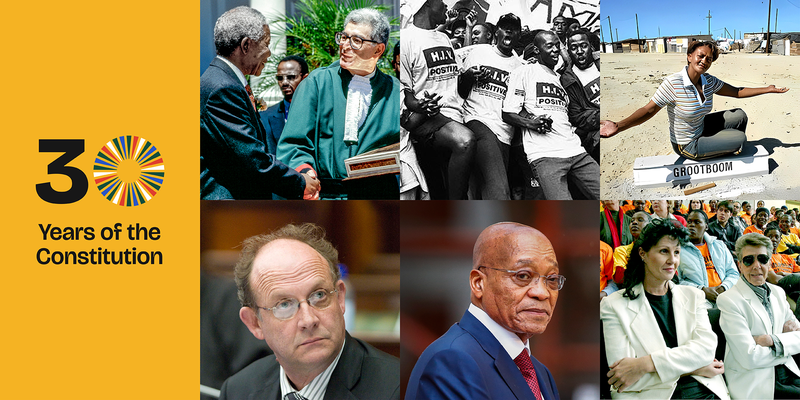
CONSTITUTION @ 30: From equal rights to the death penalty, seven Constitutional Court judgments that shaped SA
Full Article
Original Source
Read the full article at Dailymaverick →KhanList aggregates and links to publicly available news content. We do not host full articles from third-party sources. Always verify important information with original sources.