
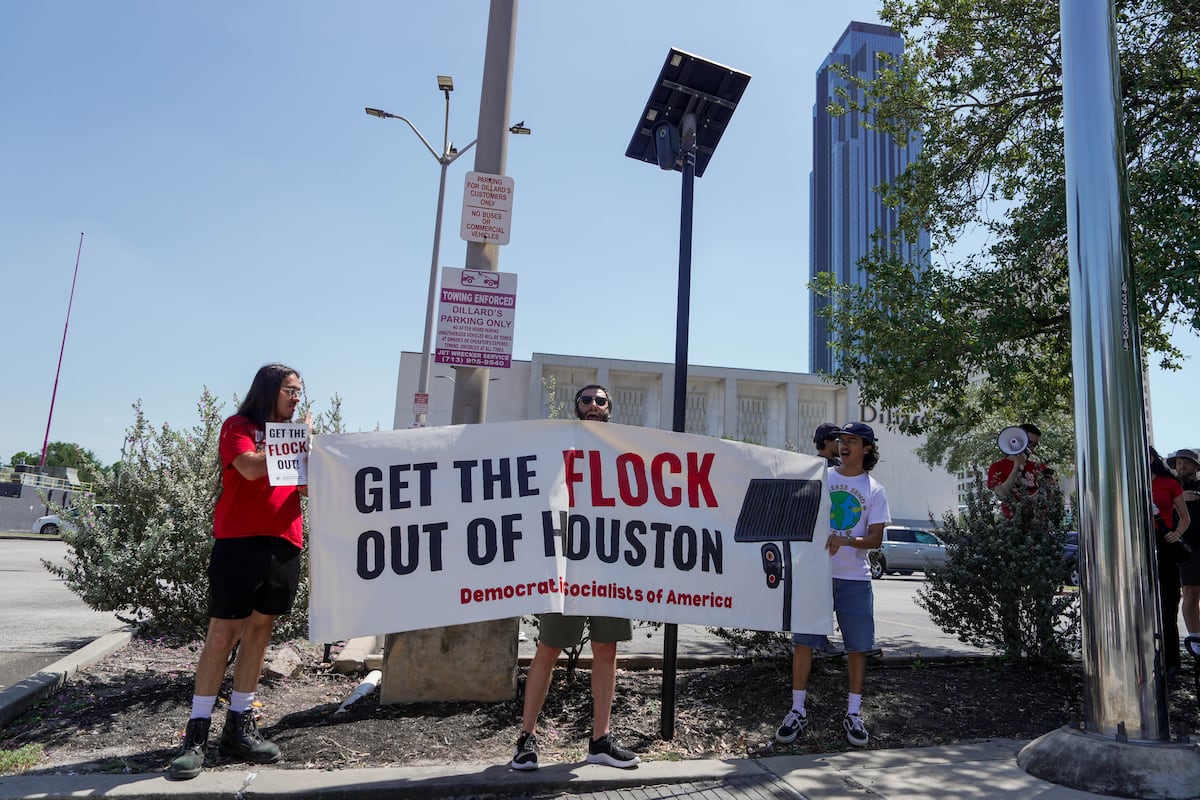
At first Matías Núñez began encountering online reports and citizen complaints about the proliferation of Flock cameras, the private automatic license plate reader service that has been contracted by police departments, universities, neighborhood associations and businesses across the United States. And then one day he found two of those devices in his own neighborhood in the coastal city of Hollywood, Florida: “I realized that every time I pass by, they record my location, and that they’re cropping up everywhere in my area. Once you see them, you start noticing them everywhere.”Hollywood is one of six thousand municipalities in the country that have contracts with Flock Safety, the Atlanta-based security company that operates these kinds of automated license plate readers known as ALPRs, which have proliferated in 49 of the 50 states. At first the cameras were praised because they made it easier to locate crime suspects, missing people and stolen vehicles. Then they began to be implicated in increasingly frequent episodes of police abuse and privacy violations, to the point that citizen demands for their ban or regulation have worked their way into the campaign debates for the midterms on November 3.“There are no limits on where these cameras can point. In my neighborhood there were cameras aimed at residents’ homes as well as watching the main streets. That means people are being monitored 24 hours a day, seven days a week: every time they come home, when they’re in their car, at all times. It’s crazy,” complains Núñez, a 36-year-old businessman who lives in a quiet neighborhood where children ride bikes in the afternoons and neighbors gather to celebrate Halloween and birthdays together. “While the city’s good intentions are understandable, there aren’t sufficient regulations to effectively control this. Another big concern is that the data are not owned by the [government] agencies, which opens the door to possible malicious use of all that information.”In recent months, dozens of police officials across the country have been embroiled in scandals and fired for unauthorized use of information stored by Flock, which ultimately belongs to the company. In Sharonville, Ohio, police lieutenant Walter Cordes was charged with a “felony” after admitting that he tracked a person 29 times via Flock over several months. In Fresno, California, a police officer whose identity has not been revealed was suspended after improperly using the system and other confidential databases. In Fulton, Georgia, the Bureau of Investigations opened a file on a police department employee who kept access to the system after resigning. In Waukegan, Illinois, officer Oscar Magpali was charged with five felonies for tracking co-workers and other people he knew. In Milton, Georgia, officer Randy Dula was dismissed for using the system to harass his wife.These are just a handful of the hundreds of cases documented by the Institute for Justice (IJ), a nonprofit public-interest law organization that maintains one of the most complete records of these incidents and litigates to challenge the legality of the system. “When the government can track the everyday movements of citizens — to their workplaces, places of worship, doctors or protests — it exerts over private life a kind of power the Constitution does not allow,” IJ journalist Christopher Ingraham wrote in August when launching the database.In Florida, the system was also used to track immigrants as part of the Trump administration’s deportation plan. A data-team investigation by the Suncoast Searchlight found that between March 13 and May 5, 2026, the state police carried out more than 250 related searches using Flock’s automatic license plate reader system before and during “Operation Tsunami,” an operation coordinated by federal and state agencies that resulted in the arrest of more than 1,100 people in Florida.In the campaign for the midterms on November 3, candidates across the political spectrum have included the Flock camera issue in their campaign promises and slogans.“Get the flock out,” read the T-shirts promoting Florida Democratic and socialist Senate candidate Angie Nixon. In Wisconsin, Republican congressman and gubernatorial candidate Tom Tiffany has promised to suspend state funding for Flock cameras and create a task force to establish privacy protections, penalties for misuse, limits on data retention and “safeguards against Communist China and other foreign adversaries.” In Pennsylvania, Democratic governor and re-election candidate Josh Shapiro as well as his Republican opponent Stacy Garrity have said they support banning Flock cameras in their state; a similar measure was already approved by Republican governor Ron DeSantis in Florida.For Matías Núñez, who identifies as independent and voted for Republicans in recent elections, this is an issue that transcends partisan preferences: “What worries me most is the desensitization of citizens to constant surveillance, which pushes us toward an authoritarian state. Regardless of political affiliation, Democrat or Republican, these technologies open the door to future abuses and a further erosion of our rights, especially our privacy.”Sign up for our weekly newsletter to get more English-language news coverage from EL PAÍS USA Edition
‘Constant surveillance is pushing us toward an authoritarian state’: voters demand regulation of Flock cameras
Full Article
Original Source
Read the full article at English →KhanList aggregates and links to publicly available news content. We do not host full articles from third-party sources. Always verify important information with original sources.