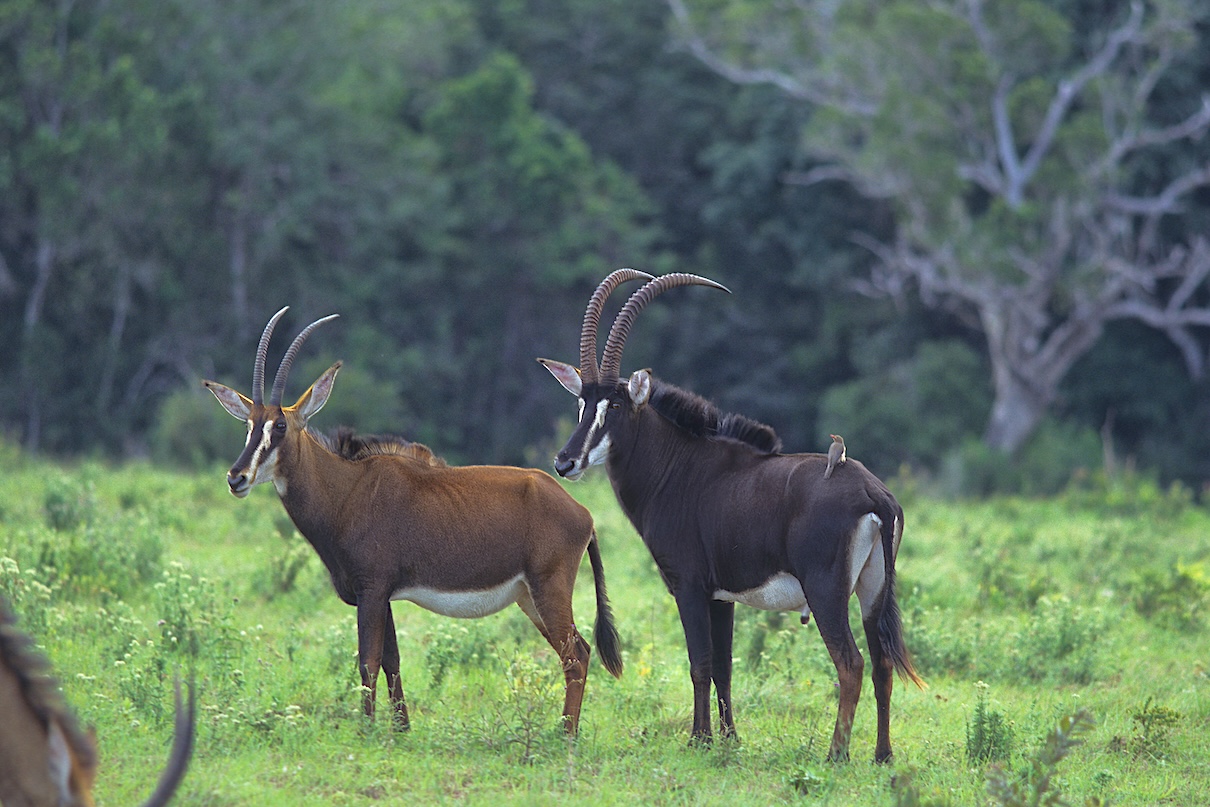
There is a recent trend of introducing ungulates like various antelope species outside their natural home ranges, a practice that carries large risks and should only be carried out under very limited circumstances, a new op-ed argues.This is why the IUCN’s guidelines for responsible wildlife translocation classify the importation of nonnative wildlife as something to be carried out only under a very narrow set of exceptional circumstances.“Isn’t the essence of conservation about, as much as possible, allowing evolution to run its course un-engineered? The IUCN guidelines exist for good reason, and history suggests they should be followed,” the authors write.This article is a commentary. The views expressed are those of the authors, not necessarily of Mongabay. Introducing animals outside their natural ranges is a practice fraught with risk, one that the International Union for the Conservation of Nature (IUCN) — the recognized global authority on the natural world — explicitly discourages. The IUCN’s guidelines for responsible wildlife translocation classify the importation of nonnative wildlife as a “critical risk” to be carried out only under a very narrow set of exceptional circumstances. There are very good reasons for these precautions. The natural world is awash with examples of species that were released outside their natural ranges becoming invasive, with devastating consequences. Even if species released outside their natural ranges don’t become invasive, they may still drastically disrupt the ecological dynamics of a community. For decades, translocations of animals within their former ranges have been used as a helpful tool in conservation. Reintroduction of species for conservation purposes such as bolstering an existing population, reestablishing a population that has gone extinct in the wild, and maintaining genetic diversity all rely on translocations. Such movement of animals may also help enhance tourism by offering greater numbers or a more diverse array of local species. Moving animals outside their natural range (an introduction rather than a reintroduction), however, is a fundamentally different and a potentially problematic proposition. The outcomes of these “conservation introduction” cases are often binary: the animals struggle mightily, if not die off, or the animals manage to acclimate to the unfamiliar surroundings and proceed to compete for resources with the native species, potentially inflicting harm in the process. And while examples of failed conservation introductions abound, the frequency of such actions appears to be accelerating, especially with respect to ungulates. Ugandan kob antelope at Murchison Falls National Park, where the species is naturally resident. Image courtesy of Kenneth Coe. A live example of a conservation introduction gone dramatically wrong can be seen in Africa in the plant kingdom. Consider the case of Neltuma juliflora (formerly Prosopis juliflora and commonly known as mesquite or mathenge). This fast-growing and drought-resistant shrub, native to South and Central America, was touted by scientists as a solution to combat desertification as well as fodder for people and livestock, and development agencies began distributing N. juliflora in earnest during the 1970s and ’80s, especially to East Africa and the Horn of Africa. Initially lauded for its benefits, this “super shrub” proved to be a noxious invasive a couple of decades later, crowding out rangelands, harming livestock, and stimulating populations of malaria-carrying mosquitoes. Today, no less than 18% of Kenya’s Baringo county and 12% of the country of Ethiopia host tracts of N. juliflora, now deemed impossible to eradicate and widely acknowledged as one of the most problematic invasive species in the world. While it is unlikely that a conservation introduction of ungulates would lead to such a social and economic crisis for humans, it is certainly capable of causing negative ecological impact. The die-off of the roan antelopes (Hippotragus equinus) translocated outside their natural range in Shimba Hills National Reserve in Kenya in the 1970s and ’80s, for example, is an unsurprising outcome. What is not so obvious is the possible insidious effects of introduced species that manage to survive and compete for resources against indigenous species. Plains zebras (Equus quagga), for example, have recently been introduced to the same reserve (Shimba Hills), and are now competing for resources against Kenya’s last remaining herds of sable antelopes (Hippotragus niger), a population that is already declining from a past size of hundreds down to fewer than 50 now. Sable antelope photographed at Shimba Hills National Reserve in Kenya. Image courtesy of Kenneth Coe. Two of the lessons from N. juliflora are that (1) the potential impact of a non-indigenous species is impossible to predict, and (2) insidious effects can take years to become apparent. Indeed, we don’t know and we may not know for quite some time if the sable antelopes — selective grazers with exacting ecological requirements — will be outcompeted by the zebras, adaptable nonselective grazers. Their interactions may be exacerbated by the isolation and small size of Shimba Hills. The risk/reward of the zebra introduction appears one-sided, however, as the reward is just tourists in Shimba Hills getting to see an additional mammal species, one that is common, familiar and widespread in Africa, and that does not belong in Shimba Hills. Then there are genetic issues to consider. Species may appear morphologically similar, but by virtue of having been isolated for long time periods, may in fact be genetically distinct species. As more research is conducted, an increasing number of ungulates are being split into different species or subspecies. The giraffe, for instance, until recently considered to be one species, has recently been split into four Unless animals being introduced are from nearby and similar populations, there is the risk of genetic mixing and contamination, resulting in a population that is no longer well adapted to its local habitat. In Uganda, Uganda kobs (Kobus kob thomasi) were recently introduced to Kidepo Valley National Park, where they have never occurred. There is a separate and distinctive subspecies of kob called the white-eared kob (K. k. leucotis) residing mostly in neighboring South Sudan, but at least periodically vagrant and possibly resident in Kidepo. The infusion of Uganda kobs into Kidepo could artificially create a Uganda kob x white-eared kob hybrid population, undermining the genetic integrity of both subspecies. The Uganda kobs may also disrupt other ecological relationships with other species in Kidepo. So, under what circumstances should nonnative introductions take place? The IUCN guidelines discourage conservation introductions except under extraordinary circumstances: To avoid extinction of the species (e.g., by relocating critically endangered animals from a war zone, or a permanently depleted habitat); Introducing a species to perform a specific ecological function (e.g., introducing an insect species to help eradicate an invasive plant). A group of Ugandan kob antelope at Murchison Falls National Park, Uganda. Image courtesy of Kenneth Coe. An example of this is the establishment of an “insurance ex situ” population of hirola (Beatragus hunteri), a species closely related to hartebeest (Alcelaphus buselaphus). The hirola has a very localized distribution on the border between eastern Kenya and southern Somalia. Between the 1960s and now, the hirola population has dropped from tens of thousands to likely fewer than 500, due mostly to hunting, drought, and habitat loss, while the population in Somalia is believed to have disappeared. Between 1963 and 1996, 77 animals were moved to Tsavo East National Park as a precautionary establishment, and the hirolas still number around 75 individuals in Tsavo East today. This represents exactly the kind of justified exception the IUCN envisions with respect to conservation introductions. Outside of such exceptional cases, the introduction of animals into areas where they are not indigenous is a gamble with ecosystems, and history shows it is a gamble we consistently lose. And, of course, there is the big picture: isn’t the essence of conservation about, as much as possible, allowing evolution to run its course un-engineered? The IUCN guidelines exist for good reason, and history suggests they should be followed. Charles Foley is a senior conservation scientist at Lincoln Park Zoo in the U.S., and a member of the IUCN Antelope Specialist Group. Kenneth Coe is a former chair of the advisory council of The Nature Conservancy’s Africa Program and a member of the IUCN Antelope Specialist Group. Their views are their own and do not reflect the views of any affiliated organizations. See related coverage: ‘Beasts of the East’ chronicles the unheralded restoration successes of America’s eastern wildlife Cheetahs reintroduced to Zambia’s Greater Luangwa Ecosystem Bangladesh tests a return to the wild for extinct peafowl populations Cite this articleCharles Foley, Kenneth Coe (2026). Conservation shouldn’t gamble with nonnative species introductions (commentary). Mongabay Conservation news. DOI: https://doi.org/10.66709/news-324805 Credits Topics
Conservation shouldn’t gamble with nonnative species introductions (commentary)
Full Article
Original Source
Read the full article at News →KhanList aggregates and links to publicly available news content. We do not host full articles from third-party sources. Always verify important information with original sources.