
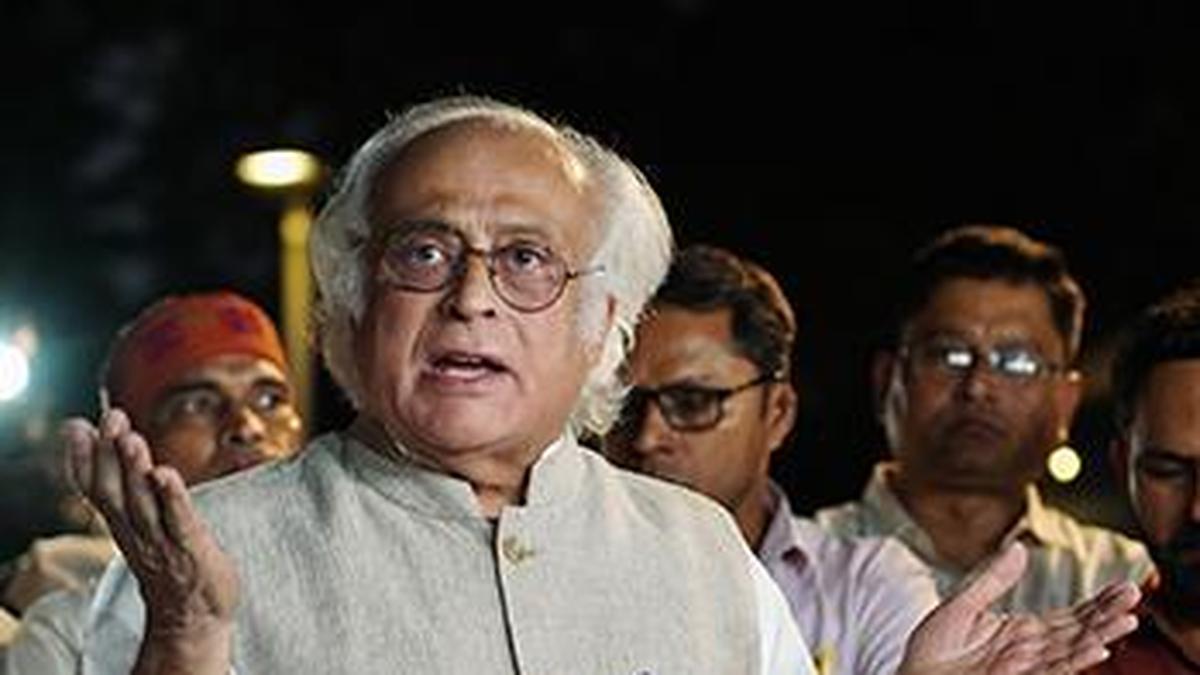
Jairam Ramesh addresses a press conference. File | Photo Credit: ANI Criticising the government for weakening the grievance redressal mechanism under the rural employment programme Viksit Bharat Guarantee for Rozgar and Aajeevika Mission (Gramin), which replaced the Mahatma Gandhi National Employment Guarantee Act in July this year, Congress general secretary (communications) Jairam Ramesh said the government has reduced India’s most significant rights-based law to an administrative scheme. Mr. Ramesh was responding to The Hindu’s report on the government dropping several provisions that had figured in the draft rules circulated in May, some of which were also part of the previous rural jobs programme.Key clauses dropped include a provision requiring the registration of a first information report (FIR) for prima facie evidence of financial irregularities, and the requirement to place action-taken reports before local body meetings for review and monitoring.In a post on X, Mr. Ramesh said that while the government had an opportunity to strengthen mechanisms to address violations of the programme’s provisions, it had instead “removed those avenues altogether”.In the continuing trend of converting India's most significant rights-based law into nothing more than an administrative scheme, the Union Ministry of Rural Development (MoRD) has notified a set of rules on grievance redress which further disempower workers and people, leaving their so called right as yet another jumla. Where the Government could have shown its intent to immediately redress violations of the core provisions of the Act, it has decided to remove those avenues altogether. The final VB–G RAM G Grievance Redressal Rules, notified by MoRD on 2 November 2026, have significantly diluted several important provisions contained in the draft Rules published in May 2026. The key changes are: 1. Removal of penalties for failure to resolve grievances within the stipulated timeframe: The draft Rules explicitly stated that failure to dispose of a grievance within seven working days would constitute a contravention of the Act and attract action under Section 27. This provision has been deleted from the final Rules. While timelines remain, there is no longer an explicit provision in the Rules holding officials accountable for non-compliance. 2. Removal of the obligation to initiate criminal proceedings in cases of financial irregularities: The draft required the District Programme Coordinator (DPC), after obtaining legal advice, to ensure that an FIR was lodged and necessary proceedings initiated where prima facie evidence of financial irregularities emerged from preliminary enquiries or social audit findings. This provision has been entirely deleted. 3. Removal of mandatory oversight by elected Panchayati Raj Institutions: The draft required action taken on grievances to be placed before Intermediate and District Panchayat meetings for review and monitoring. This provision has been deleted, weakening democratic oversight of grievance redressal. 4. Removal of mandatory weekly grievance-receiving days: The draft required officials at every level to be available to receive grievances on at least one designated day every week. This requirement has been removed, making it harder for workers to know when and where they can approach officials. 5. Removal of dedicated grievance redressal desks: The draft mandated grievance redressal desks at every Block and District to facilitate registration of complaints and provide information about the implementation of the Act. This provision has been deleted. 6. Dilution of the requirement for physical verification of complaints: The draft explicitly required enquiries through spot verification or inspection. The final Rules permit examination of official records and other information but do not expressly require physical verification. This is particularly problematic where complaints concern falsification of muster rolls, fraudulent payments or discrepancies between official records and ground realities. 7. Removal of mandatory quarterly reporting: The draft required the DPC to submit quarterly reports to the State Government detailing the number, nature and categories of grievances, along with their disposal and pendency. This provision has been deleted, weakening institutional monitoring and accountability. 8. Weakening of automatic escalation: The draft explicitly required grievances unresolved within fifteen days to be automatically escalated to the next higher authority through the digital platform. The final Rules retain mandatory escalation after fifteen days but remove the explicit requirement that it be automatic. 9. Removal of an explicitly mandated State-level grievance redressal mechanism: The draft required State Governments to establish grievance redressal mechanisms at Gram Panchayat, Block, District and State levels. The final Rules expressly specify only Gram Panchayat, Block and District levels, although they allow other levels to be designated. 10. Removal of detailed appellate provisions from the Rules: The draft explicitly specified the appellate hierarchy, a 45-day period for filing appeals and a 30-day deadline for their disposal. The final Rules replace these provisions with a reference to Schedule I of the Act. Whether this reduces the substantive right of appeal depends on the corresponding provisions of the parent Act. 11. Reduced flexibility for State-level digital grievance systems: The draft recognised digital grievance platforms provided by either the Central or State Government. The final Rules place greater emphasis on a Central Government-designated digital platform, reducing the express flexibility available to States. Without making sufficient financial allocations, ensuring the realisation of the guarantees is the sole burden of the State, and there is no avenue by which people can ensure redress for what are daily violations. Using the mirage of digital governance, the rules clearly demonstrate that the rights will remain on paper / in the cloud. Today while millions of workers are not able to record their attendance through (National Mobile Monitoring System) NMMS, are not able to receive their wages due to Aadhaar-Based Payment System (ABPS), even grievances are now going to be placed in the digital domain without accountability.— Jairam Ramesh (@Jairam_Ramesh) November 4, 2026According to the Congress leader, one of the most significant changes was deleting a draft provision that treated failure to dispose of grievances within seven working days as a contravention of the Act, potentially inviting action under Section 27. While timelines have been retained, the final rules do not explicitly prescribe accountability for officials who fail to meet them, he said.Mr. Ramesh further criticised the deletion of provisions mandating review of grievance-related action by Intermediate and District Panchayats, establishment of dedicated grievance redressal desks at block and district levels, and designation of a fixed weekly day for officials to receive complaints.The Congress leader said the final rules had also weakened provisions relating to physical verification of complaints, quarterly reporting by district authorities, automatic escalation of unresolved grievances, and State-level grievance redressal mechanisms. He argued that the changes reduced transparency and democratic oversight.Mr. Ramesh contended that the increasing reliance on digital platforms for grievance filing could further disadvantage rural workers already facing difficulties linked to the National Mobile Monitoring System and the Aadhaar-Based Payment System.“Using the mirage of digital governance, the rules clearly demonstrate that the rights will remain on paper and in the cloud,” he said, adding that millions of workers continued to face challenges in recording attendance and receiving wages. Published - November 04, 2026 10:31 pm IST
Congress slams dilution of grievance redressal rules under rural jobs scheme
Full Article
Original Source
Read the full article at Thehindu →KhanList aggregates and links to publicly available news content. We do not host full articles from third-party sources. Always verify important information with original sources.