
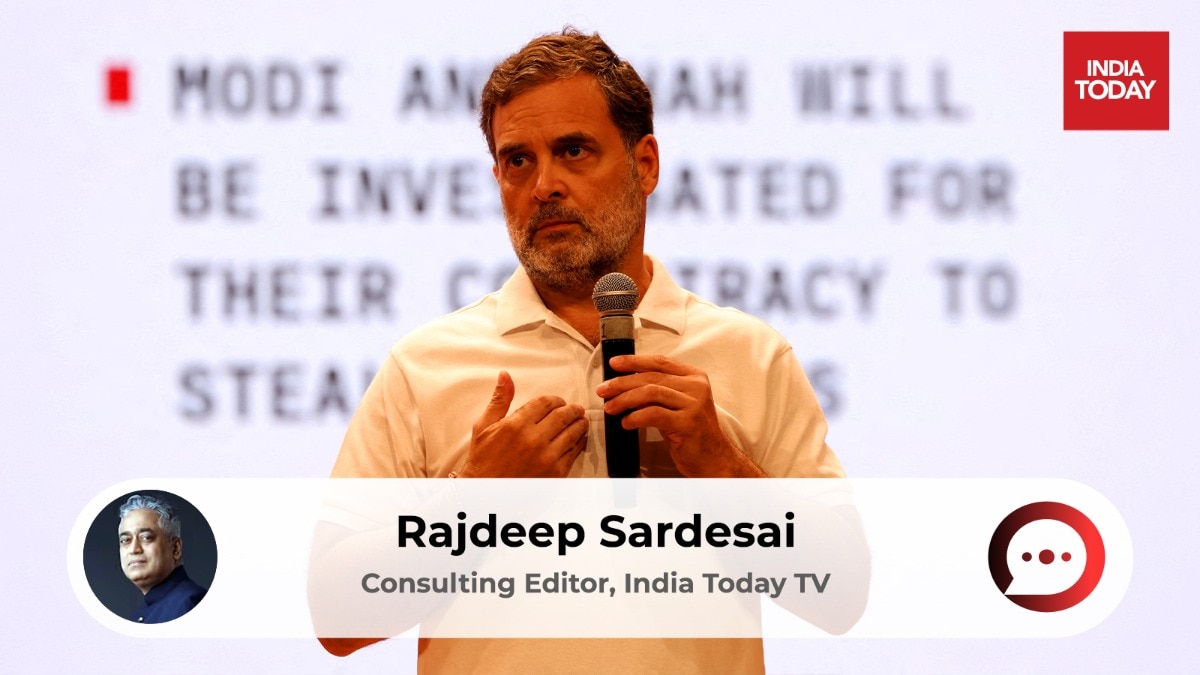
Last week, Rahul Gandhi quite literally set the cat among the political pigeons when he asked a deceptively simple question: why do Narendra Modi and the BJP appear so resistant to anti-incumbency even after more than a decade in power? "Even my grandmother was defeated by anti-incumbency in 1977," he pointed out, before alleging that the electoral process itself was being manipulated to ensure the Modi-led BJP's continuance in power.It is an explosive charge. And, as with many of Rahul Gandhi's recent interventions on elections, there is an uncomfortable truth in it – but also a dangerous temptation to oversimplify.Rahul Gandhi is right about one thing: the Election Commission of India has suffered a serious credibility deficit. That is not merely an Opposition talking point any more.The controversy over the Special Intensive Revision (SIR), the questions surrounding the "logical discrepancy" category in West Bengal, the scale of deletions and the delays in adjudicating appeals have all raised legitimate questions about transparency and due process. The Supreme Court itself has described the situation as reflecting a "trust deficit" between constitutional functionaries. The numbers should concern anyone who cares about the sanctity of the electoral roll: 22 lakh citizens in West Bengal have gone in appeal so far, of which around 1.26 lakh cases have been decided. And, 93% of these adjudicated cases have turned out to be legal voters. When a citizen's right to vote can be jeopardised by a database mismatch or an opaque verification process, the burden of proof cannot casually be shifted from the state to the citizen. Elections are not simply about what happens on polling day; they begin with who is allowed to appear on the electoral roll.Not to forget the manner in which cash transfers by the government were allowed while voting was on in Bihar, brazen hate speech going unchecked in Assam, election symbols being snatched away from recognised parties to legitimise defections and election calendars being neatly 'adjusted' to suit the ruling party. And that is why the ECI cannot wave away concerns about its functioning as merely political allegations. There is a genuine apprehension based on the recent track record that the Election Commission isn't a neutral umpire.But here is where Rahul Gandhi also risks getting it wrong. To argue that the BJP's electoral dominance is principally the consequence of a rigged or compromised electoral system is to ignore an inconvenient mountain of political evidence. It also risks becoming an escape route for the Congress and the wider Opposition.Consider the simplest question: are India's polling agencies also part of the conspiracy? Since 2014, election after election has shown Narendra Modi retaining a formidable personal popularity, particularly across large parts of the Hindi heartland and western India. Polls can be wrong – sometimes spectacularly so – and some pollsters certainly deserve scrutiny. But to dismiss the underlying political phenomenon because the BJP has benefited from it is to misunderstand what has happened to Indian politics over the past decade.This isn't only the Modi factor either. The BJP has built something that the Congress has struggled to replicate: a formidable political and organisational machine. It has a vast cadre network, the RSS ecosystem, deep financial resources, an aggressive communications apparatus, a clear ideological proposition and considerable experience in converting national narratives into electoral campaigns.Look at the money involved. According to expenditure statements filed with the ECI, the BJP reported spending Rs 529.38 crore across the five Assembly elections held this year in Assam, Kerala, Tamil Nadu, West Bengal and Puducherry. The Congress reported Rs 248.55 crore across the same five contests. In West Bengal alone, the BJP reported spending Rs 286.99 crore – more than the Congress's combined expenditure across all five elections.These are official declared figures, not estimates of undeclared expenditure. They don't prove electoral wrongdoing. But they do demonstrate the extraordinary asymmetry in resources available to the principal national parties: a well-oiled Ferrari versus a second-hand Fiat is hardly a level playing field.And the BJP's financial advantage is not a minor footnote. During the same election period, the BJP's central headquarters reported receipts of roughly Rs 1,473 crore, compared with about Rs 207 crore reported by the Congress.You don't need a conspiracy theory to explain the existence of an enormously powerful election machine. You need to explain why its principal rival has failed to build an equally effective one despite having been in power for decades.That is the question Rahul Gandhi must confront. The Congress's problems cannot all be outsourced to the Election Commission. Leadership battles, organisational decay, factionalism, defections, weak state-level structures and the absence of a compelling alternative political narrative have all contributed to its decline.In state after state, the Congress has often appeared to be fighting itself even before it fights the BJP.And this is where the anti-incumbency argument becomes particularly interesting. Because anti-incumbency does exist.In 2018, the Congress defeated the BJP in three major Hindi-heartland states - Madhya Pradesh, Rajasthan and Chhattisgarh. The BJP was not invincible. In 2023, the BJP lost its grip on power in Karnataka. In 2024, the BJP itself lost its parliamentary majority and had to rely on allies to form the government. The result was a reminder that Indian voters can and do punish incumbents.So perhaps the more interesting question is not: Why doesn't anti-incumbency work against Modi? It is: Why hasn't the Opposition been able to convert anti-incumbency into a sustained national alternative?That distinction matters.In 2019, the Congress-led Opposition struggled to convert its 2018 state-level successes into a national challenge. The Pulwama-Balakot episode altered the political narrative dramatically with a wave of nationalist muscle flexing. In 2024, the Opposition improved its parliamentary performance, but the INDIA alliance was never quite able to become the coherent political alternative that its arithmetic promised. Differences between allies, leadership questions and strategic missteps repeatedly got in the way. Why, for example, did Nitish Kumar, the leader who crafted the India alliance, leave the fold months ahead of the 2024 general elections ? That is a question that goes to the heart of the ego-centric battles within the opposition.The Congress cannot simultaneously argue that the BJP is electorally unbeatable and then avoid asking why the Opposition remains so politically beatable.Even now, in Modi 3.0, there are signs of political fatigue, discontent and areas of vulnerability. But political opportunity is not the same thing as political victory. Anti-incumbency is a potential force; it needs an organised political vehicle to translate it into votes and seats.And that brings us back to Rahul Gandhi. He is right to demand answers from the Election Commission. An electoral referee whose credibility is questioned cannot simply tell everyone to trust the referee. The ECI needs transparency, accountability and institutional credibility. The controversy over the electoral rolls, in particular, demands much greater disclosure and independent scrutiny.But the answer cannot stop there. If the Opposition believes that electoral-roll additions and deletions have been compromised by centralised systems, the obvious demand should be an independent audit of the process – constituency by constituency, addition by deletion, algorithm by algorithm. Establish the facts. Follow the evidence. Let the evidence determine the scale of the problem.But once that is done, the Opposition must also look in the mirror. Because blaming the umpire cannot explain every defeat.The Congress has lost elections where the ECI was not the central issue. It has won elections when the BJP was the incumbent. And the BJP's rise cannot be explained simply by the alleged failings of an electoral referee. There is a political, organisational, ideological and leadership story here that is far bigger than the ECI.The danger for Rahul Gandhi is that the more he looks exclusively outward, the less pressure there is on his own party to look inward. Perhaps the real challenge for the Congress is to hold two thoughts in its head simultaneously: defend the integrity of the electoral process and fix the integrity of its own political machine. One without the other is not enough.There is, finally, one set of numbers that I used in my last election book that tells the story more starkly than any speech. Between 2009 and 2024, the BJP's vote count increased from roughly 7.84 crore to a whopping 23.59 crore. The Congress, by contrast, barely moved from around 11.9 crore to 13.67 crore. The figures are not an explanation for everything – India's electoral map is far more complicated than a national vote tally – but they are a powerful reminder of the scale of the political transformation.Call it 'Moditva', the Modi phenomenon, Hindutva politics, organisational superiority or simply the BJP's ability to win elections. But don't call it only the ECI. The Election Commission must answer for its credibility deficit.The Congress must answer for its own deficit. And India's democracy deserves answers to both.(The writer is a senior journalist, author and columnist. Views are personal.)- Ends
Congress on offensive amid EC row: Where Rahul Gandhi gets it right and wrong
Full Article
Original Source
Read the full article at Indiatoday →KhanList aggregates and links to publicly available news content. We do not host full articles from third-party sources. Always verify important information with original sources.