
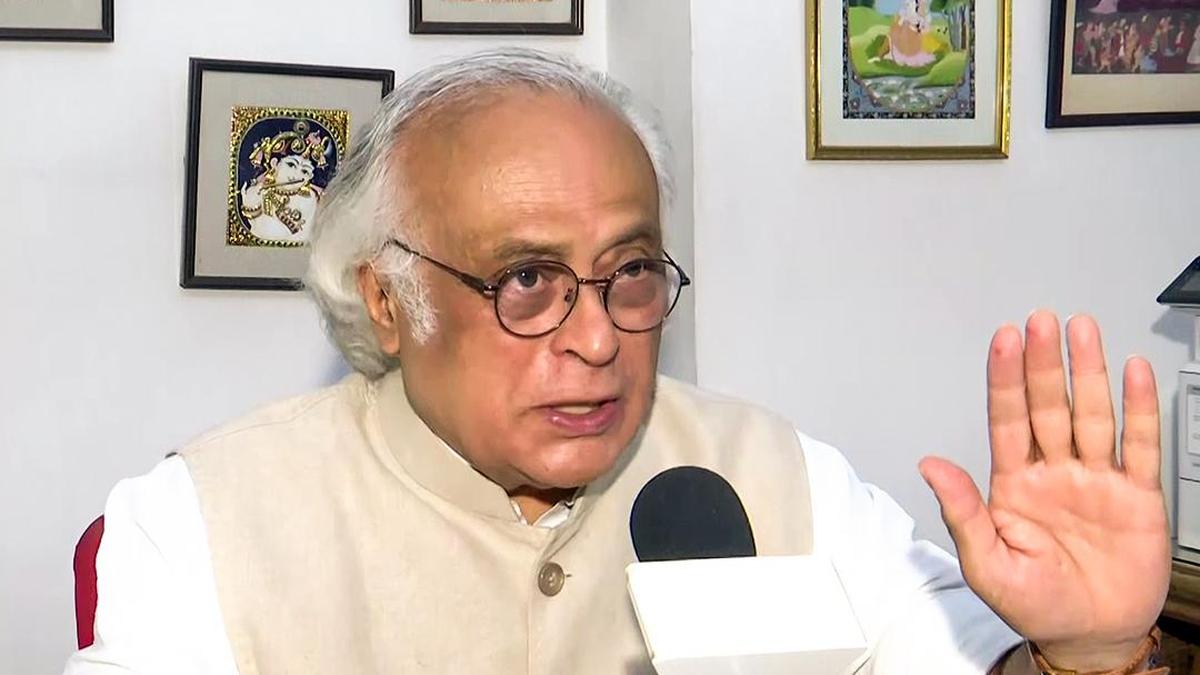
Congress MP Jairam Ramesh said, arguing that the government, through the Bills defeated in the previous session, had removed the constitutional protection for maintaining the State-wise proportion of seats in the Lok Sabha. File | Photo Credit: ANI The ongoing speculation that the government will suitably amend the legislative package comprising the Constitution (131st Amendment) Bill and the Delimitation Bill to ensure a proportionate 50% increase in the strength of each State in the Lok Sabha, in order to address the concerns of its allies, is only an “optical illusion”, Congress general secretary Jairam Ramesh told The Hindu on the eve of the monsoon session of Parliament.On April 17, the 131st Constitution Amendment Bill, which sought to redistribute Lok Sabha seats on the basis of the 2011 Census and expedite the implementation of women’s reservation, was defeated by a united Opposition. In a House where 528 members were present and voting, 298 voted in favour of the Bill, falling short of the required two-thirds majority.“The talk of a proportionate 50% increase in the strength of each State in the Lok Sabha is an optical illusion. It is meaningless in light of Article 81(2)(a) of the Constitution,” Mr. Ramesh said, arguing that the government, through the Bills defeated in the previous session, had removed the constitutional protection for maintaining the State-wise proportion of seats in the Lok Sabha.The legislation sought to amend Article 81(1) to increase the number of Lok Sabha members from the current 543 to 850, and Article 81(3) to lift the 1971 freeze, but it left Article 81(2)(a) untouched. This Article maintains the ratio between the number of seats and the population of a State must be roughly equal across all States.“The Bills circulated by the government in the last session removed the Constitutional freeze on the distribution of Lok Sabha seats, which means that it is now a Constitutional imperative to reallocate seats in favour of the more populous States,” Mr. Ramesh said.This, he argued, leaves a wide ambit for the Delimitation Commission, which is appointed by the government, and whose decisions are protected from judicial challenge by Article 329 of the Constitution.“The Modi government may commit to a proportionate 50% increase for all States in the Lok Sabha for the 2029 elections. However, after the elections, the Commission can very well change the State-wise distribution of Lok Sabha seats, favouring the more populous States in the allocation of seats,” he said.Using the 1971 Census as the basis for the distribution of Lok Sabha seats is crucial to maintaining a federal balance, Mr. Ramesh said. The Congress has proposed that this freeze should continue for another 25 years, extending it to 2051.The composition of the Lok Sabha, however, has changed since the Bills were defeated on April 17. The government’s numbers have increased following splits in the Trinamool Congress and Shiv Sena (UBT).Mr. Ramesh appealed to both the Dravida Munnetra Kazhagam (DMK) and the Telugu Desam Party (TDP) to not compromise the interests of the southern States.The DMK, since the Congress’s decision to align with Tamilaga Vettri Kazhagam (TVK) following the defeat of the DMK-led alliance in the Tamil Nadu Assembly election, has maintained its distance from the Congress, and it remains unclear how it would vote if the Bill returns to Parliament. The TDP, a key BJP ally, had sought the retention of the 1971 reference in the legislation.“The DMK played a pivotal role in the Constitutional freeze of 1976. The DMK and the TDP played a crucial role in the Constitutional freeze of 2001. Hopefully, both will now continue to play the key role in ensuring there is no unfreezing,” Mr. Ramesh said. Published - July 19, 2026 08:26 pm IST
Congress leader Jairam Ramesh calls talk of 50% seat increase for all States an ‘optical illusion’
Full Article
Original Source
Read the full article at Thehindu →KhanList aggregates and links to publicly available news content. We do not host full articles from third-party sources. Always verify important information with original sources.