
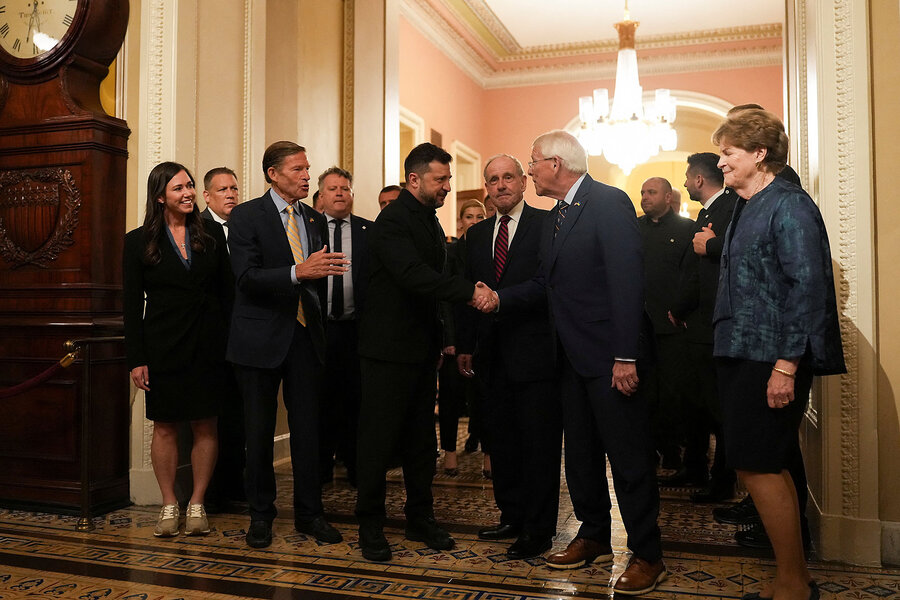
Iran isn’t the only nation facing new threats of U.S. sanctions. In September, the House will take up a Russia sanctions bill that could become Congress’ first significant action on Ukraine since President Donald Trump returned to the White House.The Senate in early August overwhelmingly passed the bill, which aims to squeeze Russia’s war effort in Ukraine by targeting the oil and gas exports that fund it. House members have indicated some bipartisan support.Experts say the bill has weak points, such as loopholes allowing the president to decline to enforce certain measures. Its expansion of presidential tariff powers has been controversial among lawmakers who say it hands over power that should belong to Congress. Why We Wrote This If passed, a bill imposing sanctions on Russia because of its war in Ukraine would mark a new step for congressional action related to that conflict. But the bill gives the president leeway to influence tariffs and other penalties. Here’s what’s in the bill and how some of its provisions could play out.What would the bill accomplish?The United States already has thousands of sanctions on Russia. For example, it cuts off Russia’s major banks from the U.S. financial system and freezes assets within U.S. jurisdiction for Russian President Vladimir Putin’s inner circle of oligarchs. The bill writes these sanctions into law, so they can’t be overturned at a president’s whim. It also cracks down on Russia’s “shadow fleet” of vessels that it uses to dodge those existing sanctions, making it easier for the U.S. to target certain ships, whose owners aren’t clearly known, that are moving Russian oil and gas. An oil tanker is moored at the Sheskharis complex in Novorossiysk, Russia, Oct. 11, 2022. The bill also directs the president to impose up to 100% tariffs on the five countries that the U.S. trade representative determines are the largest importers of both Russian oil and gas (unless countries are actively working to reduce their dependence).Russia has been hit hard by Ukraine’s targeted strikes on its energy sector.“Russia’s economy is actually in a very weak shape, and now is a really good time to hit them,” says Maia Nikoladze, a deputy director at the Atlantic Council’s Economic Statecraft Initiative.Experts are divided on how consequential the bill would be in terms of harming Russia for Ukraine’s benefit. Philip Luck, director of the Center for Strategic and International Studies’ Economics Program, cautions that any sanctions must be strictly enforced to be effective. Ms. Nikoladze says the tariffs’ effectiveness depends on a complicated set of factors, and that there may not be immediate consequences for Russia.But the bill would still mark a notable departure from Congress’ recent inaction on Ukraine. And experts agree there’s significant symbolic value to Congress making a long-term commitment to sanction Russia, as the bill ties the termination of sanctions to a signed and congressionally reviewed peace deal.Dr. Luck says that commitment could reassure allies and make businesses think twice before investing in Russia.“This is getting us back in the game,” he says.How much leeway would the law give President Trump regarding tariffs?One of the most controversial parts of the bill is that it hands the president the ability to impose steep tariffs on countries that buy Russian oil. In 2025, Mr. Trump imposed worldwide tariffs that the Supreme Court later ruled were illegal. He has continued to try to find ways to impose tariffs on selected countries.Experts like Clark Packard, a research fellow at the libertarian-leaning Cato Institute, believe the president could use the threat of tariffs as leverage with countries like India, which is a significant buyer of Russian oil and is engaged in ongoing trade talks with the U.S. Julia Demaree Nikhinson/AP U.S. President Donald Trump listens as Russia's President Vladimir Putin speaks during a news conference at Joint Base Elmendorf-Richardson in Anchorage, Alaska, Aug. 15, 2025. That leverage derives from how the bill is written: The president has some leeway in how steep tariffs would be on top buyers. The administration also can designate which countries would be targeted.“Because [Mr. Trump] has this threat, it just adds a little more uncertainty into all these negotiations,” says Mr. Packard.The bill gives Mr. Trump other leeway as well: It allows the president to waive any sanction or tariff if he believes doing so is necessary for the “national interest.” All he needs to do is submit a written explanation to Congress.Mr. Trump could use the waiver power as incentive in a trade negotiation, experts say, or to lift sanctions on Russia if he wants to try to motivate President Putin.“Any congressional sanctions always have this giant asterisk that’s basically the waiver clause,” says Dr. Luck. “The administration or any administration can essentially waive any sanctions kind of whenever it wants.”How have Mr. Trump and Congress shifted on Ukraine?After Russia attacked Ukraine in 2022, Congress passed nearly $174.2 billion in emergency appropriations to help Kiev. But by the time Mr. Trump took office for his second term, support had largely stalled.That started to shift early this year, when South Carolina Sen. Lindsey Graham’s lobbying convinced Mr. Trump to green-light the bill, after almost a year of withholding his support. Then, a group of Senate Democrats traveled to Ukraine to build pressure for congressionally passed sanctions. Senator Graham’s death in July, followed by Ukrainian President Volodymyr Zelenskyy’s trip to Washington where he put pressure on Democratic senators, were catalysts for the Senate to pass it in August.Mr. Trump has indicated he’ll sign the bill into law if it passes the House. His relationships with presidents Putin and Zelenskyy have shifted throughout the course of the conflict. The president had a falling-out with Mr. Zelenskyy in early 2025, accusing him of being “disrespectful” in a heated Oval Office meeting. But their relationship has improved, and Mr. Trump has cooled on Mr. Putin after initial optimism that the two could come to an agreement to end the war.
Congress eyes tighter sanctions on Russia – with wiggle room for Trump
Full Article
Original Source
Read the full article at Csmonitor →KhanList aggregates and links to publicly available news content. We do not host full articles from third-party sources. Always verify important information with original sources.