
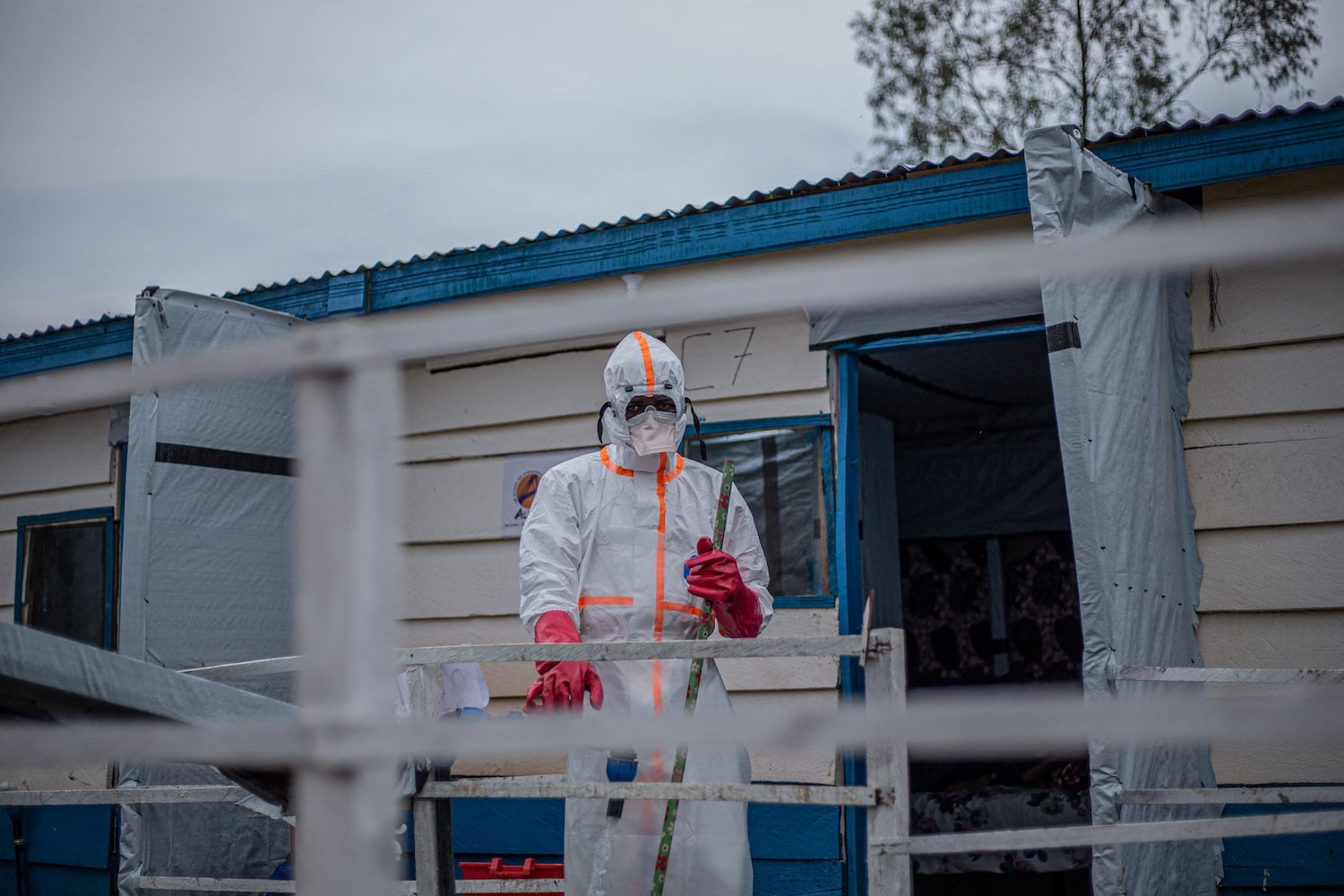
Welcome to Foreign Policy’s Africa Brief. The highlights this week: Health leaders issue new warnings about the Ebola outbreak in the Democratic Republic of the Congo, voters choose continuity in Cape Verde’s presidential election, and the board of an African literary prize exonerates a winner accused of using artificial intelligence. Six months into the fastest-growing Ebola outbreak in history, the rare Bundibugyo variant of the virus shows no sign of slowing down in the Democratic Republic of the Congo. It is exacerbated by an underfunded health system and armed conflict in eastern provinces, where global mining projects have led to increased disease transmission. The outbreak is “still serious, and is still not under control,” said Jean Kaseya, the director-general of the Africa Centres for Disease Control and Prevention, or Africa CDC. The death toll since the outbreak began in May has passed 5,500 people, with more than 11,000 people infected, according to Congolese government figures released last week. Infections are now spreading at double the rate as when the outbreak began, according to Kaseya. More than 80 percent of new cases are emerging outside of known contact lists, and more than 65 percent of deaths have occurred outside of healthcare facilities, he added. Kaseya called the lack of coordination between Congo’s government and foreign donors “a collective failure,” urging donors to release $1.6 billion in pledged aid. International donors have disbursed more than $962 million to organizations that are implementing Congo’s Ebola response. But around $700 million of that sum was unaccounted for as of last month, according to Kaseya. The Africa CDC said that it was too early to attribute this discrepancy to embezzlement, but an investigation is underway. In 2020, Congo’s former health minister was convicted of embezzling more than $400,000 from funds intended to fight Ebola during the 2018-2020 outbreak. Meanwhile, Congolese health workers—who have not been paid for months—have gone on strike. Médecins Sans Frontières (MSF) warned last week that ambulances had run out of fuel, staff were untrained, and that the Congolese government and United Nations agencies needed to “strengthen oversight and accountability.” MSF has called the outbreak “out of control.” For Congo, dealing with the Ebola crisis requires tackling systemic issues beyond healthcare, including poverty, conflict, and inefficient governance. But Congolese President Félix Tshisekedi appears to be focused on cementing his grip on power. On Nov. 9, he signed a law that critics say could grant him a third term in office. Congo’s 2006 constitution allows a maximum of two presidential terms and explicitly prevents parliament from changing those rules under any circumstance. The new law lowers the threshold for holding national referendums and permits constitutional overhauls through referendums “in case of absolute necessity.” Tshisekedi became president in January 2019; his second term ends in 2028. He has said that he is not seeking a third term but would serve one if given a mandate by voters. “I have not asked for a third term, but I tell you this: If the people want me to have a third term, I will accept,” Tshisekedi said in May. On Nov. 1, the Front for the Refoundation of the Nation, a new rebel alliance led by former Congolese President Joseph Kabila, sent a letter to U.S. officials and the U.N. peacekeeping mission in Congo warning that any constitutional changes could derail peace negotiations. Kabila’s alliance includes the Rwanda-backed rebel group M23. The Trump administration negotiated a peace accord between Congo and Rwanda in December 2025 that seemed to prioritize securing U.S. access to Congo’s critical minerals over tackling domestic government reforms and bolstering a weak state. Expanded mining in Congo’s forests has increased human contact with animals that carry the Ebola virus, according to scientists. Nearly one year on, amid an Ebola outbreak and on the precipice of further conflict, Congo is paying the price for the institutional neglect enshrined in the deal. Wednesday, Nov. 18: An Egyptian court hears the retrial of Lina Attalah, the editor in chief of Mada Masr, on charges of publishing false news and running an unlicensed website. The U.N. has described the charges against Attalah as an assault on press freedom. The U.N. Security Council hears a briefing from the International Criminal Court on its work in Libya. Thursday, Nov. 19, to Saturday, Dec. 19: Dak’Art, the biennale of contemporary African art, returns to Dakar, Senegal. Wednesday, Nov. 25: The U.N. Security Council is due to renew its sanctions targeting al-Shabaab and other armed groups in Somalia. Amnesty report on South Sudan. A new report from Amnesty International accuses South Sudan’s government and U.N. peacekeepers of failing to act on advance warnings of a March massacre that killed more than 200 people. The report came ahead of an announcement that South Sudan would again delay general elections to February 2027. The elections were previously scheduled for Dec. 22. The South Sudanese government did not cite a reason for the move, but authorities have repeatedly pushed back elections since 2022 amid a power struggle between President Salva Kiir and his ousted former deputy, Riek Machar. A 2018 power-sharing arrangement between Kiir and Machar broke down last year after an attack on a military base in Upper Nile state by an armed group known as the White Army, which killed more than 250 soldiers. Kiir accused Machar and his party’s military wing of colluding with the White Army, which Machar denied. Machar is currently on trial for charges including treason. Cape Verde elections. Cape Verdean President José Maria Neves was reelected on Sunday, capturing more than 63 percent of the vote amid record low turnout, according to provisional results. Neves’s main challenger, former Justice Minister Joana Rosa—the country’s first woman presidential candidate—conceded on Monday. The lack of opportunities for young people in Cape Verde was a major election topic. Rosa pledged to address issues facing young people, while Neves promised to organize a summit to address youth emigration. According to data released in July by Cape Verde’s statistics body, around 65 percent of people aged 15 to 35 said they intended to emigrate. Neves’s party has dominated Cape Verdean politics since it gained independence from Portugal in 1975. Madagascar’s ties to Russia. U.S. Africa Command’s deputy commander, John Brennan, warned against Madagascar’s strengthening ties with Russia last week, saying that Moscow is importing the “Sahel model” to the island. “We are concerned about Russia wanting to proliferate [the Sahel model] elsewhere across the continent,” Brennan said in a media briefing. Since the country’s 2025 coup, Russia has supplied the military-backed government with weapons—amid repeated calls from young Madagascans for a return to democracy. Some Africans perceived Brennan’s comments as lecturing from the United States. “America is not talking to Russia as a partner. It is talking to Madagascar as a client,” Fortune Madondo wrote in Modern Ghana, suggesting that the United States might condition assistance to needy Madagascar on its allegiance. The criticism underscored why it’s important that U.S. officials consider how their comments land in Africa. If not framed carefully, they could play into Russia’s narrative that the United States is acting like a colonial power. Ghana to boost local manufacturing. Ghana will invest $10 billion over four years in a domestically funded “new economy” program to boost local manufacturing and jobs. Ghanaian Finance Minister Cassiel Ato Forson told parliament in his 2027 budget speech last Friday that the funds will increase refining capacity and reduce lower-value raw materials exports. Around $1.5 billion of the package will be allocated to financing refining facilities for gold, manganese, bauxite, and lithium. The Ghanaian government said it is relying on tax reforms already approved by parliament, better tax collection, and revenue from oil and minerals exports to finance the program. The winner of this year’s 2026 Caine Prize for African Writing, Zimbabwean writer Simbarashe Kundizeza, has been cleared of using artificial intelligence to write his award-winning short story, “The Blue Fighter,” after an October article in the Atlantic said that the AI detection software Pangram found the story was entirely AI-generated. The Atlantic article sparked pushback from Africa’s literary community. Critics said AI detection tools are disproportionately weaponized against authors from marginalized backgrounds. Following a monthlong review, the Caine Prize’s board said that digital forensic evidence showed the article was human-written and that Kundizeza’s $13,000 award stands. Lame-Duck Trump Heads to Asia by Rishi Iyengar What a Hormuz Endgame Could Actually Look Like by Keith Johnson How Netanyahu Lost His Bet on Trump by Azriel Bermant Nigeria’s surveillance state. An investigation by Ajibola Amzat for the Center for Collaborative Investigative Journalism found that Nigeria has spent billions of dollars of public funds on surveillance technology that is supposedly intended to fight insecurity—but is routinely used instead to monitor protesters, journalists, and government critics. “Constitutionally guaranteed dissent is being watched and increasingly hunted while the terrorists and bandits freely operating in several corners of Nigeria’s 36 states remain elusive,” Amzat wrote. Europe’s externalized borders. On Monday, five European countries—Austria, Denmark, Germany, Greece, and the Netherlands—announced plans to send asylum-seekers who have exhausted all legal avenues to Rwanda. In 2024, the United Kingdom scrapped a similar deal due to legal challenges over the country’s human rights record. Since 2019, the European Union has also funded a scheme operated by the U.N. refugee agency that temporarily evacuates refugees from Libya to Rwanda. In light of this week’s news, we’re revisiting Sally Hayden’s 2020 Foreign Policy dispatch from Rwanda’s refugee centers. “At what point does the EU become responsible for refugees it has forced from its borders through externalization policies?” Hayden wrote at the time.
Congo’s Escalating Ebola Crisis
Full Article
Original Source
Read the full article at Foreignpolicy →KhanList aggregates and links to publicly available news content. We do not host full articles from third-party sources. Always verify important information with original sources.