
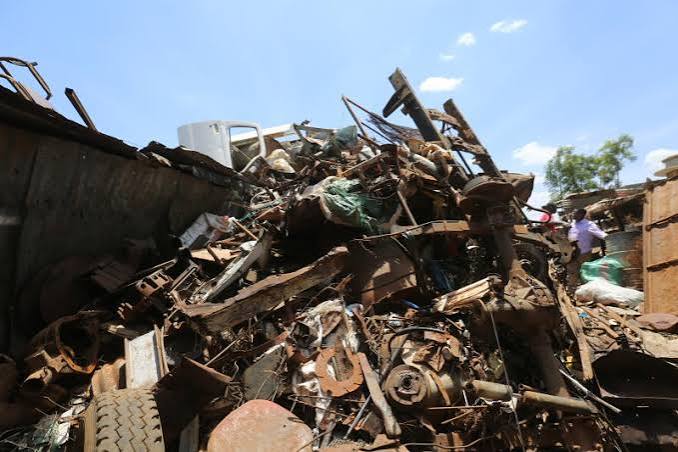
Follow THISDAYLIVE on GoogleAdd us as a preferred source to see more of our stories in Google Follow us on Google A nation that cannot protect the infrastructure it has it built will struggle to achieve the prosperity it seeks to create, argues K BOLANLE ATI-JOHN A nation cannot build prosperity while allowing its infrastructure to be systematically dismantled and sold as scrap. Yet across Nigeria, railway tracks disappear, electricity transmission towers collapse after their structural components are removed, telecommunications cables are severed, and manhole covers and drainage grates vanish from public roads. What should be enduring investments in national development are converted into commodities for private profit, leaving society to bear the enormous costs of replacement, disrupted services and diminished economic productivity. The scale of the problem demands that we move beyond describing individual acts of vandalism. On 30 May 2026, six transmission towers on the Apir–Lafia 330kV lines collapsed during a heavy downpour after vandals had removed critical components. In August, five towers fell on the Ikot Abasi–Eket 132kV line, and structural members had been stripped from seven more, leaving them at risk of collapse. Telecommunications networks are under similar strain: the Nigerian Communications Commission recorded 44,678 fibre-cut incidents in the first nine months of 2026, including 9,283 attributed to vandalism. Other causes included degradation, cable connection faults and construction-related damage. Such incidents expose weaknesses not merely in physical protection but in the arrangements through which public assets are stolen, transported, purchased, processed and absorbed into legitimate commerce. The fundamental question is whether Nigeria is confronting isolated acts of opportunistic theft or an organised criminal economy sustained by commercial demand, financial incentives and institutional weaknesses. A hungry or unemployed individual removing a manhole cover may be the visible offender, but poverty may help explain why individuals become involved in theft; it cannot, on its own, explain the commercial networks capable of purchasing, transporting, processing and marketing substantial quantities of stolen infrastructure. We must therefore investigate the entire value chain. Who purchases stolen railway tracks and electricity cables? Who provides the capital enabling intermediaries to accumulate these materials? Where are they transported, processed or melted? How do they enter domestic manufacturing or international commodity markets? Are some commercial operators knowingly accepting stolen infrastructure, and are public officials facilitating the trade through negligence, corruption or deliberate protection? These are investigative questions, not conclusions about particular businesses or nationalities. The nationality of an investor is immaterial; the relevant considerations are beneficial ownership, commercial conduct, financial transactions and criminal responsibility. The economic logic is particularly destructive. A criminal enterprise may acquire metal worth relatively little as scrap while inflicting damage that costs the state millions to repair. The collapse of an electricity transmission tower involves far more than the replacement value of its steel components. It interrupts industrial production, threatens public safety and imposes substantial costs on electricity consumers. The criminal captures a small private benefit while transferring an enormous economic burden to society. In effect, the country pays repeatedly for infrastructure it has already financed. Nigeria has not been entirely inactive. The Critical National Information Infrastructure Order of 2024 designated important telecommunications and digital assets for special protection. Government has also pursued restrictions on scrap metal exports. This month, the Ministry of Steel Development held stakeholder consultations in Lagos to validate the draft Scrap Metal (Collection, Trading, Recycling and Regulation) Regulations, 2026, which would license operators, regulate collection and aggregation centres and require transaction traceability. These measures rightly treat the scrap market as part of the problem. But a draft regulation is not an operational control; its effectiveness will depend on implementation, institutional capacity and sustained accountability. Borno State, by contrast, imposed a total ban on ferrous scrap scavenging and trading in October. That may be understandable where security risks are acute, but blanket bans risk pushing the trade underground, where it is harder to police. The case involving Inner Galaxy Steel Company and Jiuxing Integrity Industrial Ltd illustrates why attention must extend beyond those physically removing infrastructure. In May 2026, the Nigeria Security and Civil Defence Corps (NSCDC) obtained a court order to seal the companies’ facilities after railway materials were reportedly recovered at premises in Birnin Yero, Kaduna State. According to the NSCDC, suspects are being investigated for offences including conspiracy, theft, destruction of railway infrastructure, concealment of stolen property and financing of terrorism. The companies and individuals concerned are entitled to the presumption of innocence, and these allegations must be established through due process. The case’s ultimate significance will depend on the quality of the investigation and the outcome of judicial proceedings. International experience offers useful lessons, though not ready-made solutions. Britain’s Scrap Metal Dealers Act 2013 introduced dealer licensing and banned cash payments for scrap, backed initially by coordinated police operations against metal theft; later strains on enforcement showed how quickly gains erode when attention moves elsewhere. South Africa has restricted exports of certain scrap metals and tightened controls on dealers, recognising the connection between infrastructure crime and organised commercial networks. The common lesson is that market regulation works only when it is matched by sustained enforcement. For Nigeria, the strategic response should rest on four mutually reinforcing principles: prevention, protection, deterrence and enforcement. Their purpose must be to make infrastructure theft difficult to undertake, commercially unattractive, increasingly unlikely to succeed and costly for those who nevertheless engage in it. Prevention must begin with the market that creates demand for stolen materials. Scrap metal is a legitimate and economically valuable industry, providing employment, supporting recycling and supplying domestic manufacturers. The objective is not to criminalise legitimate operators but to deny criminals access to the industry. Licensing, verifiable supplier identities, documented transactions, appropriate restrictions on cash purchases and reliable records of material provenance would make it harder to introduce stolen infrastructure into lawful commerce. Identifiable public infrastructure components, such as rails, sleepers and tower members, should be marked by their owners, and their possession or purchase should require credible evidence of lawful disposal or transfer. Protection concerns the physical vulnerability of national assets. Critical infrastructure cannot be secured through legislation alone. Operators and security agencies must jointly identify vulnerable locations, establish risk-based surveillance, improve incident reporting and deploy appropriate monitoring technologies. Tamper-resistant components and alternative materials with limited resale value should be considered wherever technically feasible. Communities living near critical installations can also provide valuable early warning, provided reporting arrangements are credible and informants are protected. Deterrence and enforcement are closely connected but perform different strategic functions. Deterrence seeks to discourage criminal activity before it occurs, while enforcement ensures that violations attract credible consequences. Potential offenders must believe both that theft is unlikely to succeed and that its consequences will outweigh the anticipated rewards. Penalties written into legislation have limited value when offenders expect little prospect of detection. Investigations must therefore follow the stolen materials and the money, identifying not only those who physically commit theft but anyone who knowingly finances, organises, purchases, conceals or processes stolen infrastructure. That requires admissible evidence, financial intelligence and genuine inter-agency cooperation. Identifying financiers, tracing transactions, revoking licences and recovering criminal proceeds will alter the calculations of those organising the trade far more than arresting foot soldiers. Where criminal responsibility is established, penalties and asset forfeiture should be applied in accordance with the law. Corporate influence, political connections or foreign nationality must neither confer immunity nor substitute for evidence of guilt. These principles require an institutional mechanism capable of coordinating their implementation. Police, NSCDC, intelligence agencies, customs, regulators, prosecutors and infrastructure operators hold different responsibilities, and criminals exploit the gaps between them. A standing national infrastructure protection and metal theft coordination mechanism, convened by the Office of the National Security Adviser and operating within existing statutory mandates, including the NSCDC’s responsibility for protecting critical national assets, could integrate intelligence, market inspections, financial investigations and prosecution without creating another layer of bureaucracy. Its first tasks should be practical: a single national register of infrastructure theft incidents shared by operators and security agencies; a joint inspection programme for scrap yards and processing plants once licensing takes effect; and verification of origin for scrap and semi-processed metal leaving through seaports and land borders, since material that cannot be sold at home can still be exported. Its performance should be measured against actual reductions in deliberate theft, service disruption and economic losses, rather than the number of meetings convened or suspects paraded. There is also a broader governance question. Public infrastructure represents accumulated national wealth. Its destruction impoverishes society and weakens investor confidence. A government that builds new infrastructure while failing to protect existing assets is effectively attempting to fill a leaking reservoir. The greater the investment programme, the more consequential that failure becomes. Nigeria must therefore abandon the reactive cycle of outrage, arrests, official declarations and eventual institutional silence. The objective is not simply to prosecute more offenders after the damage is done, but to prevent the destruction, protect vulnerable assets, deter criminal participation and dismantle the commercial networks that knowingly sustain the trade. The ultimate measure of success will not be another regulation, another raid or another announced prosecution. It will be fewer stolen railway tracks, fewer collapsed transmission towers, safer public roads, more reliable services and a criminal market deprived of its profitability. A nation that cannot protect the infrastructure it has already built will struggle to achieve the prosperity it seeks to create. Rear Admiral Ati-John (Rtd) is a Nigerian strategist, security expert and a Distinguished Fellow of the National Defence College, Abuja, and writes from Lagos.
CONFRONTING NIGERIA’S CRIMINAL ECONOMY OF METAL THEFT
Full Article
Original Source
Read the full article at Thisdaylive →KhanList aggregates and links to publicly available news content. We do not host full articles from third-party sources. Always verify important information with original sources.