
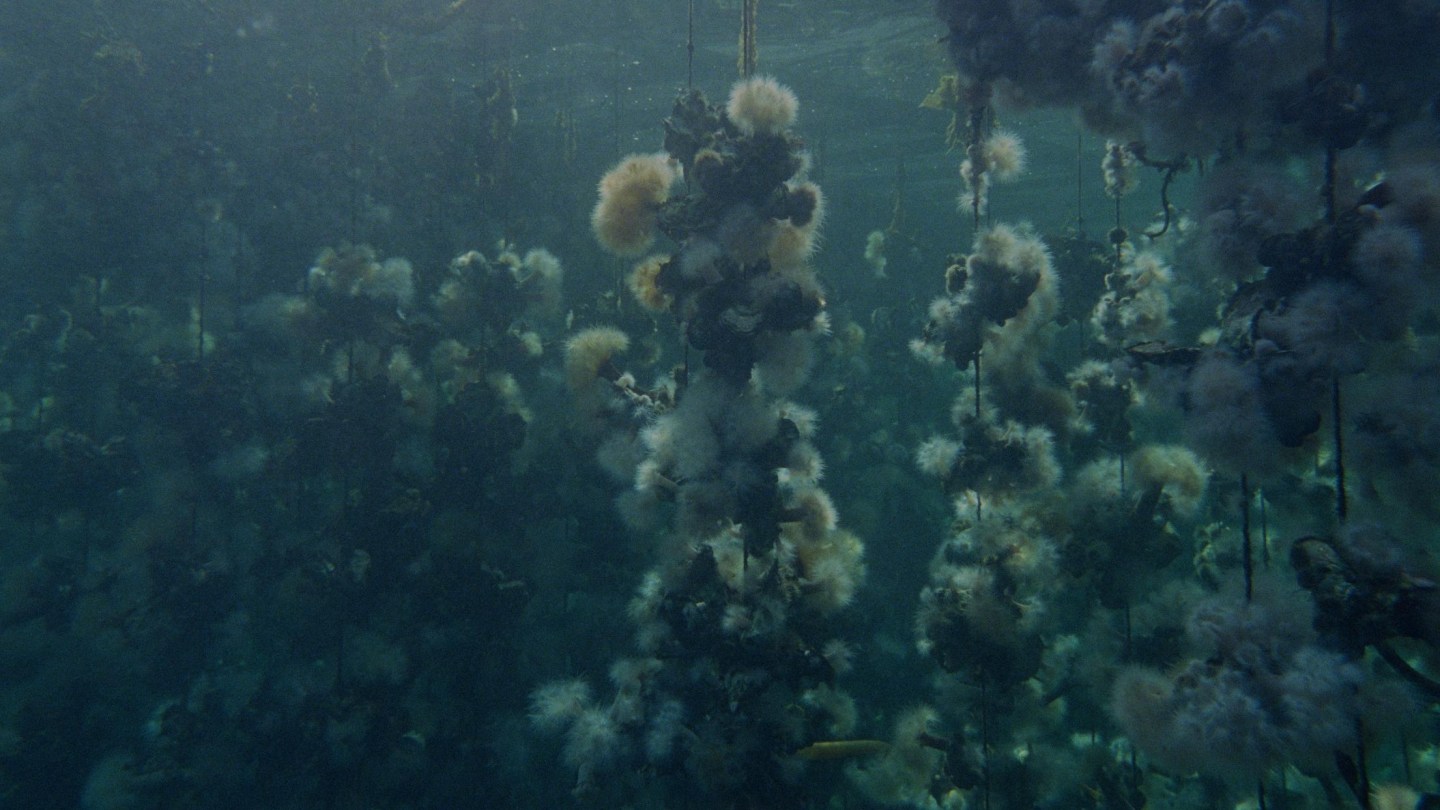
If the liminal atmosphere in Backrooms, enhanced by the cinematography of Jeremy Cox, gave you a sense of dread, his camera work on Concrete Turned to Sand will take you into a very different space – oyster farms in British Columbia, Canada. Yes, oyster farms! But again, you better get ready for an immersive sensory cinematic experience that will plunge you into a world full of otherworldly, almost sci-fi-esque, images and all sorts of different emotions and sensations. The film from Vancouver-based directors Jessica Johnson and Ryan Ermacora, will screen, starting on Oct. 11, in the BFI London Film Festival‘s (LFF) Documentary Competition program, but it is not your regular doc. In fact, notes about the film, which is shot on 35mm, describe it as “a radical refusal of the conventional documentary narrative.” The movie from Slag Pile Films received its world premiere at the Hot Docs Canadian International Documentary Festival in Toronto and will now celebrate its international premiere in London. Audiences can expect natural richness, such as underwater images of glistening shellfish, to encounter ecological dread. After all, the oysters on the coast of the Discovery Islands that are featured in the film take years to reach maturity, but all around them, the pace of environmental change is accelerating. And through Cox’s lens, nature looks, and almost feels, otherworldly. The film’s soundscape, created with sound artist and musician Scott Gailey, adds another key sensory layer. ‘Concrete Turned to Sand,’ courtesy of Slag Pile Films Don’t expect a multitude of data charts and the like, though. After all, the press notes for the film highlight: “Amid accelerated climate change and lives increasingly hyper-mediated by technology, the film resists the impulse to explain, choosing sensation over exposition.” You can catch a trailer for Concrete Turned to Sand right here, but THR can now also premiere an exclusive clip from the film at the end of this post. Through their work, Johnson and Ermacora explore “the convergence of labor, landscape and the political and economic forces that shape them.” As a result, in Concrete Turned to Sand, oyster farming becomes a lens for the collision of different time scales: the years it takes an oyster to mature, the accelerating pace of environmental change, and the geological time of our planet. And that is by design. After all, the creative team explains: “By placing human labor and science within these vastly different temporalities, the film asks us to reconsider not only how we look at the state of the environment, but how we understand our own brief presence – and effect – within it.”The rich cinematic imagery and sound give new forms to the often complex and invisible realities of climate change. ‘Concrete Turned to Sand,’ courtesy of Slag Pile Films “We worked with scientists to provide insight into ocean acidification and its impacts, while offering perspectives on the geological timescale of our ecological circumstances,” say Johnson and Ermacora. “This project explores methods of representing climate change by experimenting with optical and auditory techniques that play with the distanciation between the viewer and the ecological subject of the film. Concrete Turned to Sand creates an encounter between the beauty and strangeness of our world, engaging us to think beyond our atomization and towards broader ecological understanding and context.” For some scientific insight and to get another glimpse into the world of the film, check out an exclusive clip from Concrete Turned to Sand below.
‘Concrete Turned to Sand’ Dives Into Oyster Farms, With Otherworldly Imagery From the ‘Backrooms’ DP (Exclusive Clip)
Full Article
Original Source
Read the full article at Hollywoodreporter →KhanList aggregates and links to publicly available news content. We do not host full articles from third-party sources. Always verify important information with original sources.