
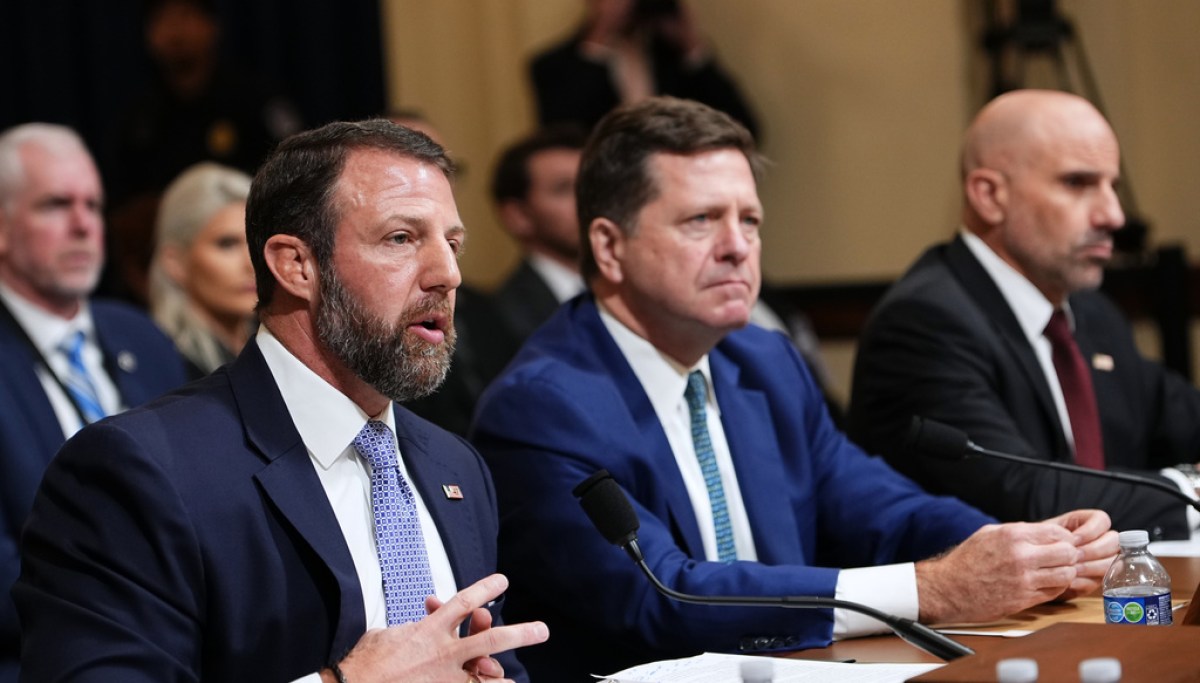
House Democrats and Republicans focused a more than three-hour hearing in Washington on Wednesday on the federal government’s response to a series of outages affecting both the private and public sector.Trump administration officials told the House Homeland Security Committee on Wednesday that investigators so far have found no evidence of a cyberattack behind the nationwide FAA ground stop or a string of other technology outages, but lawmakers repeatedly brought up incidents and pushed the three witnesses from the Department of Homeland Security, the director of National Intelligence, and the FBI for assurance.The hearing, titled “Worldwide Threats to the Homeland: 25 Years After 9/11,” has long been planned but arrived just days after Microsoft services went offline, bank customers had trouble accessing their accounts, and a classified National Security Agency communications network went down. The committee’s past global threats hearings have been consumed by debates over domestic terrorism. That dispute resurfaced Wednesday when Rep. Bennie Thompson (D-MS) pressed the FBI’s deputy director to name a right-wing threat after he cited antifa. But lawmakers kept returning to disruptions their constituents had experienced themselves, from lost access to email to canceled flights.Officials found separate causes, but lawmakers wanted specifics Lawmakers from both parties pressed officials on why so many unrelated systems failed within days of one another and what the government could do to keep them running.Rep. Michael Guest (R-MS) said a Navy veteran and small-business owner back home had texted him that morning with a question, “Were the outages related?” Guest posed that question to all three witnesses.“We have seen nothing that would indicate that they are related,” DHS Secretary Markwayne Mullin said. FBI Deputy Director Christopher Raia said the bureau’s cyber teams had been involved from Day 1 and had found no evidence of malicious activity. He said they would continue working with the affected companies.“At this point, there is no indication whatsoever that there is any cyber malicious activity related to any of those incidents,” Raia said. “Now, obviously, we’re going to keep working with our private sector partners in an abundance of caution, but at this point there is no indication of any cyber malicious activity.”Director of National Intelligence Jay Clayton, who was a last-minute addition to the panel, said investigators found different causes and examined the incidents both individually and alongside one another for signs of known hacking methods.Asked whether his gut told him the timing was a coincidence, Clayton affirmed he believed it was. He called it “an informed opinion,” pointing to an increase in software patches and equipment upgrades across government and industry. Mullin said he was “98% confident that this has nothing to do” with foreign adversaries.Lawmakers, meanwhile, received fewer details about what happened at the NSA.Rep. Dan Goldman (D-NY) asked whether internal upgrades brought down the classified communications network and whether the outage exposed systems to outside actors. Clayton pointed to routine maintenance and said investigators saw no sign of a foreign actor. He gave no specific account of what failed, and the exchange ended without an answer on whether the outage created a vulnerability.Mullin acknowledged to Rep. Eli Crane (R-AZ) the unusual nature of the recent streak of outages, saying he had never seen so many technology outages in such a short span. He also said DHS was convening a call with industry figures and suggested that companies warn customers ahead of planned upgrades that could interrupt service.Republicans and Democrats press Mullin on CISA staffing The outages drew attention to a related question that Chairman Andrew Garbarino (R-NY) said he had been asking about since June: how quickly the Cybersecurity and Infrastructure Security Agency can rebuild its workforce.Mullin told the committee in June that the agency needed roughly 600 hires. Garbarino said about 250 selected candidates were still awaiting security clearances in September. Asked how many had started since June and how many were still waiting, Mullin said he would have to get back to the committee with an answer.Rep. Michael McCaul (R-TX) said the FAA and NSA outages appeared to be technical failures, but they left him concerned about what foreign adversaries could do to U.S. networks. “I would urge you to get CISA full steam because the threats haven’t gone away,” he told Mullin.Democrats pressed Mullin on why the administration had cut the cybersecurity workforce in the first place, citing a decline from about 3,400 employees at the start of the administration to about 2,200 in June.Mullin said those decisions predated his tenure and that new technology had helped CISA meet its current obligations. He also cited lengthy security clearances and competition with private-sector salaries as barriers to hiring specialists.Garbarino urged him to look for recruits with expertise in artificial intelligence, and Mullin said he hoped the Senate would soon confirm a permanent director.“Our CISA director, we hope, will be confirmed,” Mullin told the committee. “I believe it’s on track to do that.”Iran targeting some of same sectors that went down Mullin’s written testimony notably said hackers affiliated with the Iranian government and pro-Iran cybercriminals had increasingly targeted U.S. transportation, financial services, healthcare, water, and energy networks since February. Transportation and finance were among the sectors hit by the recent outages.However, the three witnesses insisted that the recent outages were neither coordinated nor plotted by nation-states such as Iran, and said they found no evidence that the disruptions were the work of hackers.The warning about Iran went beyond cybersecurity. Clayton told lawmakers the threat of Iranian “lethal plotting” inside the United States and abroad had “substantially increased.”MULLIN GOES ON OFFENSE AFTER USING GOVERNMENT JET TO FLY TO LSU GAME FOLLOWING FAA GROUND STOPMcCaul also asked about CNN’s report that U.S. intelligence had detected possible Iranian planning for a “dirty bomb” attack targeting senior administration officials in Washington. Clayton declined to discuss the specific intelligence.He did, however, point to the federal indictment of Mohammad Baqer Saad Dawood al Saadi and two alleged accomplices on terrorism charges tied to nearly 20 attacks and attempted attacks in Europe and the U.S., as evidence of Iran’s real and actionable threats to U.S. allies.
Concerns over cyberattacks and outages hijack House hearing on top threats to US
Full Article
Original Source
Read the full article at Washingtonexaminer →KhanList aggregates and links to publicly available news content. We do not host full articles from third-party sources. Always verify important information with original sources.