
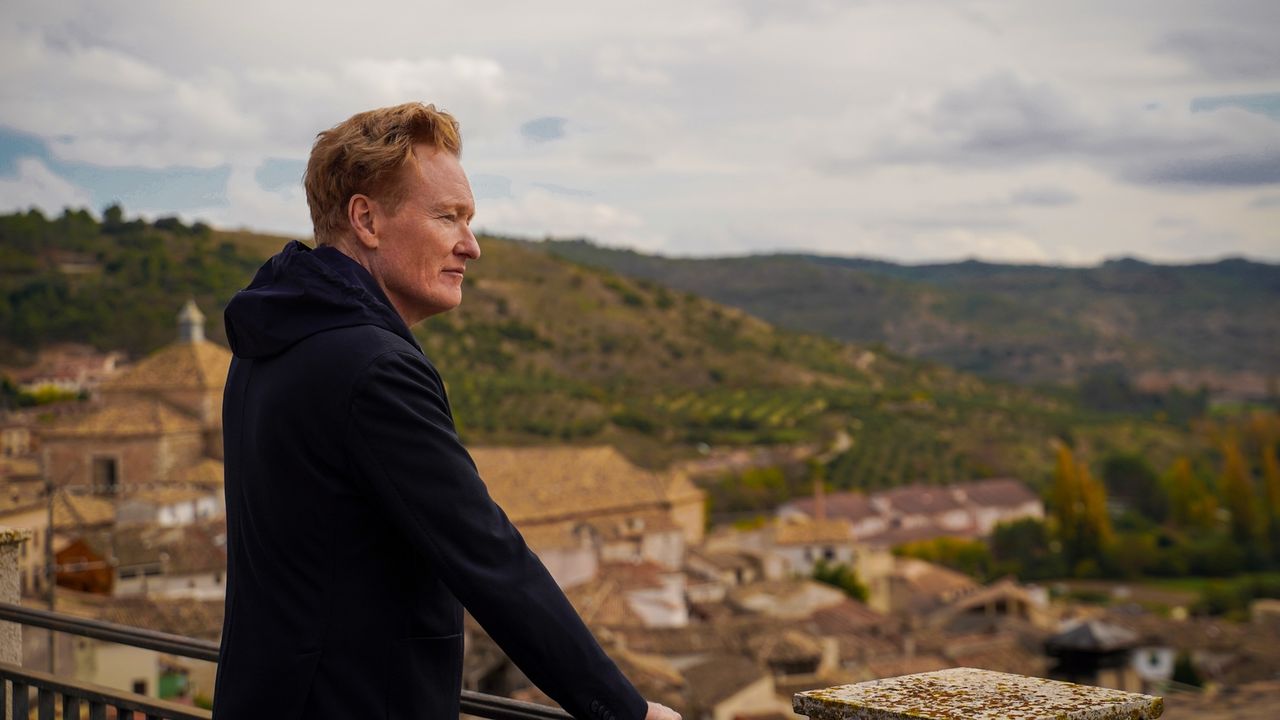
Conan O'Brien Must Go returns for its third season on August 21.Team Coco/Max“One man. Four countries. Zero shame,” is the tagline of the eponymously titled travel show Conan O’Brien Must Go. Now in its third season, the Emmy award-winning series follows the comedian and podcast host around the world as he meets up with his fans in a diverse array of destinations, visiting their places of work and family homes while providing lively glimpses of everyday life, whether that be a cricket match in a Mumbai street or tea in the Sahara desert.On paper, it might sound like your regular celebrity travel show, yet a blend of surreal improvisational comedy and appreciation of the absurd in the context of travel makes it something a little more unusual—particularly in the way in which he gives himself up to the unpredictability of cross-cultural exchanges and revels in its discomfort. “My goal is that you might not really learn anything about the country, but you do get a sense of the people,” says O’Brien. “I am basically there to be mocked.”O'Brien walks through the desert in Morocco Warner Bros. DiscoveryIn past episodes, this has meant dressing up as Sigmund Freud in Vienna, singing with The Irish Tenors in Dublin, and facing off with a python in Bangkok. This season takes him to Morocco, India, the Netherlands, and the Philippines, where he continues to embrace the chaos of the unknown before “coming back with a lot of adrenaline and a slightly different perspective on what's going on.”So, what exactly has he learned from taking on the role of transcontinental clown? I spoke with O’Brien recently over Zoom to find out how he chooses the “fish out of water” situations he places himself in, connects with confused strangers, and what his own narrative arc as a traveler—which began early on—has crystallized for him about life when he returns home.O'Brien aboard a fishing boat in the episode that takes him to the Philippines Warner Bros. DiscoveryYou really seemed like you were having an absolute ball making this show. What came first when choosing this season’s locations: the fan or the destination?It was a little bit of both. Look, let's say we had a terrific fan who was from Cleveland, Ohio. I would not go visit that fan because that isn’t the kind of travel that I want to be doing. No knock on Cleveland. So sometimes I’ll find a great fan and realize, Oh, they're from Norway. Wouldn't I love to go to Norway? First, it looks great, but it's also a great [cultural] contrast. I'm very tactile, and I insert myself into people's personal space. The Norwegians don't like that, so then I think, "well, this could be a funny dynamic, and that makes us want to meet that fan even more.Episode one of the new season takes Conan to India, where he gets involved in some song and dance. Team Coco/HBOWhen you say a country seems promising, what do you mean?Well, you want it to be visually interesting. You also want it to be a place where, maybe, its customs and culture are going to provide a great setting for a fish-out-of-water story. I think it's always good for me to go someplace where I really stand out. In this season, we go to India for an episode. I had been briefly once before, to shoot an American Express ad in Jaipur, and I’d always wanted to go back. It just felt like the most different place I could go and still be on Earth, in terms of the visual tapestries you see, the density and the chaos and the colors. And then we had some fans who contacted us who were really lively and funny, and I thought, well, we have to make this happen.The everyday frequently provides the set piece for those fish-out-of-water moments. How spontaneous is the crew in choosing to, say, send you off on a commuter train in Mumbai?I work with a great camera crew. We have terrific producers. A lot of thought goes into each episode, but so much of what ends up happening is very guerrilla-style. So with the trains, we weren't sure how it was going to work until eventually I jumped onto one, and the crew had to follow after me. We didn’t discuss it ahead of time; I just jammed in there and found out what passengers might have to say to me.In India, he also plays some cricket. Warner Bros. DiscoveryCan you talk about how much improvisational comedy happens in the show?I was never a stand-up comedian. I got started doing improvisational comedy, and that's really my comfort zone. I love trying to make something happen: If I just met you on the street and we started talking, I would probably try to make something fun happen in the moment. And those moments often yield good results. That's what I found in so many of these countries—India in particular. The people I met there were so funny and had a real sense of irony. They were really good [comedic] partners. I am never showing up to shoot comedy at strangers. I'm there to try and get a spark going between us and see what happens.To travel well often means opening yourself up to discomfort or difference, which inherently means a willingness to make a fool of yourself. Have you found transferable skills from comedian to travel host?There's a lot of common ground between the two. What I learned from years of doing comedy in front of an audience every night is that you may go in with an idea of what you're going to talk about, but the greatest thing in the world is an accident. If David Bowie's on the show, and something goes wrong—perhaps his coffee mug breaks accidentally because it was cracked—that's not a disaster. That's the greatest thing that could happen because suddenly, something real is happening with this icon, and their humanity is revealed. That's what happens a lot on these travel shows, and in travel in general. When you travel, when anyone travels, things don't go to plan. They just don't. And so, if you are ready to find the humor in it, and improvise, and figure out another way, you're going to have a great trip. Making this show is a combination of preparing for something—and then preparing for things to go another way completely.When was a moment when things went the other way?In Amsterdam, we had this idea that I would dress as Van Gogh and go to the Van Gogh Museum and walk around and look at the paintings, and loudly bemoan the fact that I never made any money in my lifetime. First, we showed up to the wrong museum. Then, we ran across a park—and I'm really running there when you see me—and I got to the Van Gogh Museum and the security guards wouldn't let me in because it was closing. Then one of them took out a little book and was writing in it for no reason. I didn't know what he was writing, and I started to say, "Oh, you—is this a diary entry? Dear diary? Van Gogh is here!” They really wanted me to go away then, and that made for a much better segment.We didn't anticipate any of that. In fact, we weren't even sure we were going to do the Van Gogh bit because it was getting late in the shoot. We were tired. I thought: Do I really want to put on a beard, and a silly hat, and a silly costume, and make an ass of myself in front of a lot of people? But then something in me said, We have to do this. Let's just go. And so we did it, and it's my favorite thing in the Netherlands episode.Is it a challenge to keep improvising while being chased by a security guard?Oh well, you know what's funny? I am at my happiest when things are a little off-kilter. I don't know why, but in all the years that I was doing my late-night show, I was at my calmest when things got chaotic. I'm a very hyperkinetic person. I’m happy when things are getting untethered.There are moments, say at a fan’s family home in Casablanca, when a joke gets lost in translation. How do you make peace with the comedy not landing?I always remember that there's another audience, which is the camera, so that when I fail, I can turn to them and look slightly deflated, and they might understand, even enjoy, seeing things not necessarily going my way. I have to remind myself that it's not just me and this person who perhaps doesn't know what I'm talking about. Take when I try to play cricket in the street in Mumbai. I'm wearing this stupid outfit and doing everything wrong, and this young kid is yelling at me because I don’t know the rules. Even though he doesn’t find me funny at all, there is comedy in that. I become this giant accident, this American idiot, if you will. Actually, that’s something I really like about the show: I never intended this, but Americans currently have a certain reputation that's inescapable, and so I revel in a 16-year-old treating me with no respect, because I don’t deserve any. I guess what I’m saying is that I am an absurd person, and I’ve been an absurd person for many decades, and perhaps that’s my form of diplomacy.It sounds like, in making this show, you've had your own kind of arc as a traveler. But I'm also interested to know what your relationship with travel was like before this?When I was very young, my father was a scientist working on antibiotic resistance and would visit lots of hospitals around the world—and sometimes, he’d take me with him. These were not posh trips, but they were amazing trips. When I was about 13, we went to almost every major city in South America over a two-and-a-half-week period. Much like I do for the show now, we were traveling or flying every single day, trekking in and out of ports, and so on. One day I’m in Chile, the next Brazil, the next Argentina, the next Colombia. My father would meet with all these doctors about how to track different antibiotics, and I remember just being at his side, overawed and blown away by smells, the sights, the food. By how strange it all was!At the time, I had bright orange hair, very pronounced freckles, and my mother made me wear a Madras sports coat that she found somewhere—presumably because I was going to be visiting important people in hospitals. I hated that jacket. It had all these different colored patches, and I was so self-conscious in it. I felt like my mom had dressed me like a circus clown. I really stood out, and it was a very awkward experience for me as a 13-year-old. Now, of course, my hair is ridiculous in different ways, and I choose to dress up as Van Gogh on camera.The Morocco episode also involves camelback riding. Team Coco/HBOAre there any recent travels that have made a similar impact?I live on the west side of Los Angeles, where neighbors don’t see each other and people live behind these high hedges. Finding myself walking and exploring densely populated parts of places like Mumbai or Manila, and seeing what everyday life is like there on the streets, made me wonder if we've lost contact with something here in America. There’s a connectedness out in those dense crowds.Traveling a lot makes me question the way I live. I don’t think travel means you come away with any great wisdom, but you do jostle your preconceived notions of what life is supposed to look like. It is the exact opposite of being on your iPhone or locked into your Netflix queue, which are in and of themselves fine, but we have too much of it. Getting out there and taking a risk—now that’s what life is supposed to be about.A bicycle ride through Manila for Conan Team Coco/HBOLale Arikoglu is the Articles Director of Condé Nast Traveler and host of the award-winning Women Who Travel podcast. Her reporting has taken her all over the world, from Patagonia to Tokyo to the Amazon Rainforest, and she is fascinated by the ways that travel intersects with style, food, music, ... Read More
Conan O'Brien on Taking His Travel Show to Mumbai, Manila, and Beyond
Full Article
Original Source
Read the full article at Cntraveler →KhanList aggregates and links to publicly available news content. We do not host full articles from third-party sources. Always verify important information with original sources.