
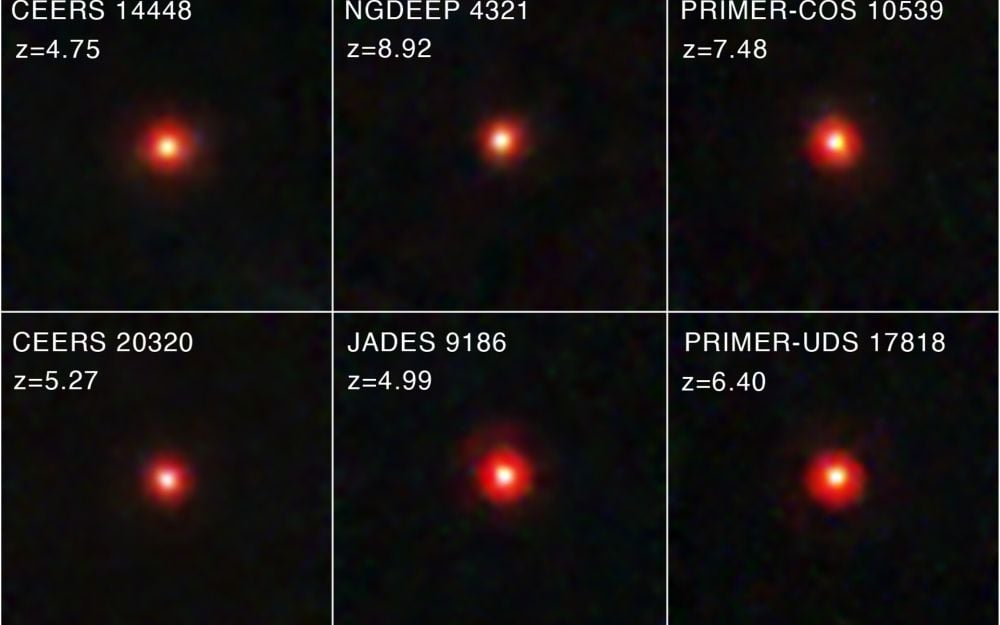
When the James Webb Space Telescope (JWST) made its famous observations of several deep fields in the cosmos, astronomers were surprised to see numerous galaxies that defied expectations. These galaxies were bright and red - earning them the nickname Little Red Dots (LRDs) - and far more abundant than cosmological models predicted. Scientists theorized that these were early quasars, galaxies with active galactic nuclei (AGNs) powered by the "seeds" that would grow to become supermassive black holes (SMBHs). However, this also conflicted with cosmological models, as it seemed unlikely that many galaxies could have formed with massive black holes less than one billion years after the Big Bang. This led scientists to consider various theories, compact collections of stars, "dusty" galaxies, supermassive stars, and "black hole stars." While the more recent Direct Collapse Black Holes (DCBHs) theory offered the most compelling argument to date, new simulations by an international team of astronomers indicate that they may be the remnants of collapsed supermassive primordial stars. The study was led by Dr. Daniel Whalen from the University of Portsmouth's Institute of Cosmology and Gravitation. His colleagues included researchers from United Arab Emirates University, the Aristotle University of Thessaloniki, the Institute for Astronomy and Royal Observatory at the University of Edinburgh, and the Harvard & Smithsonian Center for Astrophysics (CfA). The paper detailing their findings was published in the The Astrophysical Journal Letters. The little red dots could represent galaxies in an evolutionary phase predating the luminous quasar phase. Credit: NASA/ESA/CSA/ISTA)/ETH Zurich/NAOJ Previous attempts to explain the rapid formation, abundance, and spectral characteristics of LRDs all suffered from the same issue. While each explained some characteristics, none could account for everything the JWST revealed in its deep field surveys. Then came the DCBHs theory, which argues that SMBH seeds formed directly from massive clouds of cold gas. While this theory did fit Webb's observations nicely, it still faces numerous theoretical and environmental challenges. For starters, the core premise of the DCBH theory is that a massive cloud of cold gas could collapse under its own gravity. However, gas tends to fragment into smaller clouds as it cools, leading to a cluster of primordial (Population III) stars instead of a black hole seed. To prevent fragmentation, the gas cloud must remain hot, requiring a very specific amount of Lyman-Werner (LW) radiation from a synchronized star-forming galaxy in its vicinity to destroy the main coolant - i.e., molecular hydrogen (H₂). This raises additional problems, including the self-shielding nature of molecular hydrogen. As a gas cloud becomes increasingly dense, its outer layers absorb the LW radiation, shielding the inner core. This means that the critical amount of radiation required to suppress cooling across the entire cloud would be much higher. Even if the SMBH seed did manage to form, the radiative pressure it would emit (plus mechanical feedback from the disk and jets) would slow the accretion rate, significantly slowing further growth. Whalen and his team found another explanation borne out by advanced cosmological simulations. As he said in a University of Portsmouth press release: LRDs have been one of the most surprising discoveries made by the James Webb Space Telescope. They are compact, only a few hundred light-years across, but are as bright as much larger galaxies, and their unusual V-shaped spectra have defied the usual astrophysical explanations. Their lack of detectable X-ray and radio emissions has left astronomers struggling to explain what they are. Artist's impression of a galaxy forming stars within powerful outflows of material blasted out from supermassive black holes at its core. Credit: ESO/M. Kornmesser Based on their simulations, the team produced a model showing that LRDs are most likely galaxies with AGN powered by massive black holes that formed through the collapse of supermassive primordial stars. What's more, their model suggests that the black holes are largely concealed by dense, massive discs of the gas that created them. These gaseous envelopes trap high-energy X-rays while allowing some visible, ultraviolet, and infrared light to escape, which fits with the unusual light signatures detected by the JWST. The simulations also explain another long-standing mystery about LRDs: that a large cluster of stars in the disks of these small galaxies produces the blue part of the spectrum Webb observed. These disks, according to the models, contain around 100 million stars densely packed into regions measuring only 500 light-years in diameter, matching what astronomers observed in LRDs. Based on the available data, the team further concludes the black holes at the center of these primordial galaxies are only about 10 million Solar masses. This is a few orders of magnitude less than previous estimates, which indicated a maximum of 100 million Solar masses. While this research is unlikely to be the final word on the nature of LRDs, it offers what is (to date) the most fitting explanation that matches the observations. "What makes this discovery so exciting is that we may be witnessing the birth of the first supermassive black holes," said Whalen. "For decades, simulations have predicted that these objects should exist, and now the James Webb Space Telescope may finally be allowing us to see them." Further Reading: University of Portsmouth, The Astrophysical Journal Letters
Computer Simulations Provide the Best Explanation for Those "Little Red Dots" Yet!
Full Article
Original Source
Read the full article at Universetoday →KhanList aggregates and links to publicly available news content. We do not host full articles from third-party sources. Always verify important information with original sources.